
To prevent freezing in a concrete mixing station's water supply system, you must implement a proactive strategy. The most common methods involve adding antifreeze agents to the water, but a comprehensive approach also includes ensuring all mechanical components, like the water pump, are functioning correctly before winter begins.
The core challenge isn't just about preventing water from turning to ice; it's about safeguarding the entire system's integrity. A robust winterization plan combines chemical, mechanical, and operational strategies to prevent burst pipes and ensure uninterrupted production.
The Core Challenge: Why Freezing is So Destructive
The most critical issue for a water supply system in winter is the physical expansion of water as it freezes into ice. Understanding this principle highlights the urgency of preventative maintenance.
The Physics of Ice Expansion
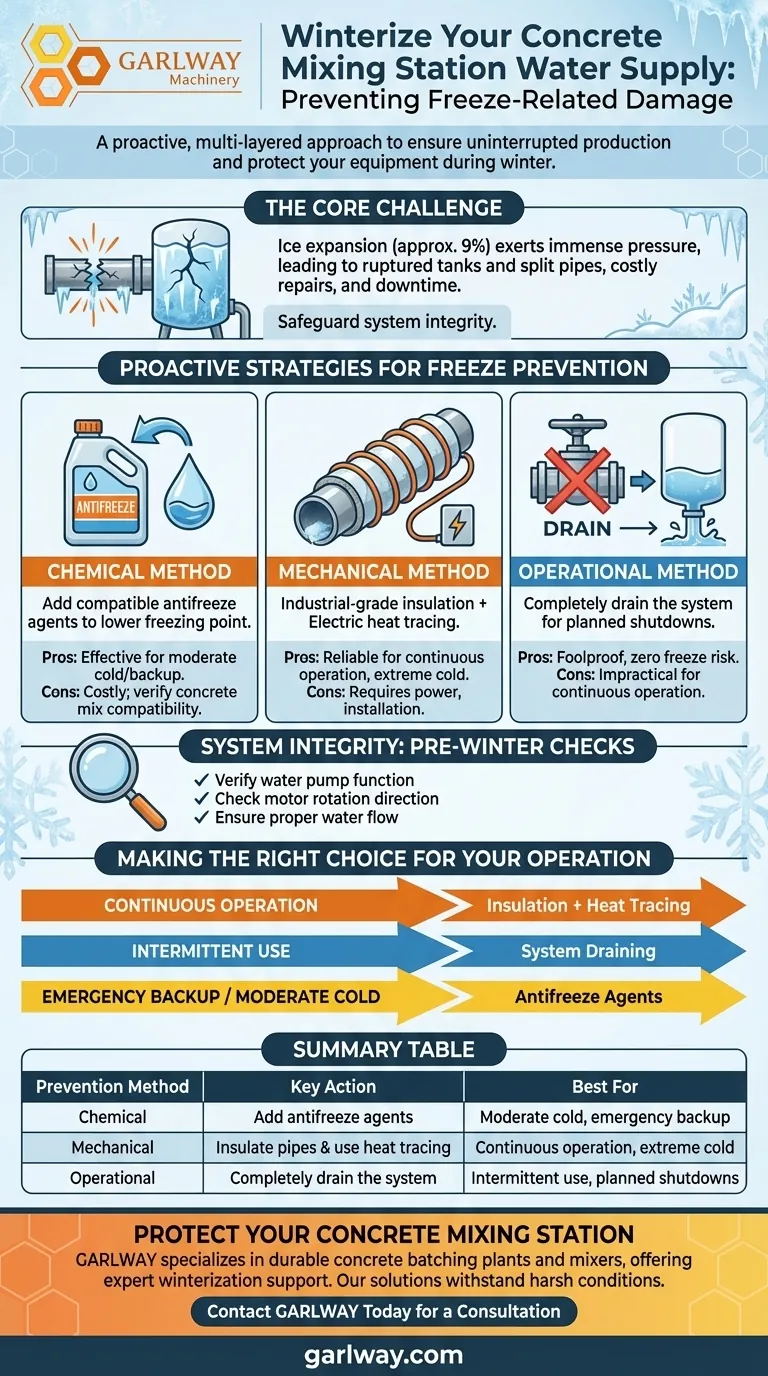
When water freezes, it expands by approximately 9% in volume. This expansion exerts immense pressure on any container it's in, whether that's a steel water tank or a PVC pipe.
The Impact on Equipment
This internal pressure is powerful enough to rupture tanks and split pipes. Such damage leads to costly repairs, significant operational downtime, and potential safety hazards from uncontrolled water release.
Proactive Strategies for Freeze Prevention
Protecting your water supply system requires more than a single solution. A multi-layered approach provides the most reliable defense against cold weather.
Chemical Method: Antifreeze Agents
The most direct approach, as mentioned, is adding a compatible antifreeze agent to the water. This lowers the freezing point of the water, preventing ice from forming at standard freezing temperatures.
Mechanical Method: Insulation and Heat Tracing
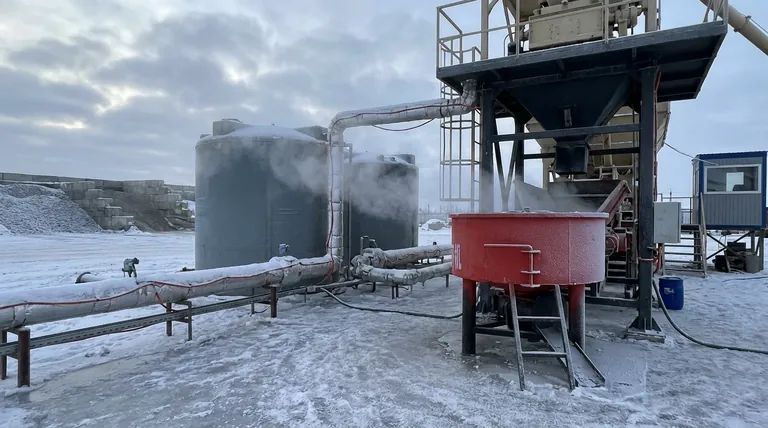
Wrapping pipes, pumps, and tanks with industrial-grade insulation is a fundamental first step. Insulation slows the rate of heat loss, protecting the system during short cold snaps.
For more extreme or prolonged cold, insulation should be paired with electric heat tracing. This involves running a heated cable along the length of the pipes to provide a constant, low level of heat that actively prevents freezing.
Operational Method: System Draining
If the mixing station will be shut down for an extended period, the simplest and most effective solution is to completely drain the water supply system. With no water present, there is zero risk of damage from freezing.
System Integrity: Pre-Winter Checks
Before the first frost, it is essential to inspect the system. This includes verifying the water pump is functioning correctly and checking that the motor's rotation direction is correct to ensure proper water flow. A pump that isn't running properly cannot circulate water, making it much more susceptible to freezing.
Understanding the Trade-offs
Each freeze prevention strategy comes with its own set of considerations. Choosing the right one depends on your operational needs and budget.
The Downside of Antifreeze
While effective, antifreeze agents can be costly and may impact the chemical properties of your concrete mix. You must ensure any additive used is approved for the specific mix design and will not compromise the final product's strength or durability.
The Limits of Insulation Alone
Insulation does not generate heat; it only slows its loss. In prolonged, deep-freeze conditions, insulation alone may be insufficient to prevent a static column of water from eventually freezing.
The Inconvenience of Draining
Draining the entire system is highly effective but impractical for facilities that must operate continuously or start up quickly. The time required to drain and then refill and prime the system can cause significant delays.
Making the Right Choice for Your Operation
Your winterization strategy should be tailored to your plant's specific operational schedule and the severity of your local climate.
- If your primary focus is continuous operation: Combine high-quality insulation with an active heat tracing system for the most reliable, round-the-clock protection.
- If your primary focus is cost-effective protection for intermittent use: A thorough system draining procedure before any planned shutdown is your most foolproof method.
- If your primary focus is an emergency backup or dealing with moderate cold: Carefully selected antifreeze agents can be effective, but always verify their compatibility with your concrete specifications.
Ultimately, proactive preparation is the key to avoiding winter-related damage and downtime.
Summary Table:
| Prevention Method | Key Action | Best For |
|---|---|---|
| Chemical | Add antifreeze agents | Moderate cold, emergency backup |
| Mechanical | Insulate pipes & use heat tracing | Continuous operation, extreme cold |
| Operational | Completely drain the system | Intermittent use, planned shutdowns |
Protect your concrete mixing station from costly winter downtime. GARLWAY specializes in construction machinery, offering durable concrete batching plants, mixers, and expert support for construction companies and contractors globally. Our solutions are built to withstand harsh conditions. Contact GARLWAY today for a consultation on winterizing your equipment and ensuring uninterrupted production.
Visual Guide
Related Products
- HZS180 Ready Mix Concrete Plant for Foundations with Sand and Cement
- HZS35 Small Cement Concrete Mixing Batch Plant
- HZS120 Ready Mix Concrete Batching Plant Commercial Mud Cement Mixer
- Commercial Electric Concrete Mixer Machine HZS 50 Small Batch Plant for Sale
- Construction Products Concrete Plant Machine Mixing Concrete Mixer
People Also Ask
- What is a ready mix concrete batching plant? The Engine of Modern Construction
- What is the name of the machine used in ready mix? Unpacking the Complete Concrete System
- What systems are included in a ready-mix concrete plant? A Guide to the 6 Core Systems
- How does a ready-mix concrete plant work? A Guide to Efficient, High-Quality Production
- What are the components of a ready mix concrete plant? A Guide to Precision and Efficiency





