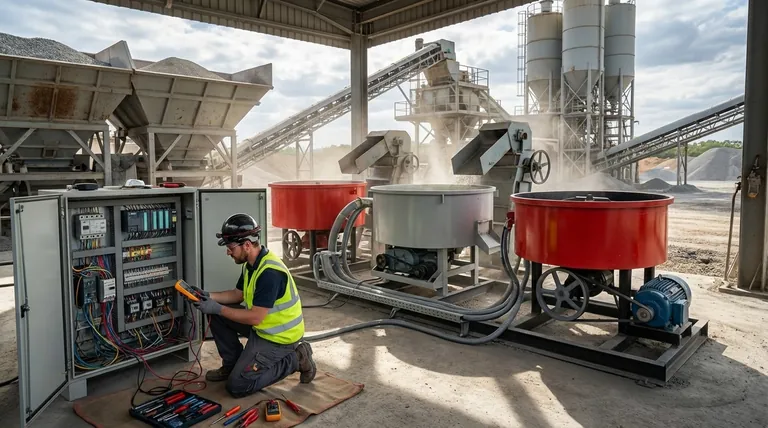
The most common faults in the electrical control system of a concrete mixing plant typically originate from four key areas: the PLC controller, weighing sensors, intermediate relays, and mechanical auxiliary actuators. These components form the brain, senses, and muscles of the operation, and a failure in any one can halt production or severely compromise the quality of the concrete.
Understanding these faults requires seeing the electrical system not just as a collection of parts, but as an integrated network. The core challenge is that a single symptom, like an incorrect aggregate weight, can point to a failure in the sensors, the controller, or the mechanical components that execute the commands.
The Purpose of the Electrical Control System
The electrical control system is the central nervous system of the entire mixing plant. Its primary job is to execute a preset formula with precision and repeatability, while ensuring the safety of the equipment and personnel.
Automation and Precision
The system is responsible for the automated control of the entire production process. It allows an operator to input a specific concrete recipe, and it then manages the precise weighing and delivery of each material.
Self-Locking and Interlocking Logic
A critical function is its built-in safety logic. The system uses self-locking and interlocking functions to prevent dangerous or illogical operations, such as opening an aggregate gate while a conveyor belt is not running.
Fault Detection and Alarms
The system continuously monitors its own operation. When it detects an abnormality, such as a motor overload or a sensor failure, it is designed to trigger an alarm and, in some cases, initiate a protective shutdown.
Diagnosing Core Component Failures
Faults rarely announce their exact location. Effective troubleshooting requires understanding what each primary component does and how it can fail.
The PLC Controller (The Brain)
The Programmable Logic Controller (PLC) is the central processor that runs the entire plant. It receives input from sensors, executes the programmed recipe logic, and sends output commands to relays and actuators. A PLC failure is the most critical as it can bring the entire system down.
Weighing Sensors (The Senses)
Weighing sensors (or load cells) provide the raw data for material measurement. Their accuracy is paramount for producing quality concrete. Faults here directly lead to incorrect batching, compromising the final product's strength and consistency.
Intermediate Relays (The Messengers)
The PLC operates on low-voltage signals, which are not powerful enough to run large motors or open heavy gates. Intermediate relays act as switches, taking a low-power signal from the PLC and using it to control a high-power circuit for an actuator. They are a frequent point of failure due to mechanical wear and tear on their internal contacts.
Mechanical Auxiliary Actuators (The Muscles)
These are the components that do the physical work, such as conveyor motors, butterfly valves, and bin gates. While they are mechanical, they are controlled electrically. A failure here means a PLC command is sent, but no physical action occurs.
Common Pitfalls in Troubleshooting
True expertise lies not just in knowing the components, but in understanding the challenges of diagnosing their interactions.
Distinguishing Sensor vs. PLC Faults
An incorrect weight reading on the operator screen could be a faulty weighing sensor, a damaged signal cable, or a malfunctioning input card on the PLC. A systematic approach is required to isolate the true source without replacing the wrong components.
Ignoring Environmental Factors
Dust, moisture, vibration, and temperature fluctuations are constants in a mixing plant environment. These factors can degrade sensor accuracy, cause corrosion on relay contacts, and overheat a PLC, leading to intermittent and hard-to-diagnose faults.
Overlooking Power Supply Issues
Unstable voltage or electrical "noise" from large motors can interfere with the sensitive electronics in the PLC and sensors. A reliable, clean power supply is fundamental to the stability of the entire control system.
Making the Right Choice for Your Goal
Your maintenance and troubleshooting strategy should align with your plant's primary operational objective.
- If your primary focus is batch quality and consistency: Prioritize the regular calibration and physical protection of your weighing sensors from debris and moisture.
- If your primary focus is maximizing uptime: Concentrate on the health of high-wear electromechanical parts like intermediate relays and contactors, which are often the first to fail from repeated use.
- If your primary focus is overall system reliability: Ensure the PLC is protected in a clean, climate-controlled cabinet with a stable power supply to prevent catastrophic failure.
Ultimately, viewing the electrical system as an interconnected whole is the key to moving from reactive repairs to proactive and predictive maintenance.
Summary Table:
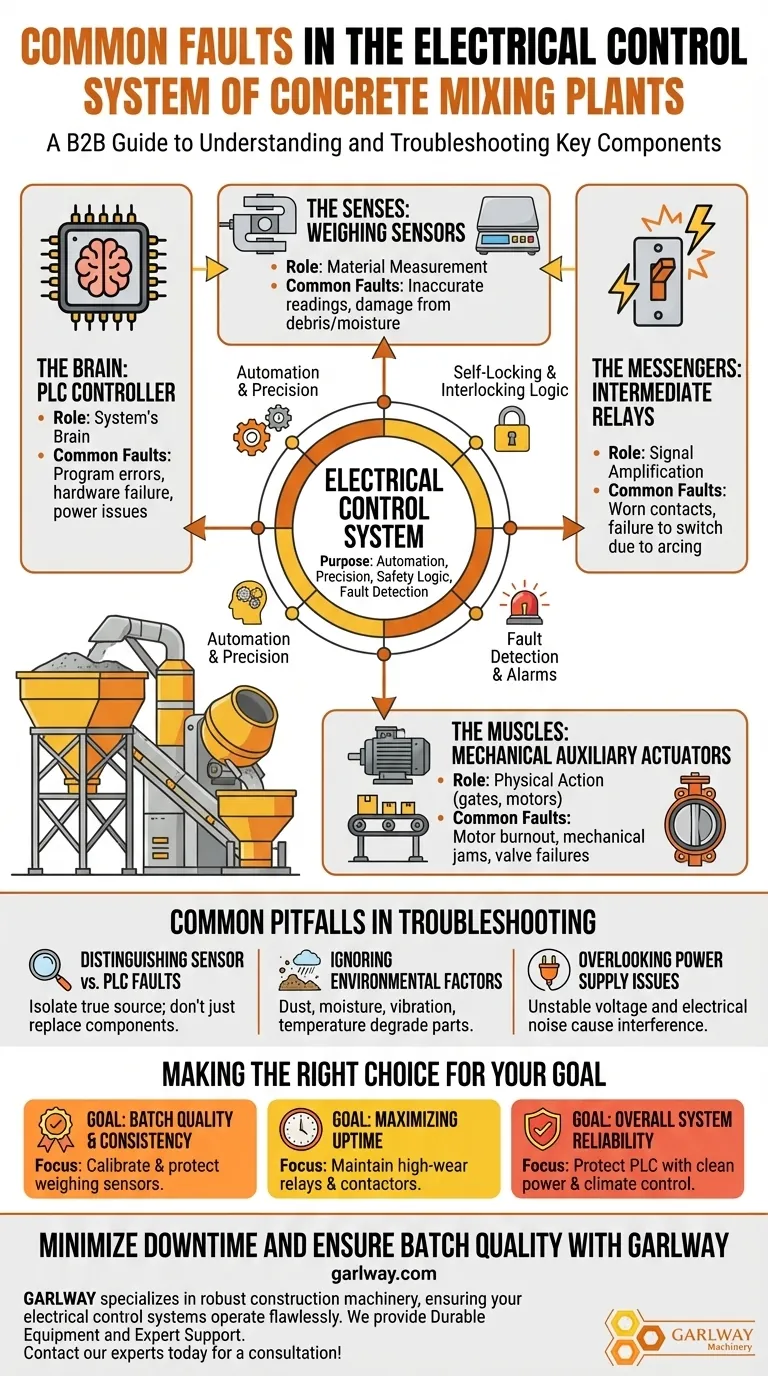
| Component | Role | Common Faults |
|---|---|---|
| PLC Controller | System's Brain | Program errors, hardware failure, power issues |
| Weighing Sensors | Material Measurement | Inaccurate readings, damage from debris/moisture |
| Intermediate Relays | Signal Amplification | Worn contacts, failure to switch due to arcing |
| Mechanical Actuators | Physical Action (gates, motors) | Motor burnout, mechanical jams, valve failures |
Minimize Downtime and Ensure Batch Quality with GARLWAY
Is your concrete mixing plant's electrical system causing costly delays and inconsistent batches? GARLWAY specializes in robust construction machinery, including advanced concrete batching plants designed for reliability. Our expertise ensures your electrical control systems—from PLCs to sensors—operate flawlessly.
We provide:
- Durable Equipment: Built to withstand harsh plant environments.
- Expert Support: Guidance on maintenance and troubleshooting to maximize uptime.
Let's keep your production running smoothly. Contact our experts today for a consultation tailored to your operational goals!
Visual Guide
Related Products
- Commercial Electric Concrete Mixer Machine HZS 50 Small Batch Plant for Sale
- HZS90 Large Multiquip Concrete Mixers for Construction
- HZS120 Ready Mix Concrete Batching Plant Commercial Mud Cement Mixer
- HZS35 Small Cement Concrete Mixing Batch Plant
- HZS180 Ready Mix Concrete Plant for Foundations with Sand and Cement
People Also Ask
- What are the types of concrete mixers used in batching plants? Choose the Right Mixer for Your Project
- What is the core component of a concrete batching plant? The Mixer Unit Defines Your Concrete Quality
- Why is proper maintenance important for a concrete batch mix plant? Maximize Uptime & Profitability
- Why buy concrete batch plant parts only from the manufacturer? Protect Your Investment and Maximize Uptime
- What are the two main types of concrete batch mixers? Choose the Right Mixer for Your Project