
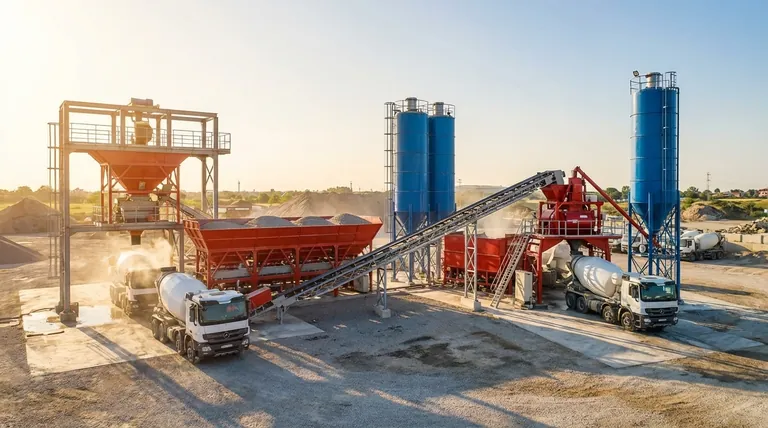
At its core, a concrete batch plant is an automated factory that transforms raw ingredients into ready-mix concrete. It operates by precisely weighing materials like aggregates (sand, stone), cement, water, and chemical additives according to a specific recipe. These measured materials are then conveyed to a central mixer, blended thoroughly, and discharged into a concrete truck for delivery.
The fundamental principle of a concrete batch plant is not merely mixing, but achieving repeatable precision at scale. It replaces manual guesswork with an automated system to guarantee that every single batch of concrete meets exact quality and strength specifications.
The Four Core Stages of Concrete Production
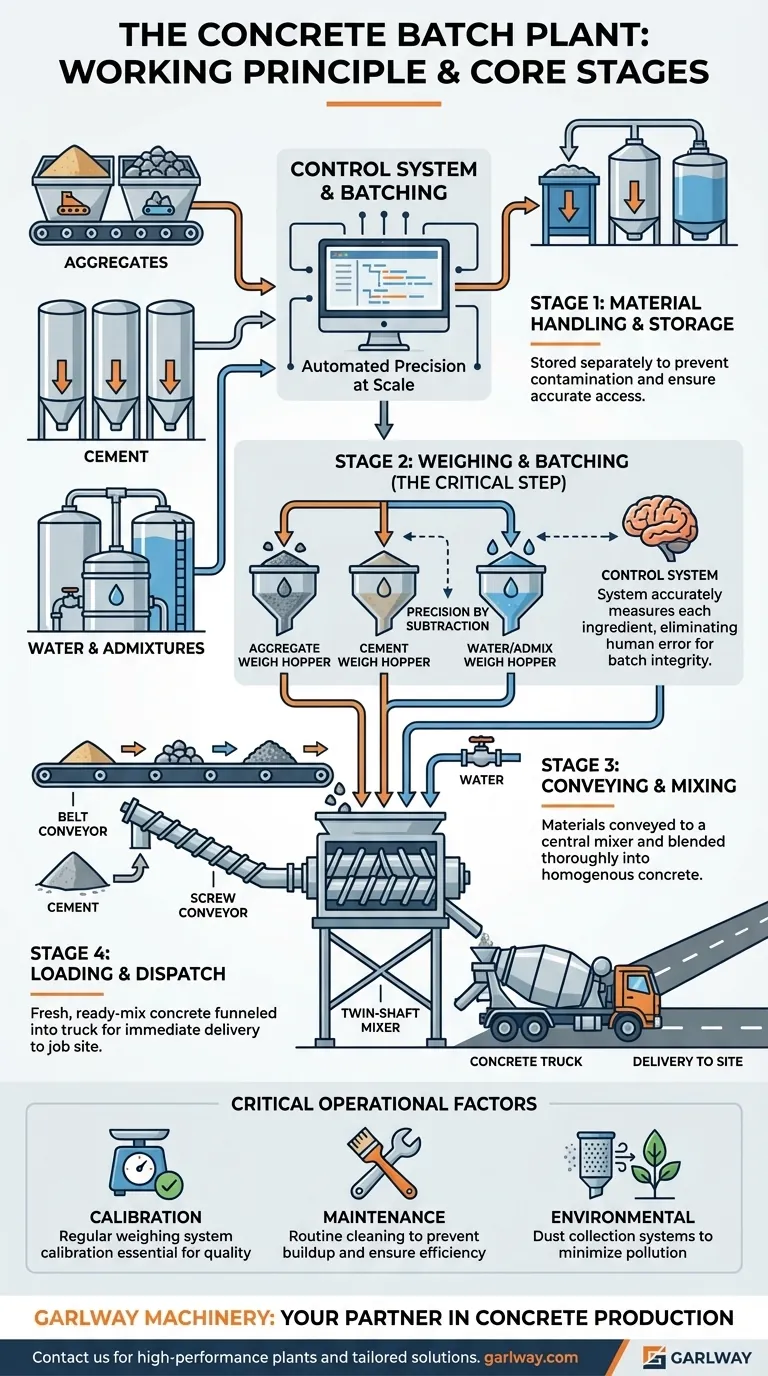
The entire operation can be broken down into a logical, four-step sequence. Each stage is managed by a central control system, ensuring accuracy from start to finish.
Stage 1: Material Handling and Storage
Before production begins, all raw materials must be stored correctly and be ready for use. This separation is crucial for preventing contamination and ensuring accurate measurement.
- Aggregates: Sand, gravel, and crushed stone are stored in large aggregate bins. Each bin holds a different size or type of aggregate.
- Cementitious Materials: Cement and other powders like fly ash are kept in tall, enclosed cement silos to protect them from moisture.
- Liquids: Water is held in tanks, while chemical admixtures (which modify concrete properties) are stored in their own separate containers.
Stage 2: Weighing and Batching (The Critical Step)
This is the most critical stage and is what gives the "batch plant" its name. The control system executes a pre-programmed mix design, calling for precise amounts of each ingredient for a single "batch."
- The Role of Weigh Hoppers: Each category of material is weighed using a dedicated scale, or weigh hopper. There is typically one for aggregates, one for cement, and one for water and additives.
- Precision by Subtraction: The system opens gates from the storage bins or silos, allowing material to fall into the weigh hopper. The control system continuously monitors the weight and closes the gates the instant the target amount is reached.
- The Control System as the Brain: This automated process ensures every ingredient is measured with high accuracy, eliminating human error and guaranteeing the final product's integrity.
Stage 3: Conveying and Mixing
Once the complete batch of materials has been accurately weighed, it must be transported to the mixer.
- Transporting the Batch: Weighed aggregates typically travel up a belt conveyor to the top of the mixer. Cement is moved from its weigh hopper through an enclosed screw conveyor.
- The Central Mixer: All ingredients are discharged into the large, powerful mixer. Here they are blended together for a specific amount of time until a homogenous, consistent concrete is formed.
Stage 4: Loading and Dispatch
After mixing is complete, the ready-mix concrete is ready for transport to the construction site.
- Discharging the Final Product: The mixer's discharge gate opens, and the fresh concrete is funneled directly into a waiting concrete tanker truck positioned below.
- Ready for Delivery: The truck can then proceed to the job site to pour the concrete before it begins to set.
Understanding the Operational Realities
While the process is highly automated, several factors are critical for maintaining quality and efficiency.
The Need for Constant Calibration
The entire system's accuracy depends on its scales. The weigh hoppers must be regularly calibrated to ensure they are measuring correctly. An uncalibrated system will consistently produce poor-quality concrete.
Maintenance is Non-Negotiable
Concrete begins to harden quickly. All components that come into contact with the mix, especially the mixer itself, must be cleaned thoroughly and regularly to prevent buildup, which can reduce efficiency and affect batch quality.
Environmental Controls
Storing and conveying fine powders like cement generates dust. Modern plants incorporate dust collection systems to minimize air pollution and protect the health of workers.
Applying This to Your Project's Goal
Understanding the process helps you evaluate what matters for a specific outcome.
- If your primary focus is high-volume structural concrete: The plant's cycle time, mixer capacity, and the reliability of its automated control and conveyor systems are the most critical factors.
- If your primary focus is specialized architectural concrete: The precision of the weigh batchers, especially for admixtures and pigments, is paramount to achieving consistent color and performance.
- If your primary focus is project flexibility on a remote site: The key consideration is whether a mobile batch plant, which can be moved and set up as needed, is more suitable than a permanent stationary plant.
Ultimately, the concrete batch plant is the industrial heart of modern construction, turning simple raw materials into a highly engineered product through systematic control and precision.
Summary Table:
| Stage | Key Activity | Purpose |
|---|---|---|
| 1. Material Handling | Storing aggregates, cement, water, and admixtures | Ensure material integrity and prevent contamination |
| 2. Weighing & Batching | Precisely measuring each ingredient via weigh hoppers | Guarantee mix design accuracy and batch consistency |
| 3. Conveying & Mixing | Transporting materials to a central mixer for blending | Achieve a homogeneous, high-strength concrete mix |
| 4. Loading & Dispatch | Discharging final product into mixer trucks for delivery | Provide fresh, ready-mix concrete to the job site |
Need a reliable concrete batch plant for your project? GARLWAY specializes in manufacturing high-performance concrete batching plants, concrete mixers, and winches for construction companies and contractors worldwide. Our automated systems ensure precise batching, consistent quality, and maximum efficiency for high-volume structural work or specialized architectural concrete. Contact our experts today to discuss your specific requirements and get a tailored solution!
Visual Guide
Related Products
- HZS120 Ready Mix Concrete Batching Plant Commercial Mud Cement Mixer
- HZS35 Small Cement Concrete Mixing Batch Plant
- HZS75 Concrete Batching Plant Cement Mixer Price Concrete Mixer Bunnings Mixing Plant
- Commercial Electric Concrete Mixer Machine HZS 50 Small Batch Plant for Sale
- HZS180 Ready Mix Concrete Plant for Foundations with Sand and Cement
People Also Ask
- What is a ready mix concrete batching plant? The Engine of Modern Construction
- What is the name of the machine used in ready mix? Unpacking the Complete Concrete System
- What is the core component of a concrete batching plant? The Mixer Unit Defines Your Concrete Quality
- What are the types of concrete mixers used in batching plants? Choose the Right Mixer for Your Project
- What are the advantages and disadvantages of concrete batching plants? Maximize Quality & Efficiency





