The Choreography of Chaos
Picture a construction site manager. Her mind is a Gantt chart of dependencies. A wheel loader is waiting for a clear path to the aggregate pile. A transit mixer, carrying the day's first batch of concrete, is stuck in city traffic two miles away. The concrete crew is idle, and the project clock is ticking.
This isn't a failure of a single machine. It's a failure of a system.
The traditional approach to concrete production is a complex choreography of separate machines and operators. Each handoff—from loader to batching plant, from plant to transit mixer, from mixer to pour site—is a potential point of failure. It introduces waiting, miscommunication, and a significant cognitive load on the person trying to coordinate it all.
This logistical friction is the invisible tax on nearly every construction project.
Deconstructing the Mobile Batching Plant
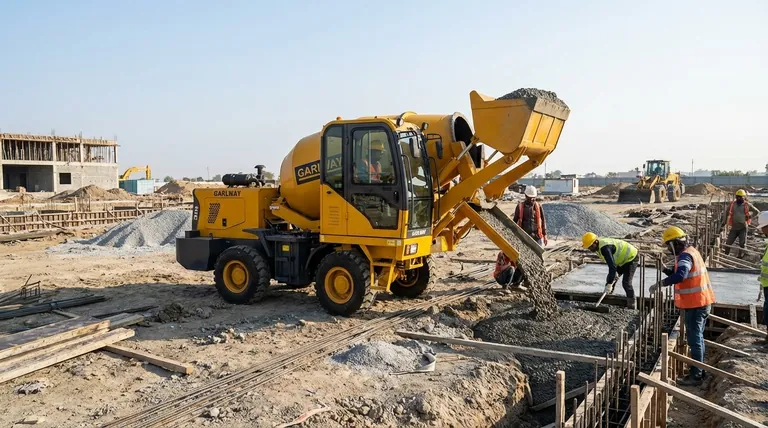
The self-loading concrete mixer presents a fundamental shift in this paradigm. It's not just a truck with a mixing drum; it is an entire batching plant, loader, and transporter engineered into a single, cohesive unit. This isn't just about saving space. It's about collapsing a complex, multi-step process into a streamlined workflow controlled by a single operator.
The genius of its mobility lies in this integration.
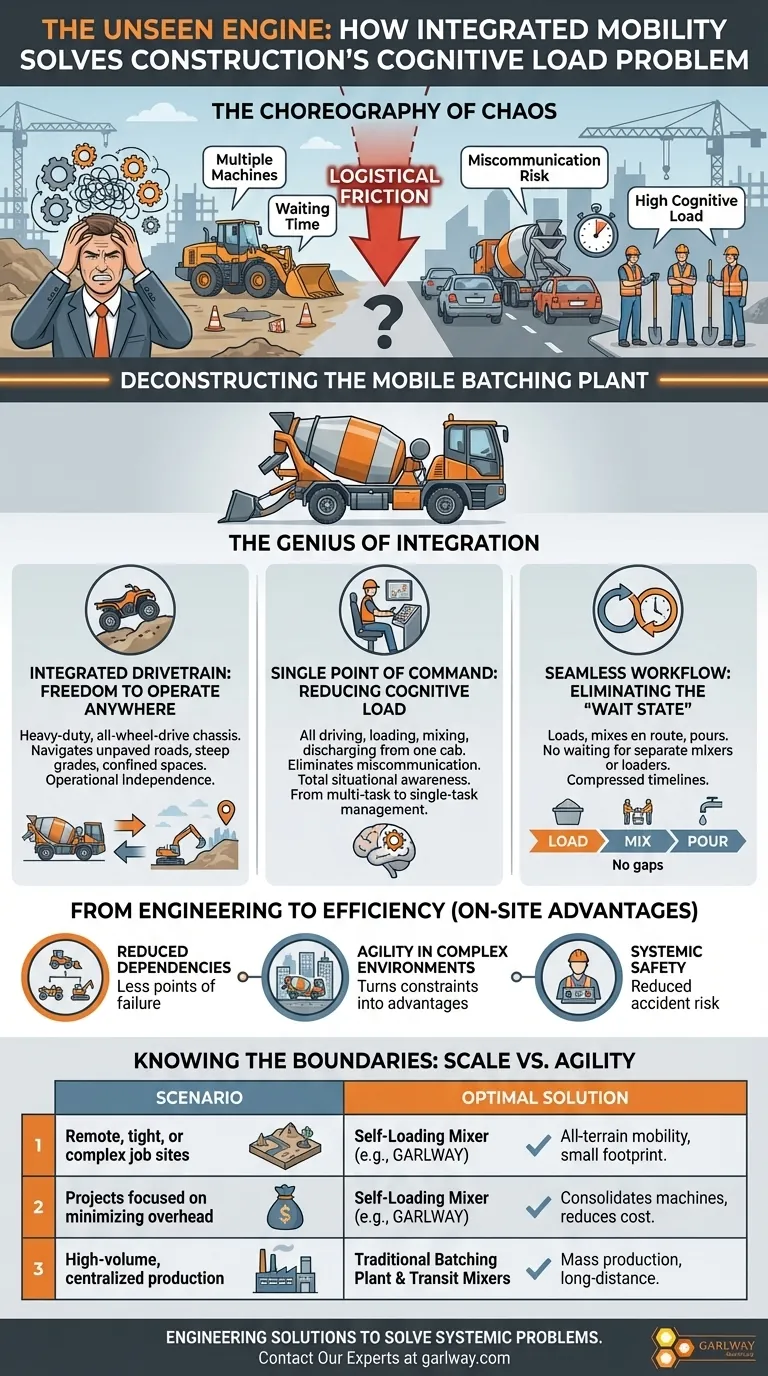
An Integrated Drivetrain: The Freedom to Operate Anywhere
The foundation of this system is a heavy-duty, all-wheel-drive chassis. Unlike disparate machines that are often limited to prepared surfaces, a self-loading mixer is designed to navigate the reality of a construction site: unpaved roads, steep grades, and confined spaces.
This design grants operational independence. The production of concrete is no longer tethered to the accessibility of large trucks. The machine goes where the work is, not the other way around.
A Single Point of Command: Reducing Cognitive Load
All driving, loading, mixing, and discharging functions are managed from one centralized operator's cab. This is a critical psychological advantage.
By eliminating the need to coordinate between a loader operator and a truck driver, you eliminate the risk of miscommunication. The operator has complete situational awareness and direct control over the entire process, from scooping the first bit of sand to pouring the final yard of concrete. The cognitive load of managing multiple moving parts is reduced to managing one.
A Seamless Workflow: Eliminating the "Wait State"
The system’s intelligence lies in its ability to load its own materials, mix the concrete en route, and arrive at the pour site ready to discharge. This seamless integration eradicates the most expensive part of any construction day: waiting time.
There is no more waiting for the transit mixer to arrive or for the wheel loader to finish its task. The entire production cycle is contained within one machine's operational loop, dramatically compressing timelines.
From Engineering to Efficiency
This integrated design philosophy translates directly into tangible on-site advantages that address the core bottlenecks of construction logistics.
-
Reduced Dependencies: By combining the roles of three machines, a project becomes less reliant on coordinating multiple pieces of equipment and the operators who run them. It simplifies scheduling and reduces the points of potential failure.
-
Agility in Complex Environments: Its compact footprint and maneuverability make it invaluable for urban infill projects, remote infrastructure work, or any site where space is a premium. It turns logistical constraints into operational advantages.
-
Systemic Safety: With one operator in full control, the risk of accidents caused by miscommunication between different heavy equipment operators is drastically lowered. Safety becomes a feature of the system's design, not just a procedural checklist.
Knowing the Boundaries: Scale vs. Agility
Objectivity is paramount. The self-loading mixer is a specialized tool, not a universal replacement. Its strength is on-site agility, not long-haul capacity.
| Scenario | Optimal Solution | Core Rationale |
|---|---|---|
| Remote, tight, or complex job sites | Self-Loading Mixer (e.g., GARLWAY) | All-terrain mobility and a small footprint are non-negotiable. |
| Projects focused on minimizing overhead | Self-Loading Mixer (e.g., GARLWAY) | Consolidates three machines into one, reducing operational costs. |
| High-volume, centralized production | Traditional Batching Plant & Transit Mixers | Designed for mass production and efficient long-distance delivery. |
The decision hinges on identifying the primary bottleneck. If your challenge is delivering massive volumes of concrete over long distances, a traditional setup remains superior. But if your challenge is logistical complexity, coordination failure, and on-site inefficiency, the integrated approach is transformative.
This philosophy of integrated, simplified logistics is at the core of the equipment we build at GARLWAY. We engineer solutions not just to perform a task, but to solve the systemic problems that hinder project success. For projects where logistical friction is the primary barrier to efficiency, understanding this shift in thinking is key. To see how this system can be applied to your specific challenges, Contact Our Experts.
Visual Guide
Related Products
- Skid Steer Self Loading Concrete Mixers for Construction
- Belle Mixer Drum Self Loading Mortar Mixers JS3000
- Portable Cement Mixer with Lift Concrete Machine
- Portable Concrete Mixer Machine Equipment for Mixing Concrete
- Portable Ready Mix Concrete Mixer Equipment
Related Articles
- The Physics of a Faster Pour: Why Bucket Shape Defines Concrete Mixer Productivity
- Beyond Gravity: The Engineering of a Perfect Concrete Pour
- Beyond the Barrel: The Physics and Psychology of a Perfect Concrete Mix
- The One-Machine Revolution: Deconstructing the Physics and Psychology of On-Site Concrete Production
- The Precision Paradox: Why Self-Loading Mixer Maintenance is About More Than Just Oil Changes