The Margin of Error
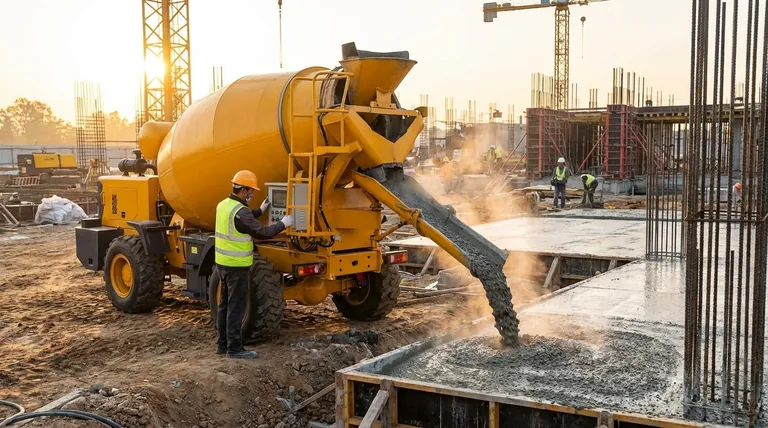
On any construction site, the most critical moments often involve concrete. A foundation slab, a structural column, a retaining wall—their integrity rests on the quality of the mix. For decades, this process was governed by approximation and experience, a craft prone to the subtle (and sometimes not-so-subtle) errors of human judgment.
A little too much water, a few seconds less of mixing time, a misjudged scoop of aggregate. Each deviation is a small gamble, a tiny compromise in the final strength. The pressure of the schedule and the physical demands of the job create an environment where consistency is the first casualty. The problem isn't a lack of skill; it's the psychology of manual labor under pressure.
This is the systemic weakness that modern self-loading mixers are engineered to solve. They don’t just mix concrete; they impose a system of mechanical and digital discipline onto a chaotic process.
The Anatomy of Control
At first glance, a self-loading mixer is a marvel of efficiency—a loader, batching plant, and transporter in one. But its true genius lies in how its components work in concert to eliminate guesswork.
The Drum and Blades: A Symphony of Motion
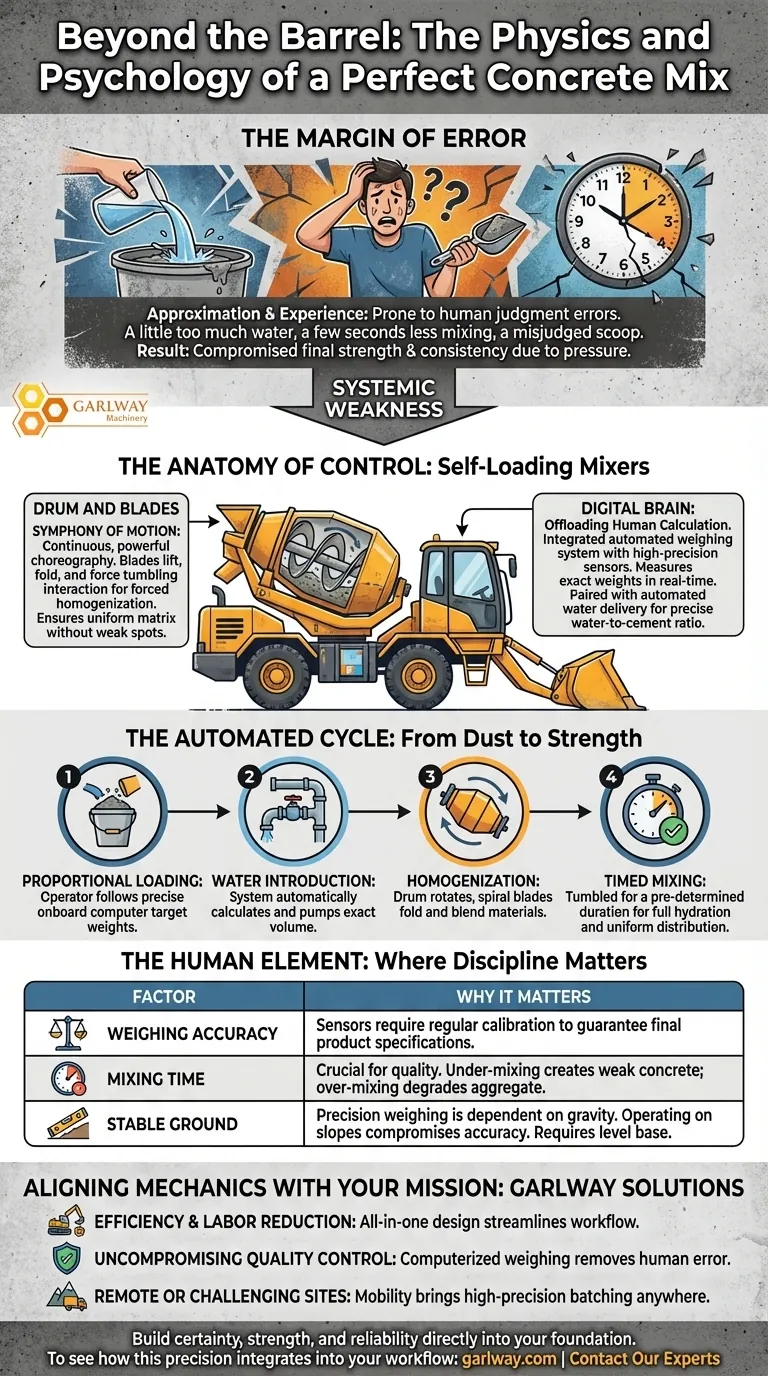
The heart of the operation is the rotating drum, but the magic is in the spiral blades welded within. As the drum turns, these blades perform a continuous, powerful choreography. They lift material from the bottom, fold it over from the top, and force a constant, tumbling interaction between every particle of sand, aggregate, and cement.
This isn't just stirring; it's forced homogenization. It ensures that the cement paste coats every single piece of aggregate, creating a dense, uniform matrix without weak spots—a level of consistency that is physically exhausting and nearly impossible to replicate manually, batch after batch.
The Digital Brain: Offloading Human Calculation
The most significant leap forward is the integration of an automated weighing system. A hydraulic shovel scoops the raw materials, but a network of high-precision sensors measures the exact weight of each component in real-time.
This system acts as the machine's disciplined mind. It doesn't get distracted. It doesn't "eyeball" the amount. It offloads the cognitive burden from the operator, whose job is now to guide the machine, not to perform complex mental calculations under pressure. Paired with an automated water delivery system, it locks in the all-important water-to-cement ratio—the primary determinant of concrete strength.
The Automated Cycle: From Dust to Strength
The entire process becomes a predictable, repeatable manufacturing cycle that happens right on site.
- Proportional Loading: The operator loads aggregates, sand, and cement. The onboard computer provides the precise target weights, ensuring the recipe is followed to the letter.
- Water Introduction: The system automatically calculates and pumps the exact volume of water needed to achieve the specified slump and strength.
- Homogenization: The drum begins its rotation, and the spiral blades start their tireless work of lifting, folding, and blending.
- Timed Mixing: The mix is tumbled for a specific, pre-determined duration. This crucial step ensures full hydration of the cement particles and uniform distribution, transforming a simple collection of ingredients into a high-performance building material.
The Human Element: Where Discipline Matters
While highly automated, the system's perfection still relies on a partnership between operator and machine. The machine provides the precision, but the operator provides the context and control.
Key Operational Disciplines
| Factor | Why It Matters |
|---|---|
| Weighing Accuracy | The system's "brain" relies on accurate sensors. Regular calibration isn't just maintenance; it's an integrity check that guarantees the final product meets engineering specifications. |
| Mixing Time | Under-mixing creates weak, non-uniform concrete. Over-mixing can degrade the aggregate. Adhering to the recommended time is a non-negotiable rule of quality control. |
| Stable Ground | The precision of the weighing system is fundamentally dependent on gravity. Operating on a slope can fool the sensors, compromising the entire batch. A level base is the foundation of an accurate mix. |
Aligning Mechanics with Your Mission
Ultimately, the value of a system like this is defined by the problems it solves on your specific project. Robustly engineered machines, such as the self-loading mixers from GARLWAY, are designed around these core principles.
- For Efficiency & Labor Reduction: The all-in-one design is the solution. It collapses the roles of multiple machines and workers into a single, streamlined workflow.
- For Uncompromising Quality Control: The computerized weighing and water system is the guarantee. It removes the primary source of batch-to-batch variation: human error.
- For Remote or Challenging Sites: Mobility is the key advantage. It brings a high-precision batching plant to locations that are inaccessible to traditional ready-mix trucks, producing fresh concrete exactly when and where it's needed.
By transforming concrete production into a controlled, on-demand process, you're not just pouring concrete. You're building certainty, strength, and reliability directly into the foundation of your project. To see how this precision can be integrated into your workflow, Contact Our Experts
Visual Guide
Related Products
- Skid Steer Self Loading Concrete Mixers for Construction
- Belle Mixer Drum Self Loading Mortar Mixers JS3000
- Portable Cement Mixer with Lift Concrete Machine
- Portable Concrete Mixer Machine Equipment for Mixing Concrete
- Portable Ready Mix Concrete Mixer Equipment
Related Articles
- The Physics of a Faster Pour: Why Bucket Shape Defines Concrete Mixer Productivity
- Beyond Gravity: The Engineering of a Perfect Concrete Pour
- The Unseen Engine: How Integrated Mobility Solves Construction's Cognitive Load Problem
- The One-Machine Revolution: Deconstructing the Physics and Psychology of On-Site Concrete Production
- The Precision Paradox: Why Self-Loading Mixer Maintenance is About More Than Just Oil Changes





