The Hidden Cost of "Good Enough" Concrete
On any construction site, concrete is the foundation of everything. Yet, its on-site production is often a battle against chaos.
A wheel loader operator coordinates with a mixer operator. Ratios of sand, gravel, and cement are measured under pressure. A miscommunication, a slight miscalculation, or a simple distraction can compromise the structural integrity of an entire batch. The cost isn't just wasted material; it's the risk of rework, delays, and reputational damage.
This isn't a failure of people. It's a failure of the system. The cognitive load placed on teams to manually manage a complex chemical process in a dynamic environment is immense. The traditional multi-machine method invites variables, and variables are the enemy of quality.
The solution is not to work harder, but to adopt a better system—a single machine that internalizes the entire process.
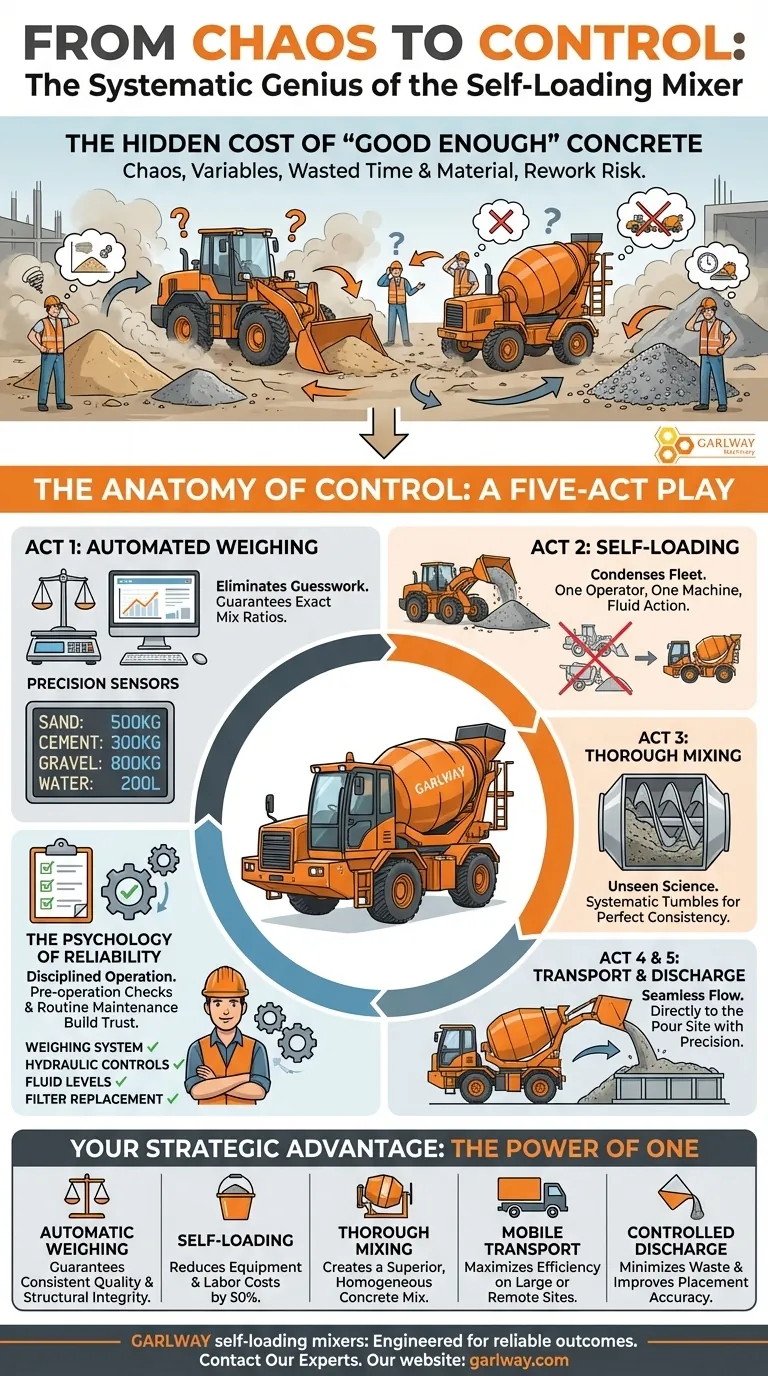
The Anatomy of Control: A Five-Act Play
A self-loading mixer is more than a vehicle; it's a self-contained, mobile batching plant. It deconstructs the chaotic process of making concrete into a sequence of precise, automated actions.
Act 1: Eliminating Guesswork with Automated Weighing
The most critical variable in concrete is the mix ratio. It's also the most common point of human error.
A self-loading mixer begins with digital precision. Before any material enters the drum, an automated weighing system, governed by high-precision sensors and a computer, measures the exact required weight of each component.
The system doesn't estimate; it guarantees. This single feature removes the most significant element of chance, ensuring every batch meets the exact design specifications.
Act 2: Condensing the Fleet with Self-Loading
A traditional site requires a ballet of machinery: a loader to scoop and carry, and a mixer to receive and blend. This means two machines, two operators, and two potential points of failure or delay.
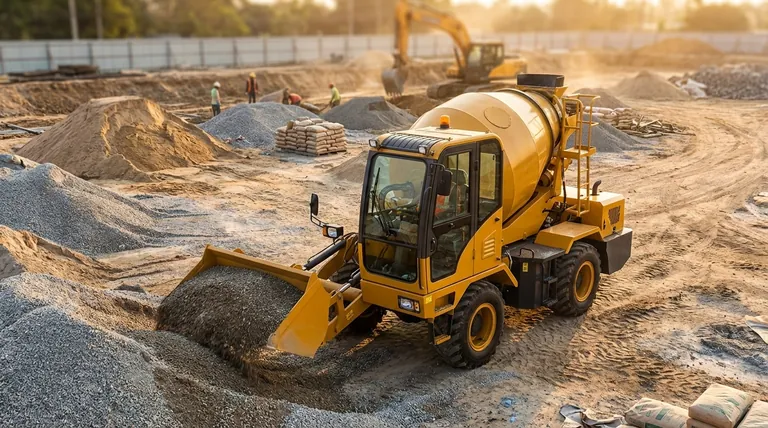
The self-loading bucket changes the entire dynamic. The operator scoops materials directly from stockpiles and loads them into the drum. A multi-step, multi-person process becomes a single, fluid action. It’s not just about saving the cost of an extra loader; it’s about streamlining workflow and eliminating logistical bottlenecks.
Act 3: The Unseen Science of the Perfect Mix
Once loaded, the materials enter a controlled environment. The mixing drum, with its internal helical blades, doesn't just stir—it systematically lifts, tumbles, and folds the aggregate, cement, and water.
This engineered motion ensures every particle is coated in cement paste, creating a strong, homogeneous mixture free from the inconsistencies that plague manual or less-controlled mixing methods.
Act 4 & 5: From Production to Placement, Seamlessly
The workflow doesn't stop after mixing. The machine transforms into a transporter, driving directly to the pour site. During transit, the drum continues a slow rotation, maintaining the mix's perfect consistency.
Upon arrival, the operator reverses the drum's rotation. This engages the spiral blades to push the concrete out with remarkable precision. This controlled discharge allows for accurate placement directly into forms, minimizing waste and cleanup.
The Psychology of Reliability
A sophisticated system is only effective if it's dependable. This is where engineering meets human behavior. The reliability of a self-loading mixer isn't just built-in; it's maintained through disciplined operation.
- Pre-operation checks are not a chore but a ritual. Verifying the weighing system and hydraulic controls builds an operator's confidence and prevents minor issues from becoming major downtime events.
- Routine maintenance, like checking fluids and replacing filters, is an investment in predictability. It ensures the machine operates at the peak performance it was designed for.
For construction companies and contractors, this discipline translates into trust—trust that the machine will perform exactly as expected, batch after batch. GARLWAY self-loading mixers are engineered for this very purpose, providing a robust platform that turns complex processes into reliable outcomes.
Your Strategic Advantage: The Power of One
By integrating five core functions, the self-loading mixer offers more than just convenience. It offers total control.
| Principle | Key Function | Strategic Benefit |
|---|---|---|
| Automatic Weighing | Computer-controlled batching | Guarantees consistent quality and structural integrity |
| Self-Loading | Integrated bucket loads materials | Reduces equipment and labor costs by 50% |
| Thorough Mixing | Engineered drum and blade rotation | Creates a superior, homogeneous concrete mix |
| Mobile Transport | Drives directly to the pour site | Maximizes efficiency on large or remote sites |
| Controlled Discharge | Reversible drum for precise pouring | Minimizes waste and improves placement accuracy |
This isn't just an equipment upgrade; it's an operational one. It allows you to produce high-quality concrete exactly when and where you need it, with a smaller team and a simpler logistical footprint.
It's time to move from chaotic improvisation to systematic control. Let us show you how a single, powerful machine can become the backbone of your entire concrete operation. Contact Our Experts
Visual Guide
Related Products
- Skid Steer Self Loading Concrete Mixers for Construction
- Belle Mixer Drum Self Loading Mortar Mixers JS3000
- Portable Cement Mixer with Lift Concrete Machine
- Portable Ready Mix Concrete Mixer Equipment
- Portable Concrete Mixer Machine Equipment for Mixing Concrete
Related Articles
- The Physics of a Faster Pour: Why Bucket Shape Defines Concrete Mixer Productivity
- Beyond Gravity: The Engineering of a Perfect Concrete Pour
- Beyond the Barrel: The Physics and Psychology of a Perfect Concrete Mix
- The Unseen Engine: How Integrated Mobility Solves Construction's Cognitive Load Problem
- The One-Machine Revolution: Deconstructing the Physics and Psychology of On-Site Concrete Production