The Physics of a Loaded Machine
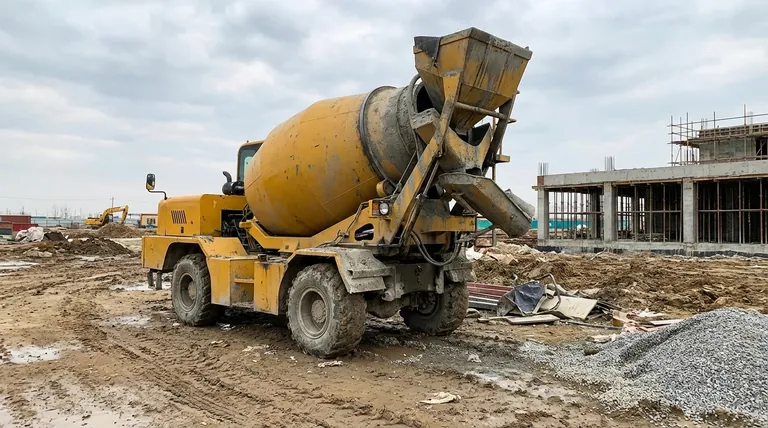
Picture a self-loading mixer, its drum churning several tons of wet concrete, navigating the uneven terrain of a construction site. It's not just a truck; it's a mobile factory with immense kinetic energy.
The critical challenge for its engineers isn't just about stopping this mass. It's about ensuring it can stop reliably, predictably, and safely, even when a component inevitably fails. This is where the philosophy of the brake system becomes more important than the force it can apply.
The Reservoir of Control
The foundation of safety in a modern mixer's brake system is compressed air. But thinking of it as just a tank is missing the point. It’s a reservoir of stopping capability, a stored buffer against the unexpected.
A Reserve Against Engine Failure
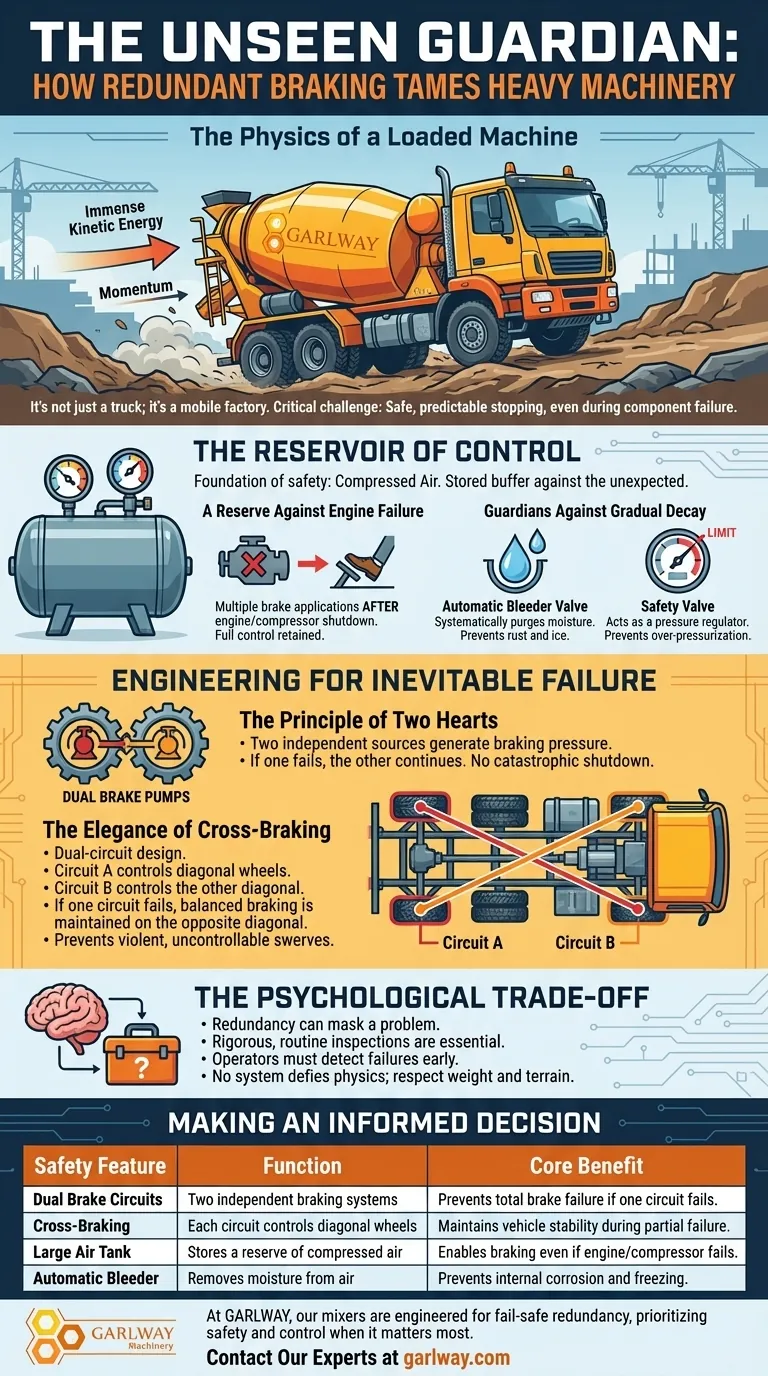
A large air storage tank holds enough compressed air for multiple brake applications after the engine and compressor have shut down. This is a profound safety feature. In the event of a sudden engine stall on a slope, the operator retains full braking control to bring the machine to a safe halt.
Guardians Against Gradual Decay
This air system is protected by two unsung heroes:
- Automatic Bleeder Valve: Systematically purges moisture from the air tank. This simple function is crucial, as it prevents the internal rust and ice formation that can slowly cripple a braking system from the inside out.
- Safety Valve: Acts as a pressure regulator, preventing over-pressurization that could rupture hoses or damage components. It ensures the system operates within its designed limits.
Engineering for Inevitable Failure
Great engineering isn't about creating parts that never break. It's about designing systems that remain functional even when a part does. The braking system in a high-quality self-loading mixer is a masterclass in this principle, built around the concept of redundancy.
The Principle of Two Hearts
The system uses dual brake pumps. This means there are two independent sources generating braking pressure. If one pump fails, the other is completely unaffected and continues to operate. It’s like having two hearts; the failure of one doesn't lead to a catastrophic shutdown.
The Elegance of Cross-Braking
This dual-circuit design enables an elegant solution called cross-braking.
- Circuit A might control the front-left and rear-right wheels.
- Circuit B controls the front-right and rear-left wheels.
If a hydraulic line in Circuit A is severed, you don't lose half your braking power on one side. Instead, you retain balanced braking on a diagonal axis. This prevents the violent, uncontrollable swerve that would occur if all braking power on the front or one side was lost. The operator can maintain control and stop the vehicle safely.
The Psychological Trade-Off of Safety
A brilliantly redundant system introduces a subtle human factor: it can mask a developing problem. A small leak in one circuit might not be immediately obvious because the other circuit is compensating perfectly.
This is why system design and maintenance discipline are intertwined. The very feature that provides a safety net during a catastrophic failure necessitates rigorous, routine inspections. The system is designed to handle failure, but it relies on operators to detect it early.
Furthermore, no braking system can defy physics. The immense weight and high center of gravity of a loaded mixer demand respect. Redundancy is a tool for managing component failure, not for overcoming reckless operation on steep grades or low-traction surfaces.
Making an Informed Decision
When evaluating heavy machinery, the design of the brake system reveals the manufacturer's entire safety philosophy. A commitment to operator safety is evident in these specific features.
| Safety Feature | Function | Core Benefit |
|---|---|---|
| Dual Brake Circuits | Two independent braking systems | Prevents total brake failure if one circuit fails. |
| Cross-Braking | Each circuit controls diagonal wheels | Maintains vehicle stability during a partial failure. |
| Large Air Tank | Stores a reserve of compressed air | Enables braking even if the engine or compressor fails. |
| Automatic Bleeder | Removes moisture and contaminants from air | Prevents internal corrosion and freezing. |
At GARLWAY, our self-loading mixers are engineered around this principle of fail-safe redundancy. We understand that the safety of your team and the security of your project depend on systems that are designed to handle the worst-case scenario gracefully.
By prioritizing features like dual-circuit cross-braking and robust air system protection, we provide machines that instill confidence and ensure control when it matters most.
If you're looking for equipment built with a deep understanding of on-site realities, Contact Our Experts.
Visual Guide
Related Products
- Skid Steer Self Loading Concrete Mixers for Construction
- Belle Mixer Drum Self Loading Mortar Mixers JS3000
- Portable Cement Mixer with Lift Concrete Machine
- Portable Ready Mix Concrete Mixer Equipment
- Portable Concrete Mixer Machine Equipment for Mixing Concrete
Related Articles
- The Physics of a Faster Pour: Why Bucket Shape Defines Concrete Mixer Productivity
- Beyond Gravity: The Engineering of a Perfect Concrete Pour
- Beyond the Barrel: The Physics and Psychology of a Perfect Concrete Mix
- The Unseen Engine: How Integrated Mobility Solves Construction's Cognitive Load Problem
- The One-Machine Revolution: Deconstructing the Physics and Psychology of On-Site Concrete Production