The Hidden Cost of a 90-Degree Angle
On a busy construction site, every second is a resource. The pressure to pour concrete is constant, driven by deadlines, labor costs, and the unforgiving cure time of the material itself. In this high-stakes environment, we often focus on the big-ticket items: engine horsepower, mixing drum capacity, or travel speed.
But profound inefficiencies often hide in plain sight, in the small, repeated actions that accumulate into significant delays. One of the most overlooked sources of friction is the geometry of the self-loading mixer's bucket. A simple 90-degree corner, where the bucket's floor meets its wall, can become a systemic drag on the entire day's productivity.
The Anatomy of a Loading Cycle
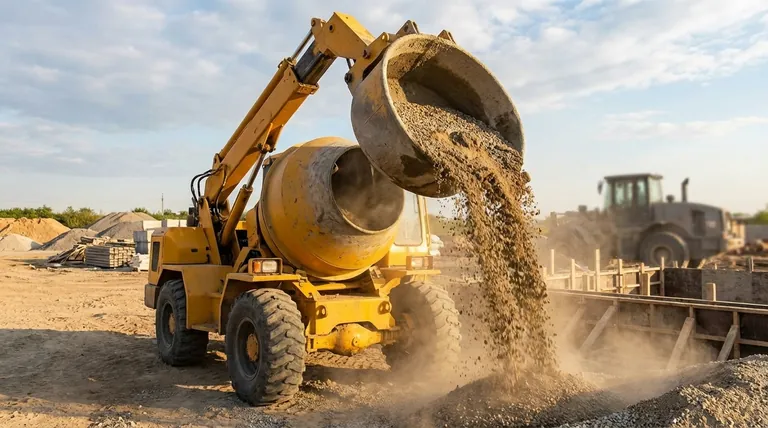
The automated workflow of a self-loading mixer is a mechanical ballet: the bucket scoops aggregates, the arm lifts, and gravity feeds the material into the mixing drum. The speed and success of this entire sequence hinge on one critical moment: the discharge.
Here, we see how a small design choice creates two vastly different outcomes.
The Box-Bucket Bottleneck
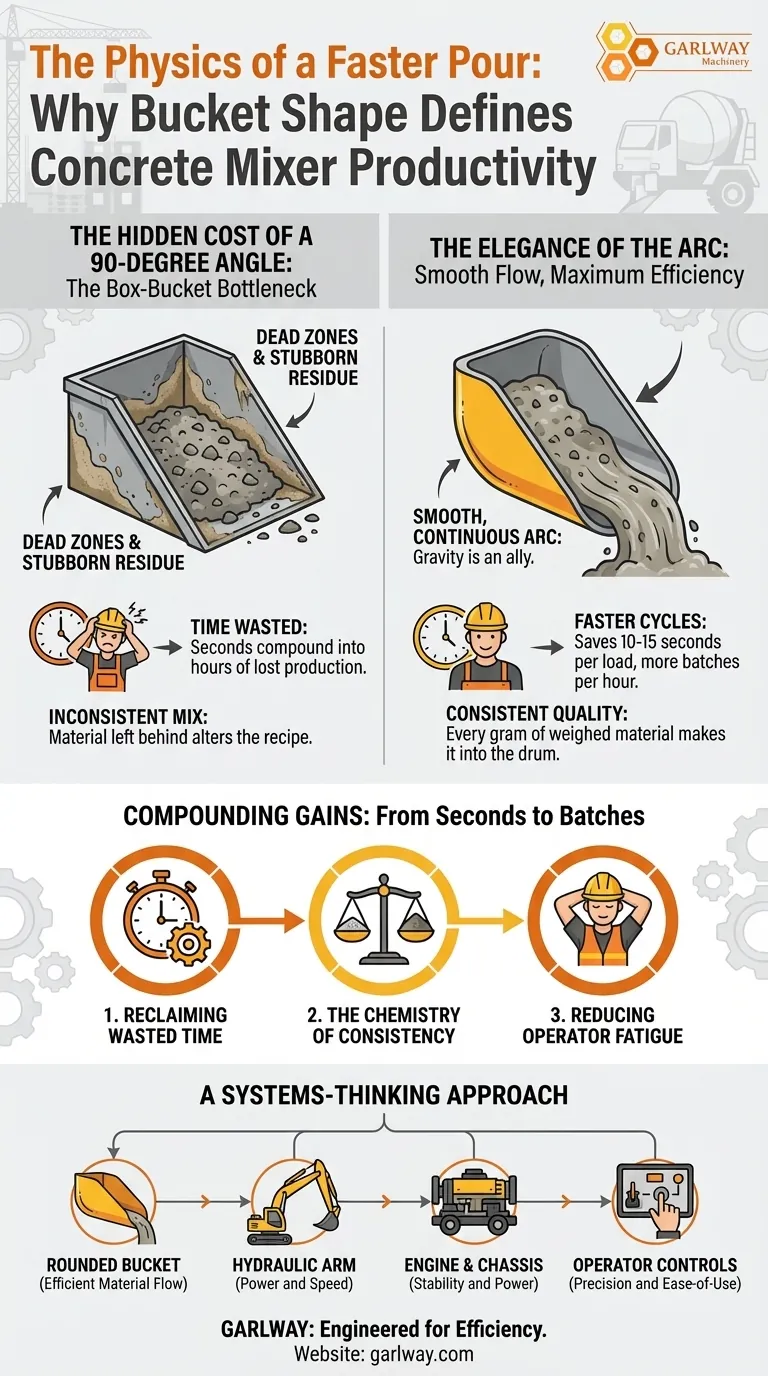
A traditional, box-shaped bucket creates natural "dead zones" in its corners. As the operator tilts the bucket to discharge, a stubborn residue of damp sand, gravel, and cement powder inevitably clings to these 90-degree angles.
This isn't just a matter of wasted material. It's a psychological and operational drain. The operator has to shake the bucket, reposition the arm, or even manually clear it, wasting precious seconds on every single cycle. Those seconds compound, turning into minutes, then hours of lost production time over a week.
The Elegance of the Arc
A rounded bucket is engineered to eliminate this friction. By replacing sharp corners with a smooth, continuous arc, the design removes the points where material can stick.
Gravity becomes an ally, not an opponent. The contents flow out cleanly and completely in a single, fluid motion. There is no shaking, no second-guessing, and no residue. The system works as it was intended—efficiently and predictably.
Compounding Gains: From Seconds to Batches
The shift from a square to a rounded bucket is more than an incremental improvement; it's a change that unlocks compounding benefits across the entire operation.
1. Reclaiming Wasted Time
Saving just 10-15 seconds per loading cycle might seem trivial. But consider a typical workday with hundreds of cycles. This small time-saving translates directly into more batches of concrete produced per hour. The machine spends more time mixing and less time fighting its own design flaws.
2. The Chemistry of Consistency
When material gets left behind in the bucket, it subtly corrupts the concrete's recipe. That small amount of leftover sand or cement means the next batch won't have the precise ratios specified in the mix design.
The complete discharge of a rounded bucket ensures that every gram of weighed material makes it into the drum. This isn't just about speed; it's about quality control. It guarantees a more consistent, reliable, and high-strength final product, pour after pour.
3. Reducing Operator Fatigue
A well-designed tool makes the user's job easier. The self-cleaning nature of the rounded bucket reduces the physical and mental load on the operator. It creates a smoother, less frustrating workflow, allowing them to focus on positioning and safety rather than wrestling with the equipment.
A Systems-Thinking Approach to Equipment
While the rounded bucket is a critical feature, its true value is realized when it functions as part of a balanced, integrated system. A fast bucket is only as good as the machine it's attached to.
| Component | Role in the System | Why it Matters |
|---|---|---|
| Rounded Bucket | Efficient Material Flow | Eliminates sticking, ensuring a fast and complete discharge. |
| Hydraulic Arm | Power and Speed | Must be powerful enough to lift a full bucket without strain and fast enough to keep pace. |
| Engine & Chassis | Stability and Power | Provides the raw power for the hydraulics and ensures the machine remains stable during lifts. |
| Operator Controls | Precision and Ease-of-Use | Intuitive controls allow the operator to leverage the machine's mechanical efficiency. |
This is why evaluating machinery requires looking beyond a single specification. True productivity comes from how well all the parts work together. At GARLWAY, our self-loading mixers are engineered with this philosophy, ensuring the benefits of an advanced bucket design are supported by a robust and responsive machine.
Ultimately, the subtle curve of a mixer bucket is a testament to great engineering—where a simple change in geometry solves a complex operational problem. For equipment designed with this level of detail to maximize your project's efficiency, Contact Our Experts.
Visual Guide
Related Products
- Skid Steer Self Loading Concrete Mixers for Construction
- Belle Mixer Drum Self Loading Mortar Mixers JS3000
- Portable Cement Mixer with Lift Concrete Machine
- Portable Concrete Mixer Machine Equipment for Mixing Concrete
- JW1000 Mobile Cement Mixer Concrete Mixer Truck and Batching Plant
Related Articles
- Beyond Gravity: The Engineering of a Perfect Concrete Pour
- Beyond the Barrel: The Physics and Psychology of a Perfect Concrete Mix
- The Unseen Engine: How Integrated Mobility Solves Construction's Cognitive Load Problem
- The One-Machine Revolution: Deconstructing the Physics and Psychology of On-Site Concrete Production
- The Precision Paradox: Why Self-Loading Mixer Maintenance is About More Than Just Oil Changes