The Allure of "Just One More Day"
There's a powerful temptation on every construction site: push the equipment for just one more day, one more pour, one more job. It feels efficient. It feels like progress. But this thinking is a cognitive trap, mistaking short-term activity for long-term productivity.
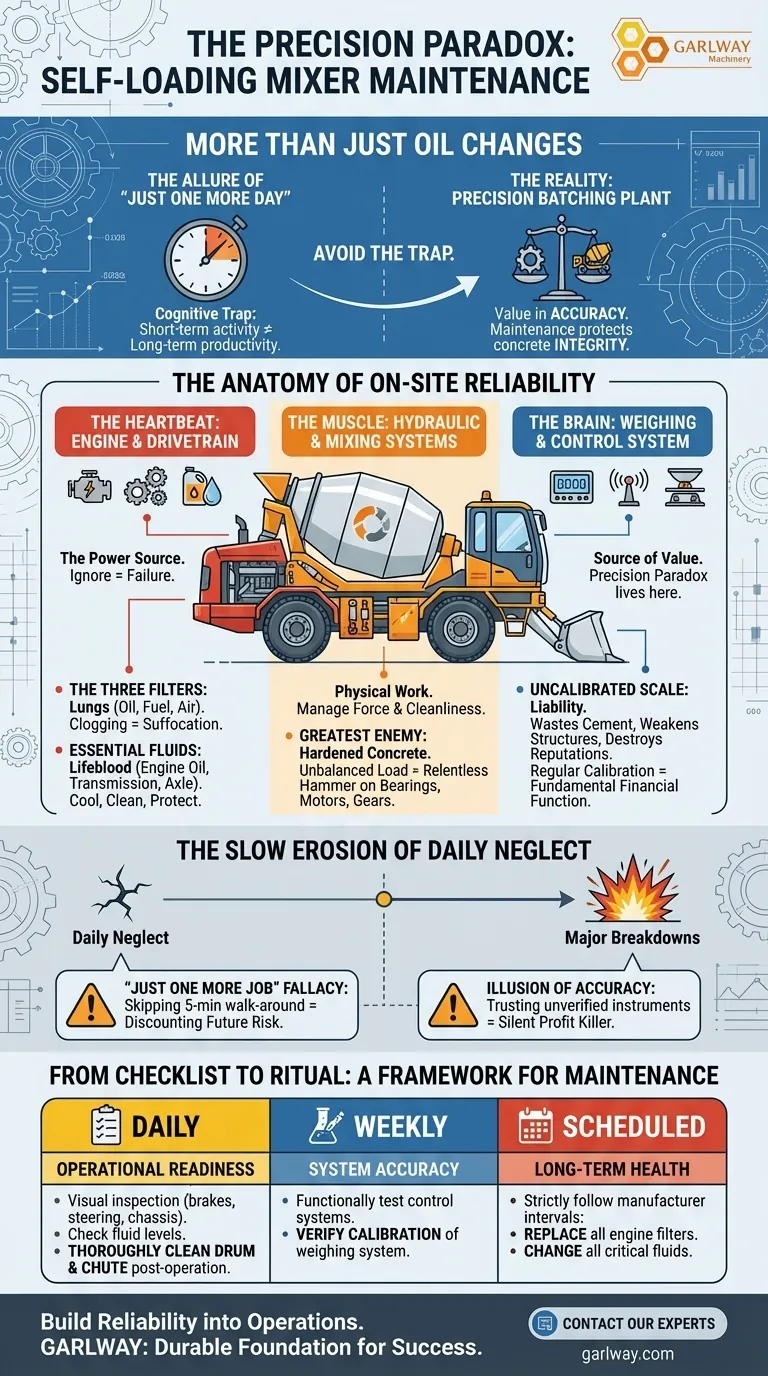
A self-loading mixer isn't just a vehicle that mixes concrete. It's a mobile, precision batching plant. Its value lies not in its motion, but in its accuracy. The goal of maintenance, therefore, isn't merely to keep the engine running. It's to protect the integrity of every single cubic meter of concrete it produces.
The Anatomy of On-Site Reliability
A machine's reliability is the sum of its systems working in harmony. When we view maintenance through this lens, simple checklists transform into a deeper understanding of the machine's interconnected health.
The Heartbeat: Engine and Drivetrain
The engine and drivetrain are the machine's heart and circulatory system. They provide the raw power. Ignoring them is like an athlete ignoring their cardiovascular health.
- The Three Filters: The oil, fuel, and air filters are the machine's lungs. Clogging them with dust and debris slowly suffocates the engine, reducing power, increasing fuel consumption, and leading to premature, catastrophic failure.
- Essential Fluids: Engine oil, transmission fluid, and axle lubricants are the lifeblood. They don't just lubricate; they cool, clean, and protect. Running on old, degraded fluid is a direct path to grinding down the machine's most expensive components.
The Muscle: Hydraulic and Mixing Systems
These systems do the physical work, and they are under constant, immense strain. Their maintenance is about managing force and cleanliness.
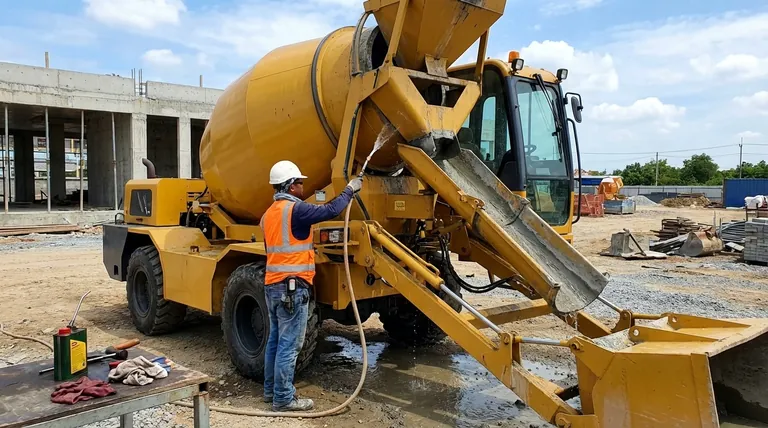
The single greatest enemy is hardened concrete. A small, leftover patch inside the drum seems harmless. But as the drum rotates, that small patch becomes an imbalance, a relentless hammer blow against bearings, motors, and gears with every single turn. Over time, this quiet force leads to loud, expensive failures. Daily, thorough cleaning isn't janitorial work; it's critical mechanical preservation.
The Brain: The Weighing and Control System
This is the system where the "Precision Paradox" lives. A mixer can be mechanically flawless—engine purring, hydraulics strong—but financially disastrous if its measurements are off. The weighing system is the source of its value.
An uncalibrated scale doesn't just produce bad concrete; it produces liability. It wastes cement, weakens structures, and destroys reputations. Regular calibration is not an adjustment; it is the fundamental act of ensuring the machine is still capable of performing its primary financial function: creating a specific, high-quality product.
The Slow Erosion of Daily Neglect
Major breakdowns rarely happen overnight. They are the final, dramatic result of a thousand small acts of neglect. Understanding the psychology behind this neglect is the first step to preventing it.
The "Just One More Job" Fallacy
Skipping a five-minute pre-operation walk-around to save time is a classic example of discounting future risk. That quick check for a leaking hose, a low fluid level, or a loose bolt is the highest-leverage activity an operator can perform. It’s the firewall that stops a small issue from becoming a project-halting failure.
The Illusion of Accuracy
We are conditioned to trust our instruments. We see a number on a digital display and we believe it. But electronic weighing systems, like any precision instrument, can drift. Assuming it remains accurate without verification is a costly assumption. It leads to inconsistent batches, failed quality tests, and wasted materials—all silent profit killers.
From Checklist to Ritual: A Framework for Maintenance
An effective maintenance plan isn't a list of chores; it's a structured ritual that builds reliability into your daily operations.
| Frequency | Focus Area | Key Tasks |
|---|---|---|
| Daily | Operational Readiness | Visual inspection of brakes, steering, and chassis. Check fluid levels. Thoroughly clean the mixing drum and discharge chute post-operation. |
| Weekly | System Accuracy | Functionally test all control systems. Verify the calibration of the electronic weighing system. |
| Scheduled | Long-Term Health | Strictly follow manufacturer intervals for replacing all engine filters (oil, fuel, air) and changing all critical fluids (engine, hydraulic, transmission). |
This disciplined approach transforms maintenance from a reactive cost into a proactive investment in uptime, quality, and profitability. It begins with a robust, well-engineered machine designed to withstand the rigors of the job site. At GARLWAY, we build our self-loading mixers, concrete mixers, and batching plants with this principle in mind, providing a durable foundation for your operational success.
A great machine deserves a great maintenance culture. To ensure your projects are built on a foundation of reliability, from the equipment you choose to the care you provide it, Contact Our Experts.
Visual Guide
Related Products
- Skid Steer Self Loading Concrete Mixers for Construction
- Belle Mixer Drum Self Loading Mortar Mixers JS3000
- Portable Cement Mixer with Lift Concrete Machine
- Portable Concrete Mixer Machine Equipment for Mixing Concrete
- Portable Ready Mix Concrete Mixer Equipment
Related Articles
- The Physics of a Faster Pour: Why Bucket Shape Defines Concrete Mixer Productivity
- Beyond Gravity: The Engineering of a Perfect Concrete Pour
- Beyond the Barrel: The Physics and Psychology of a Perfect Concrete Mix
- The Unseen Engine: How Integrated Mobility Solves Construction's Cognitive Load Problem
- The One-Machine Revolution: Deconstructing the Physics and Psychology of On-Site Concrete Production