The Unseen Forces in a Simple Machine
Picture a sailboat heeling hard, the wind howling. The sail, taut as a drumhead, strains against a line that runs to a winch. In this moment, that simple mechanical device is channeling immense forces—multiplying a crew member's pull into the raw power needed to control the vessel.
We have a psychological bias towards simple machines. We see a handle, a drum, a gear, and we implicitly trust it. But this trust obscures the brutal physics at play. A winch is a focal point of incredible stress, and a failure to respect that reality is a failure to manage risk.
The Compounding Cost of 'Good Enough'
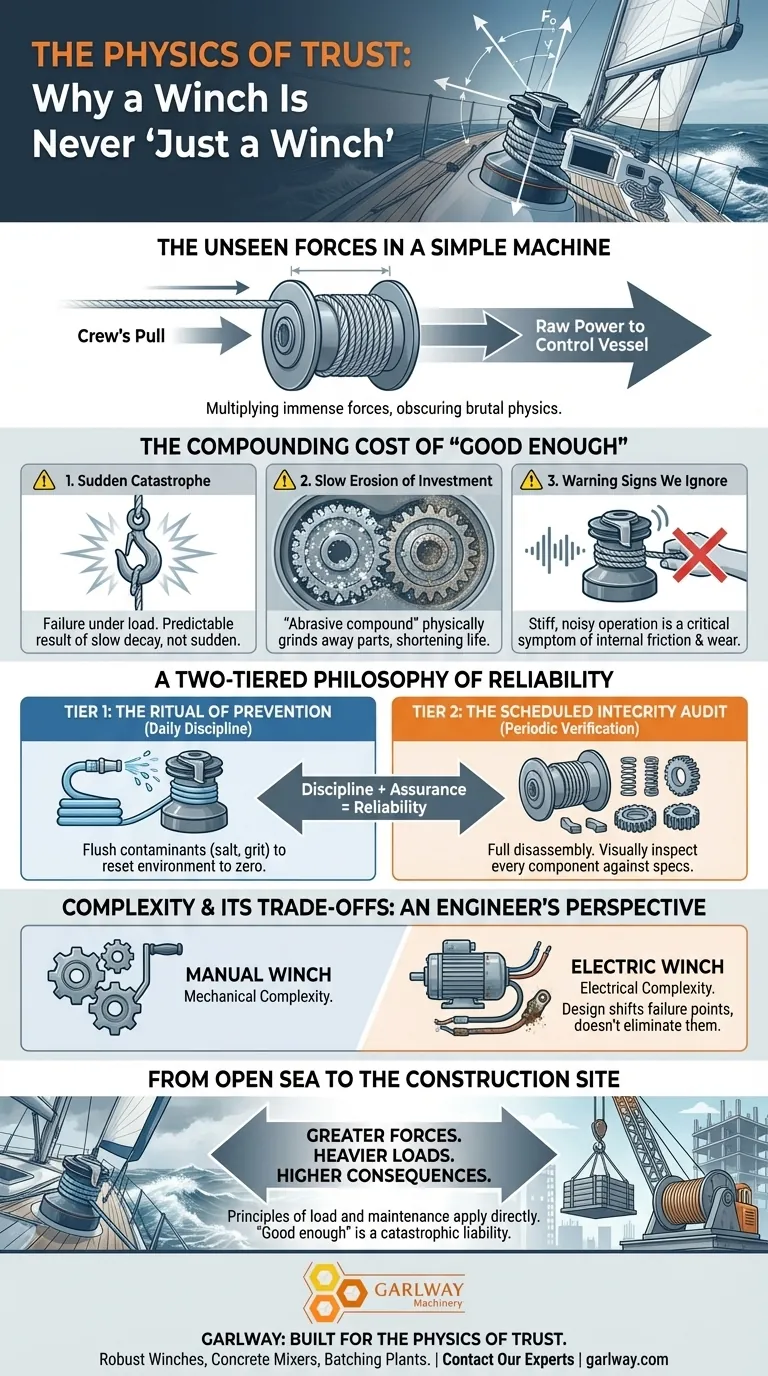
Neglecting maintenance isn't a single decision. It's a series of small, seemingly harmless choices that allow risk to accumulate silently. This accumulation manifests in three distinct ways.
1. The Sudden Catastrophe
The most terrifying outcome is catastrophic failure under load. A winch that seizes or slips doesn't just stop working; it can trigger a cascade of events that endanger the crew and the vessel. This is never a sudden event—it is the predictable result of a slow, invisible process of decay.
2. The Slow Erosion of Investment
Winches are expensive, precision-engineered tools. The source article astutely notes that salt, grit, and hardened grease become an "abrasive compound." This is not just a metaphor. This mixture physically grinds away at gears, bearings, and pawls, dramatically shortening the equipment's operational life. Regular maintenance is not a cost; it is asset preservation.
3. The Warning Signs We Ignore
A well-maintained winch operates with a smooth, quiet efficiency. One that is stiff, noisy, or difficult to turn is not a minor annoyance. It is a critical symptom of internal friction and wear—a leading indicator that the system is approaching a failure point.
A Two-Tiered Philosophy of Reliability
Effective maintenance isn't about random checks. It's a disciplined, two-tiered philosophy that applies to any high-stress mechanical system.
Tier 1: The Ritual of Prevention
This is the most frequent and simplest action: flushing the system. On a boat, it’s rinsing with fresh water after every sail. The goal isn't just to "clean" it; the goal is to reset the environment to zero, removing the corrosive agents (salt, grit, dust) before they can penetrate the mechanism and begin their destructive work. It’s about discipline.
Tier 2: The Scheduled Integrity Audit
This is the periodic deep service—the full disassembly. This is not merely about re-greasing parts. It is a scheduled audit of the system's integrity. You are visually and physically inspecting every component—the pawls, the springs, the gear teeth—to verify they still meet their original engineering specifications. This is about assurance.
| Maintenance Tier | Mindset | Key Actions |
|---|---|---|
| Tier 1: Prevention | Daily Discipline | Flush contaminants to reset the system to baseline. |
| Tier 2: Integrity Audit | Periodic Verification | Disassemble, inspect for wear, and re-lubricate. |
Complexity and Its Trade-offs: An Engineer's Perspective
The choice between a manual and an electric winch offers a perfect lesson in system design. An electric winch may have fewer moving mechanical parts, simplifying one aspect of maintenance.
But that simplicity is a trade-off.
The system's complexity hasn't vanished; it has merely shifted from the mechanical domain to the electrical. Now, the integrity audit must include wiring, terminals, and motor seals. A corroded terminal is just as dangerous as a worn-out pawl. Understanding that every design choice reallocates—but never eliminates—the sources of potential failure is the mark of a true professional.
From the Open Sea to the Construction Site
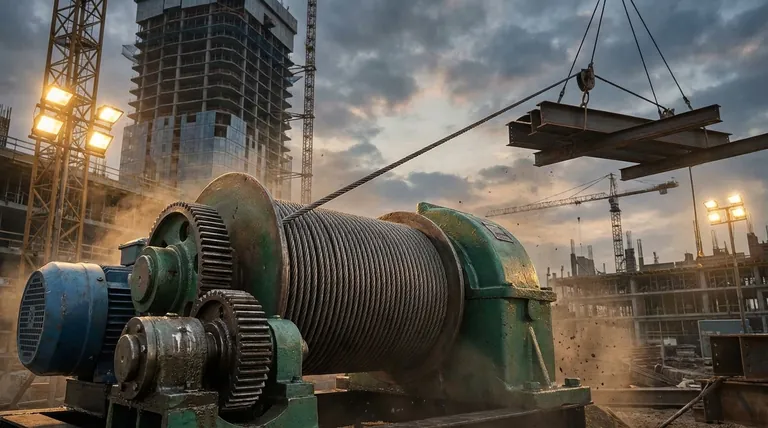
The unforgiving environment of the open sea is a powerful teacher. The principles of load management, material fatigue, and preventative maintenance learned there are directly and critically applicable to the high-stakes world of the construction site.
The forces are greater. The loads are heavier. The financial and safety consequences of failure are exponentially higher. A winch on a construction project isn't trimming a sail; it's lifting tons of material over a team of people. In this environment, "good enough" is a catastrophic liability.
This is the world GARLWAY was built for. We engineer and manufacture robust winches, concrete mixers, and batching plants for contractors who understand that equipment is not a commodity. It is the physical manifestation of their commitment to safety, efficiency, and reliability. Our machines are designed for professionals who share the engineering mindset that preventing failure is always better than reacting to it.
When your project's success and your team's safety depend on equipment that performs flawlessly under immense load, you need a partner who obsesses over the physics of trust.
Visual Guide
Related Products
- Warn Winch Windlass Boat Trailer Winch
- Electric and Hydraulic Winch for Heavy Duty Applications
- Small Electric Winch 120V and 240V for Compact Applications
- Quick Windlass Portable Winch for Truck and Boat Best Boat Winch
- Hydraulic Winding Engine Harbor Freight Winch
Related Articles
- Beyond the Bumper: The Critical System Choice in Powering Your Trailer Winch
- Force vs. Mass: The Critical Difference in Sizing a Boat Winch
- Lines of Force: The Unseen Geometry of a Boat Winch
- More Than a Number: The Engineering Psychology of Choosing a Boat Winch
- How to Choose and Optimize Winch Speed for Maximum Efficiency