The Illusion of Simplicity
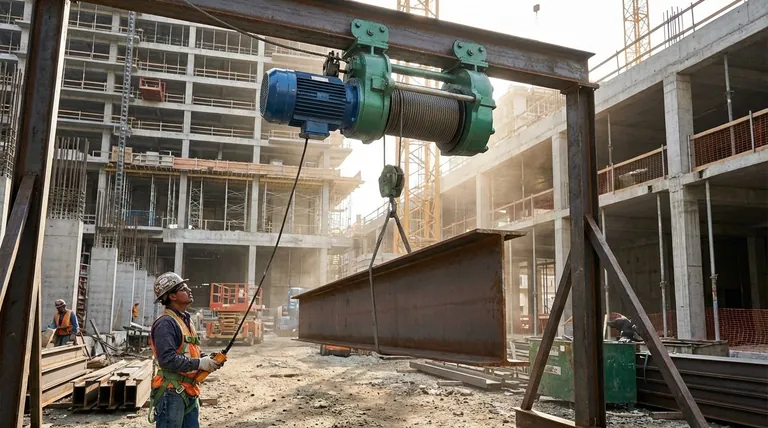
Picture a construction site. A multi-ton steel beam hangs suspended, destined for a precise location dozens of stories high. Below, an operator holds a simple pendant, directing the massive load with a push of a button.
From a distance, the operation looks effortless. Push a button, the load goes up. This is the illusion of simplicity.
In reality, that simple action initiates a complex and elegant choreography of mechanical force, electrical energy, and, most importantly, engineered trust. Understanding this system reveals why modern construction and industry can achieve feats that were once impossible.
The Anatomy of Controlled Force
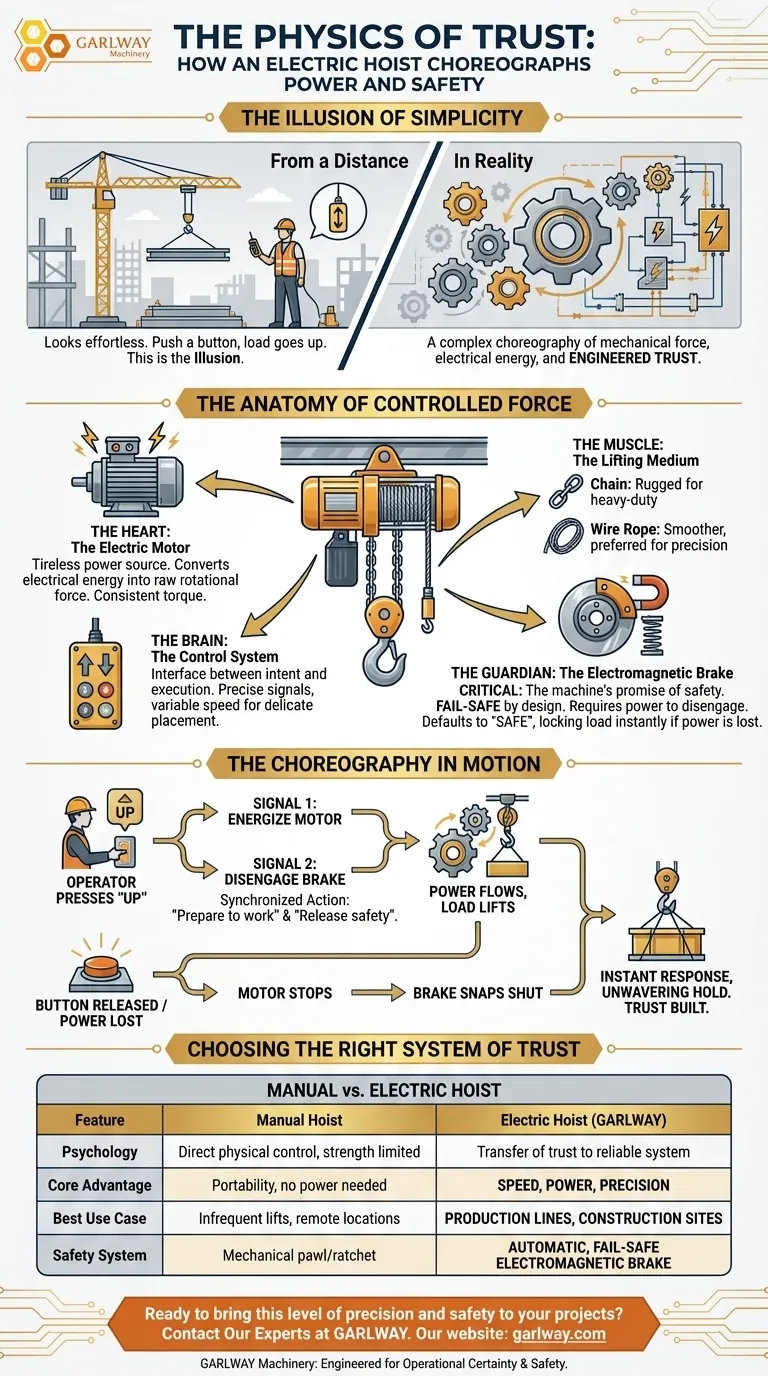
At its core, an electric hoist is a system designed to replace the fallibility and limitations of human muscle with the reliability of a machine. It achieves this through a set of core components, each playing a critical role in the dialogue between power and safety.
The Heart: The Electric Motor
The motor is the source of tireless power. It converts electrical energy into the raw rotational force needed to lift loads far beyond human capacity. It doesn't get tired, it doesn't strain, and it delivers consistent torque every time.
The Muscle: The Lifting Medium
The motor's power is useless until it's applied to the load. This is the job of the lifting medium:
- Chain: A rugged, durable option for demanding, heavy-duty applications. Each link is a point of strength.
- Wire Rope: Wound onto a grooved drum, a wire rope provides smoother, more fluid movement, often preferred for higher speeds and more delicate positioning.
The Brain: The Control System
This is the interface between human intent and machine execution. The push-button pendant allows the operator to translate their goal—lift, lower, move left, move right—into precise electrical signals. Modern systems with variable speed control transform the hoist from a simple lifting device into a precision instrument, allowing for the gentle placement of sensitive machinery or complex components.
The Guardian: The Electromagnetic Brake
This is arguably the most critical component from a psychological perspective. It is the machine's promise of safety.
Unlike a car brake that requires active pressure, an electric hoist's electromagnetic brake is designed to be fail-safe. It requires constant power to disengage. The moment the operator releases the button, or if power is lost, the brake automatically and instantly engages, locking the load in place.
This isn't just a feature; it's a fundamental principle of safe design. The system's default state is "safe." It actively works to prevent gravity from taking over.
The Choreography in Motion
When an operator presses the "up" button, two signals are sent simultaneously: one to energize the motor and another to disengage the brake. It's a synchronized action: "prepare to work" and "release the safety."
The motor's power flows through a gearbox, turning the sprocket or drum and lifting the load.
The moment the operator's finger leaves the button, the circuit is broken. The motor stops, and the electromagnetic brake snaps shut. There is no coasting, no drift. The load is held, secure and unwavering. This instant response is what builds an operator's trust in the machine.
The Inherent Trade-offs
This sophisticated system is not without its trade-offs. Its reliance on electricity makes it unusable during a power outage without a generator. Its complexity, with motors, circuits, and gearboxes, requires more diligent maintenance than a simple manual pulley.
This is the classic engineering dilemma: capability versus complexity. The right choice depends entirely on the stakes of the operation.
For low-frequency lifts in a workshop or on a remote site with no power, a manual hoist is a reliable tool. But for the high-stakes, high-volume world of modern construction, the trade-off is clear.
Choosing the Right System of Trust
The decision to use an electric hoist is a decision to prioritize speed, precision, and, above all, safety. In environments where loads are heavy, lifts are frequent, and placement must be exact, there is no substitute.
For operations where these factors are non-negotiable, the choice is clear. A system built for reliability is paramount. This is the principle behind the industrial-grade electric winches and hoists from GARLWAY, which are engineered for the demanding environments faced by construction companies globally. They aren't just pieces of equipment; they are investments in operational certainty and safety.
| Feature | Manual Hoist | Electric Hoist |
|---|---|---|
| Psychology | Direct physical control, but limited by user strength | Transfer of trust to a reliable system |
| Core Advantage | Portability, no power needed | Speed, power, and precision |
| Best Use Case | Infrequent lifts, remote locations | Production lines, construction sites |
| Safety System | Mechanical pawl/ratchet | Automatic, fail-safe electromagnetic brake |
Ultimately, an electric hoist is a testament to the engineer's craft—a tool that channels immense power through a system of intelligent controls and unwavering safety features. It allows us to build bigger, faster, and safer by placing our trust in the elegant physics of the machine.
Ready to bring this level of precision and safety to your projects? Contact Our Experts
Visual Guide
Related Products
- Electric Hoist Winch Boat Anchor Windlass for Marine Applications
- Electric and Hydraulic Winch for Heavy Duty Applications
- Hydraulic Winding Engine Harbor Freight Winch
- Heavy Duty Electric Boat Winch Windlass Anchor
- 12000 lb Electric Boat Trailer Winch with Windlass Anchor Warn
Related Articles
- How Boat Anchor Winches Prevent Injuries and Enhance Marine Safety
- Why Boat Anchor Winches Earn "Best Accessory" Status: A Deep Dive into User Satisfaction Drivers
- How to Install a Hoist Winch Safely: Avoiding Critical Mistakes
- How to Debug Hoist Winches Safely: Electrical Checks & Mechanical Adjustments
- How to Optimize Hoist Winch Safety: A Systematic Protocol for Accident Prevention