The Illusion of Constant Force
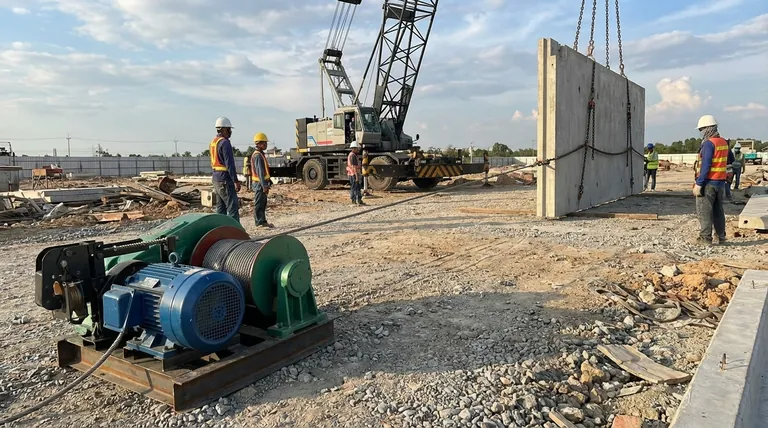
Imagine a construction site. A heavy precast concrete panel, weighing several tons, needs to be positioned with precision. The crew rigs a heavy-duty electric winch. The motor hums, the drum begins to turn, and the panel inches forward—slowly, but with immense, undeniable force.
As the panel gets closer to its destination, it seems to pick up speed. The crew feels a sense of progress. But here lies a dangerous and deeply counter-intuitive truth: as the winch's cable spools onto the drum and the load moves faster, the winch itself is becoming weaker.
Our minds tend to assume a machine's output is constant. We press a button, and we expect a consistent result. This psychological shortcut fails us with winches, because their power is not a fixed number—it's a dynamic variable.
The Anatomy of a Pull
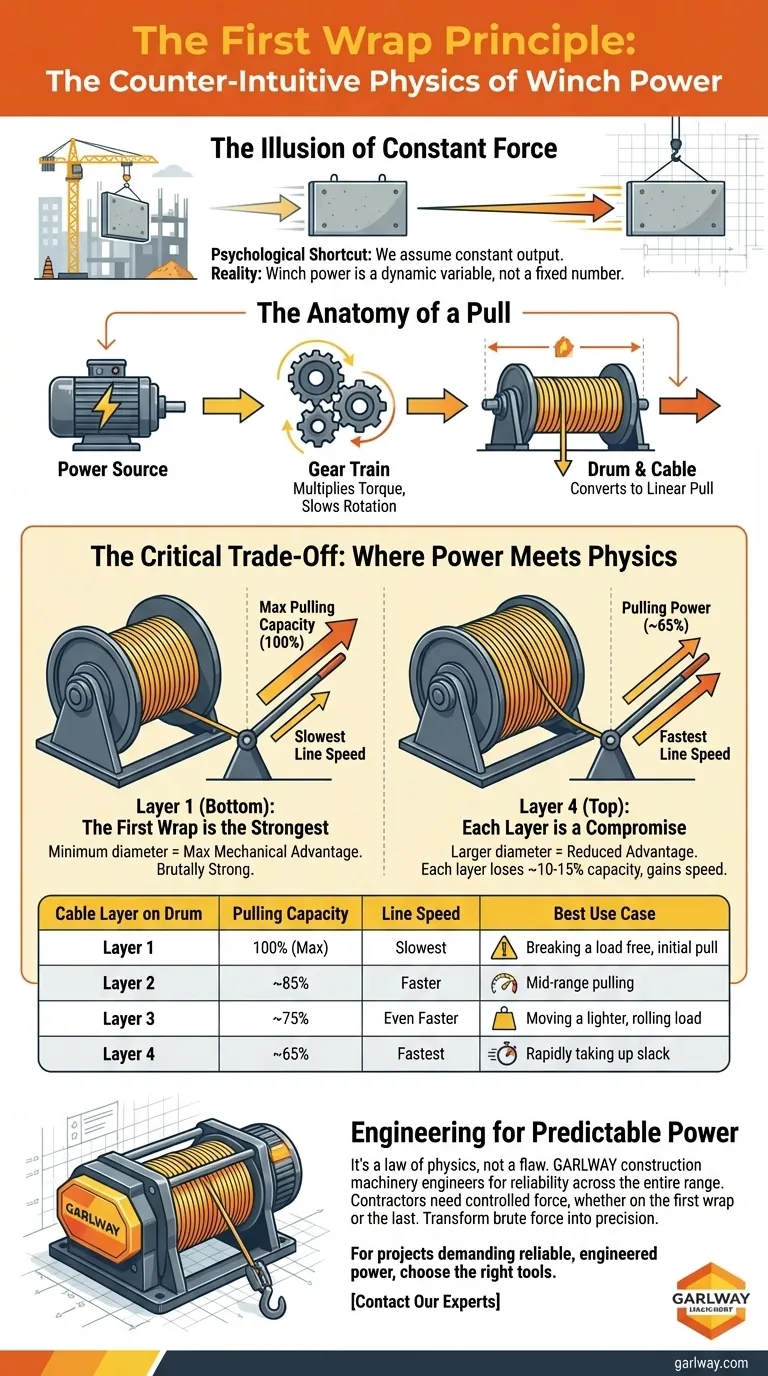
A winch is a masterpiece of mechanical simplicity, converting rotational energy into a powerful linear pull. Its elegance comes from the interplay of a few core components.
- The Power Source: An electric or hydraulic motor that provides the initial high-speed, low-torque rotation.
- The Gear Train: This is the heart of the force multiplication. It slows the motor's rotation dramatically, but in doing so, it massively increases the torque—the rotational force.
- The Drum & Cable: The drum receives this high-torque rotation, winding the cable and creating the immense pulling power at the other end.
This system is designed to transform a small, manageable input into an output capable of moving objects far beyond human strength. But the magic, and the misunderstanding, happens at the drum.
The Critical Trade-Off: Where Power Meets Physics
The rated capacity of a winch—the maximum weight it can pull—is not a promise of its performance in every situation. That number almost always refers to one specific condition: the first layer of cable wrapped around an empty drum.
The First Wrap is the Strongest
Think of the winch drum as a lever. The pull of the cable acts on the drum's outer edge, working against the rotational force at its center.
When only the first layer of cable is on the drum, the effective diameter is at its absolute minimum. This gives the gear train the greatest possible mechanical advantage. All of the multiplied torque is being applied over the shortest possible distance from the center, resulting in the maximum linear pull on the cable.
It's slow, but it is brutally strong.
Each Layer is a Compromise
As more cable winds onto the drum, each new layer increases its effective diameter. This changes the physics of the pull in two important ways:
- Pulling Power Decreases: With a larger diameter, the mechanical advantage is reduced. The motor and gears now have to work harder to exert the same pull. For each additional layer of cable, a winch can lose 10-15% of its pulling capacity.
- Line Speed Increases: A larger diameter means that one full rotation of the drum pulls in a greater length of cable. The load moves faster.
This creates a fundamental trade-off that every operator must understand.
| Cable Layer on Drum | Pulling Capacity | Line Speed | Best Use Case |
|---|---|---|---|
| Layer 1 (Bottom) | 100% (Max) | Slowest | Breaking a load free, initial pull |
| Layer 2 | ~85% | Faster | Mid-range pulling |
| Layer 3 | ~75% | Even Faster | Moving a lighter, rolling load |
| Layer 4 (Top) | ~65% | Fastest | Rapidly taking up slack |
Engineering for Predictable Power
This principle isn't a design flaw; it's a law of physics. The difference between an average tool and a professional one is how this principle is managed, communicated, and engineered for.
On a busy construction site, you don't have time for guesswork. You need equipment that performs predictably under load. This is the engineering philosophy behind GARLWAY construction machinery. Our winches are designed not just for raw power, but for reliability across their entire operational range. We understand that contractors need controlled force they can count on, whether they are on the first wrap or the last.
Understanding the physics of a winch transforms it from a tool of brute force into an instrument of precision. It’s about knowing when you need maximum torque for the initial, stubborn pull, and when you can trade that force for the speed to get the job done efficiently.
For projects that demand reliable, engineered power to move critical loads, having the right equipment is non-negotiable. If you need to ensure your operations are both safe and efficient, let's talk about the right tools for the job. Contact Our Experts
Visual Guide
Related Products
- Warn Winch Windlass Boat Trailer Winch
- Electric and Hydraulic Winch for Heavy Duty Applications
- Small Electric Winch 120V and 240V for Compact Applications
- 12000 lb Electric Boat Trailer Winch with Windlass Anchor Warn
- Quick Windlass Portable Winch for Truck and Boat Best Boat Winch
Related Articles
- Beyond the Bumper: The Critical System Choice in Powering Your Trailer Winch
- Force vs. Mass: The Critical Difference in Sizing a Boat Winch
- Lines of Force: The Unseen Geometry of a Boat Winch
- More Than a Number: The Engineering Psychology of Choosing a Boat Winch
- How to Choose and Optimize Winch Speed for Maximum Efficiency