The Illusion of Capacity
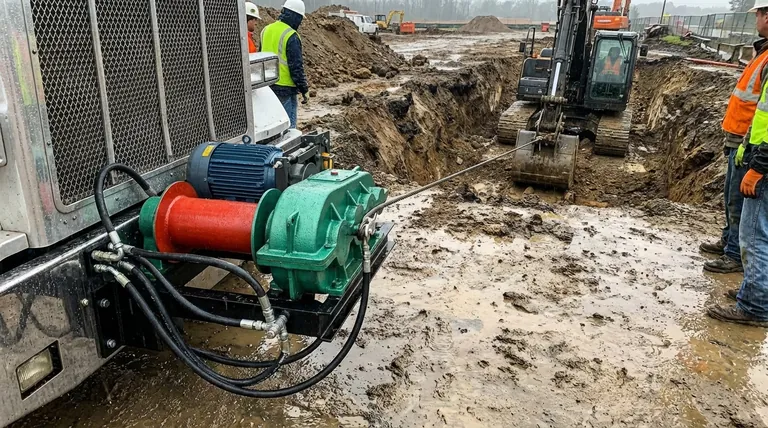
A heavy-duty excavator slides into a muddy ditch on a sprawling construction site. Work grinds to a halt. All eyes turn to the recovery vehicle. The multi-ton winch mounted to its front is the only hope for getting the project back on schedule.
In this moment, the number stamped on the winch—its "rated pulling capacity"—is almost irrelevant. The real question is, what is powering that pull? For how long? And what happens when it's pushed to its absolute limit?
We believe we choose a winch based on strength. In reality, we are making a much deeper decision about its energy system. We are choosing its philosophy of work and, more importantly, its mode of failure.
Three Philosophies of Power
The fundamental difference between winches isn't the gears or the cable, but the heart of the machine: its power source. This single factor dictates its stamina, its dependencies, and the psychological contract you make with it.
The Human Engine: Manual Winches
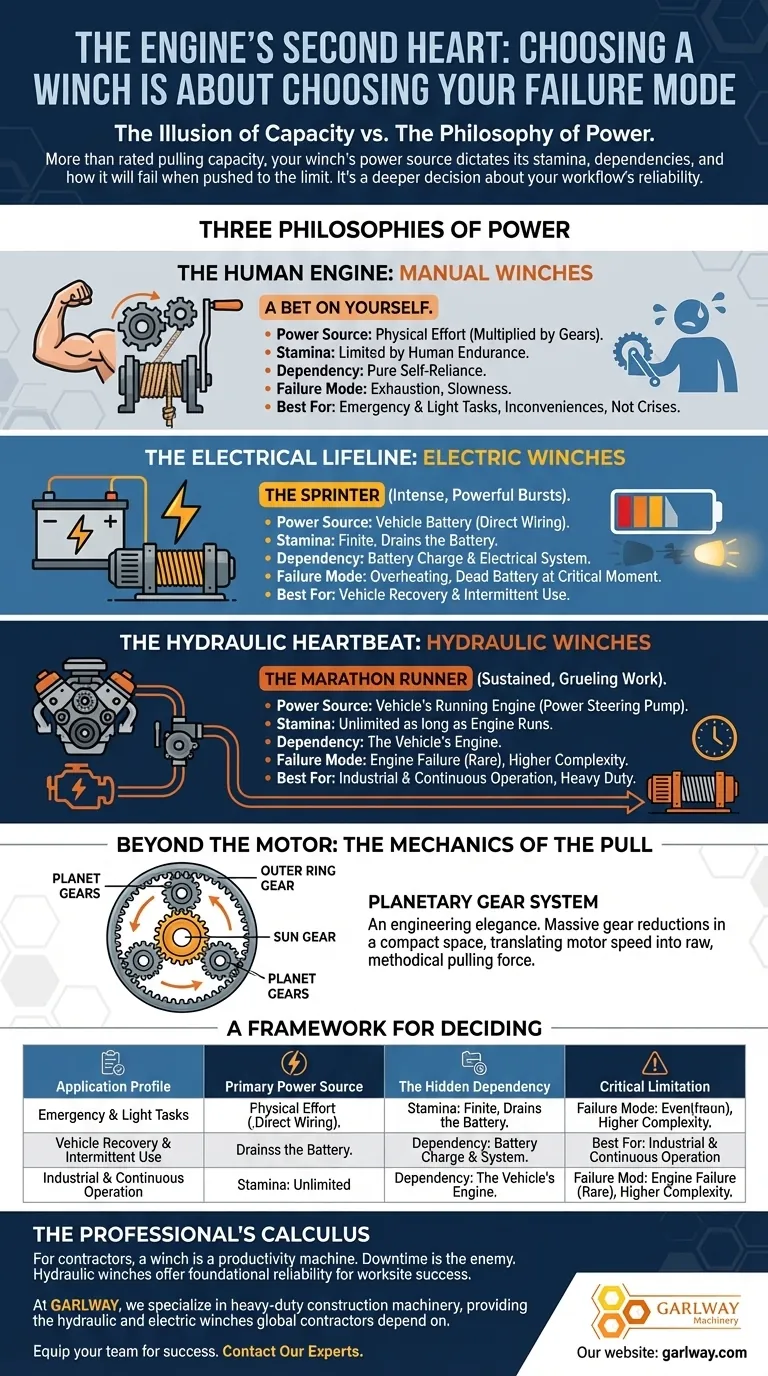
A manual winch is a bet on yourself. It runs on physical effort, multiplied through a clever system of gears. It has no batteries to drain, no electronics to short, and no engine to stall.
Its beauty lies in its simplicity. It's the ultimate reliable backup, a tool of pure self-reliance. But it is slow, laborious, and limited by human endurance. It is designed for the inconvenience you can solve with sweat, not the crisis that requires relentless, mechanical power.
The Electrical Lifeline: Electric Winches
The electric winch is the common standard for a reason. It offers incredible power on demand, wired directly to a vehicle's battery. It's a sprinter—capable of intense, powerful bursts of energy.
But this convenience comes with a hidden vulnerability. Each pull is a tax on the battery. In a difficult recovery, you can see it in the dimming headlights. The tension isn't just in the rope; it's in the countdown of your vehicle's electrical life. The primary risk is not that the winch will break, but that its power source will be exhausted at the critical moment.
The Hydraulic Heartbeat: Hydraulic Winches
A hydraulic winch doesn't rely on a finite resource like a battery. Instead, it taps directly into the vehicle's power steering pump, becoming a seamless extension of the engine itself.
As long as the engine is running, the winch can pull. It will not overheat during prolonged use. It will not drain the battery. This creates a system of profound reliability, purpose-built for scenarios where failure isn't an option. For heavy industrial and commercial work, this isn't just a feature; it's the entire point. It’s the marathon runner, designed for sustained, grueling work.
Beyond the Motor: The Mechanics of the Pull
The power source is the heart, but the gearing is the muscle. Most modern electric and hydraulic winches utilize a planetary gear system.
This is a piece of engineering elegance. A central "sun" gear turns multiple "planet" gears within an outer ring. This design allows for massive gear reductions in an incredibly compact and efficient space, translating the motor's speed into raw, methodical pulling force.
A Framework for Deciding
Choosing the right winch isn't about finding the "best" one, but about honestly assessing the nature of your work and your tolerance for risk. The trade-offs are not just in price and power, but in dependency and endurance.
| Application Profile | Primary Power Source | The Hidden Dependency | Critical Limitation |
|---|---|---|---|
| Emergency & Light Tasks | Manual (Human Effort) | Your own physical stamina. | Slow, exhausting, and low capacity. |
| Vehicle Recovery & Intermittent Use | Electric (Vehicle Battery) | The finite charge of a battery. | Overheating and potential power drain. |
| Industrial & Continuous Operation | Hydraulic (Engine Power) | The vehicle's running engine. | Higher initial cost & installation complexity. |
The Professional's Calculus
On a construction site, downtime is the only true enemy. A tool's failure is measured not by its repair cost, but by the thousands of dollars lost for every hour a project stands still.
For contractors and industrial operators, a winch is not a recovery accessory; it is a productivity machine. An electric model might handle 90% of tasks, but the 10% where it could overheat or drain a battery is precisely when project timelines are at stake.
This is why professionals turn to systems that match their operational reality. The robust, continuous power of a hydraulic winch isn't a luxury; it's a foundational component of worksite reliability. At GARLWAY, we specialize in this class of construction machinery, providing the heavy-duty hydraulic and electric winches that global contractors depend on. We understand that your equipment is an investment in uptime.
Understanding the deep connection between a winch's power source and its purpose is the key to equipping your team for success. If your work demands unwavering power, Contact Our Experts
Visual Guide
Related Products
- Warn Winch Windlass Boat Trailer Winch
- Electric and Hydraulic Winch for Heavy Duty Applications
- Small Electric Winch 120V and 240V for Compact Applications
- 12000 lb Electric Boat Trailer Winch with Windlass Anchor Warn
- Quick Windlass Portable Winch for Truck and Boat Best Boat Winch
Related Articles
- Beyond the Bumper: The Critical System Choice in Powering Your Trailer Winch
- Force vs. Mass: The Critical Difference in Sizing a Boat Winch
- Lines of Force: The Unseen Geometry of a Boat Winch
- More Than a Number: The Engineering Psychology of Choosing a Boat Winch
- How to Choose and Optimize Winch Speed for Maximum Efficiency