The Moment of Truth: More Than Just a Pour
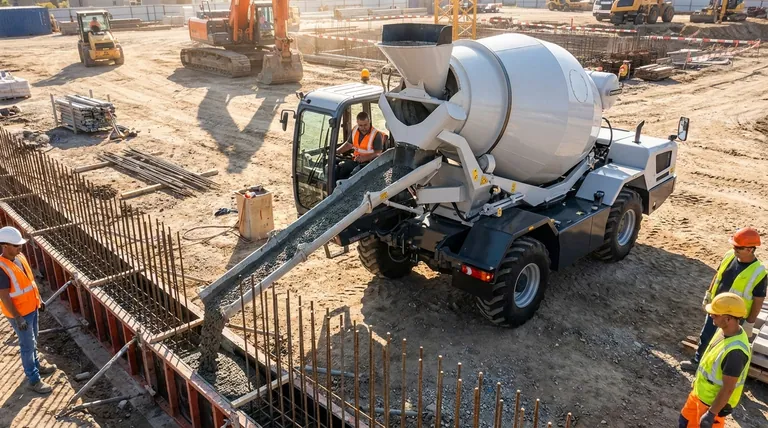
On any construction site, the most critical moment is not mixing the concrete, but placing it. Imagine a narrow column formwork, surrounded by rebar, waiting for a precise delivery. A sloppy pour means wasted material, hours of cleanup, and potentially compromised structural integrity.
The pressure on the operator is immense. This single action—the discharge—is where a project's profitability and quality are often decided. It's a moment that demands more than just brute force; it requires finesse. This is where the elegant engineering of a self-loading mixer transforms the operator from a laborer into a craftsman.
The Illusion of Simplicity: Reversing a Simple Machine
At first glance, discharging concrete seems simple: just tip the drum and let gravity do the work. But this is the old way. The self-loading mixer's genius lies in a far more active and controlled process. It doesn't fight gravity; it commands it.
The magic isn't found in a complex new component. It’s in the simple, brilliant act of reversing a process.
The Archimedes' Screw in Reverse
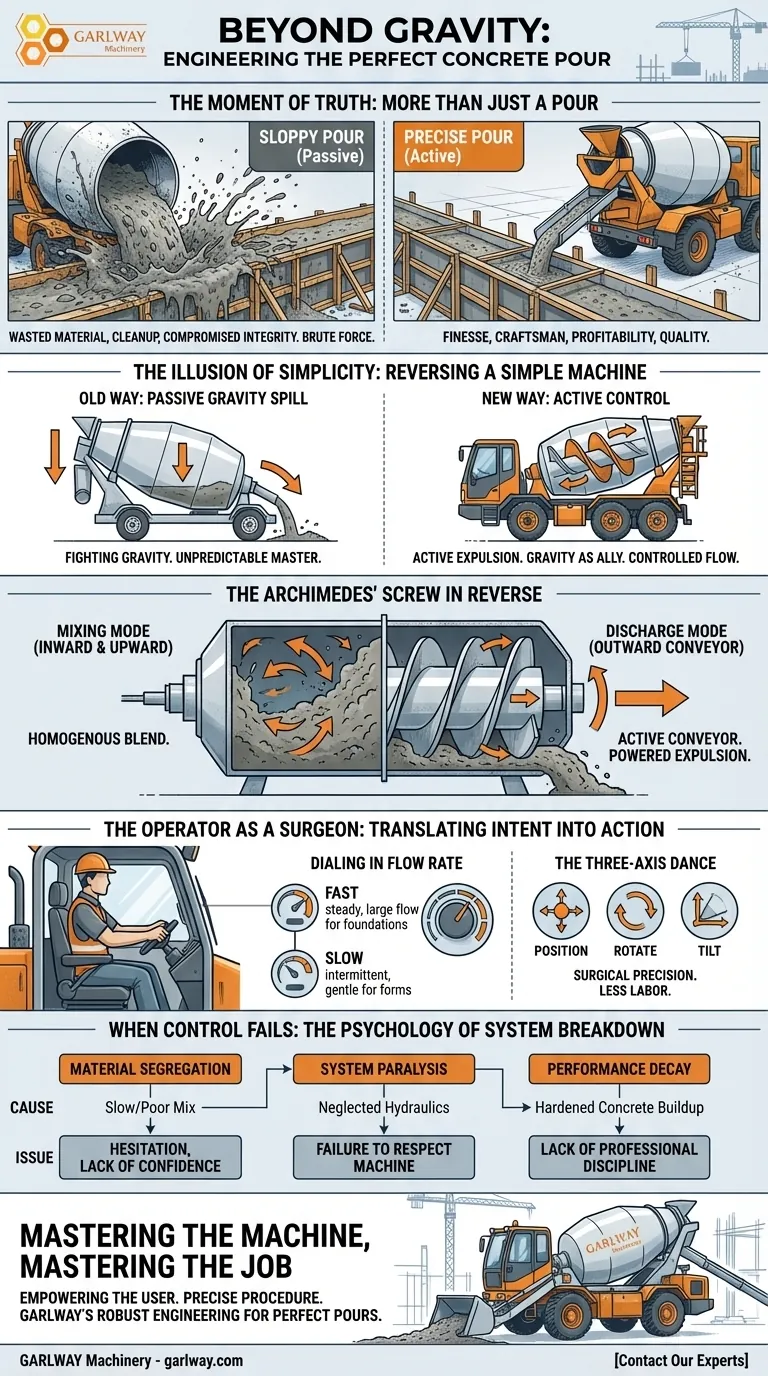
Inside the mixer's drum are massive helical blades. During mixing, they rotate in one direction, pulling aggregate, cement, and water inward and upward, ensuring a homogenous blend.
To discharge, the operator simply reverses the drum's rotation. In an instant, the blades' function is transformed. They cease to be mixers and become an Archimedes' screw, a conveyor system that actively and consistently pushes the finished concrete forward and out of the drum. This is not a passive spill; it's a powered, deliberate expulsion.
Gravity as an Ally, Not a Master
Tilting the drum is still crucial, but its role has changed. Instead of being the primary force for discharge, tilting simply positions the concrete at the mouth of the drum. It ensures the Archimedes' screw has a constant supply of material to work with.
The machine uses gravity to its advantage, making it a reliable partner in the process rather than an unpredictable master that dictates the flow. This fundamental shift from passive reliance to active control is what defines modern concrete placement.
The Operator as a Surgeon: Translating Intent into Action
This active discharge system becomes an extension of the operator’s will. The controls in the cab are not just levers; they are instruments for translating human intent into precise mechanical action.
Dialing in the Flow Rate
The operator can vary the speed of the drum's reverse rotation. A steady, fast rotation is used for quickly filling large foundations. A slow, intermittent rotation allows for a carefully measured flow, gently filling a small form without spillage or segregation. This nuance turns a messy job into a clean operation.
The Three-Axis Dance of Placement
A skilled operator combines three movements in a fluid dance: positioning the vehicle, rotating the chassis, and adjusting the drum's tilt. This allows concrete to be placed with surgical precision, directly where it's needed. The result is a dramatic reduction in the back-breaking labor of shuttling wheelbarrows and shoveling concrete by hand.
When Control Fails: The Psychology of System Breakdown
Even the most elegant system is vulnerable to failure. These failures are rarely just mechanical; they are breakdowns in the symbiosis between operator, machine, and material.
| Failure Point | Technical Cause | The Deeper Issue |
|---|---|---|
| Material Segregation | Discharging too slowly or with a poor mix | Hesitation or a lack of confidence in the pour |
| System Paralysis | Neglected or failing hydraulic system | A failure to respect the machine's essential lifeblood |
| Performance Decay | Hardened concrete buildup on internal blades | A lack of professional discipline and routine maintenance |
These pitfalls highlight a crucial psychological truth: a machine's performance is a direct reflection of the operator's foresight, confidence, and discipline.
Mastering the Machine, Mastering the Job
The self-loading mixer's discharge system is a testament to engineering that empowers its user. It elevates the task of placing concrete from a chaotic rush against time to a controlled, precise procedure.
Achieving this level of precision and reliability on your projects, however, depends entirely on the quality and design of your equipment. GARLWAY's self-loading concrete mixers are engineered for this exact purpose—providing robust hydraulic systems, intuitive controls, and durable components that make perfect pours the standard, not the exception. To bring this level of control to your job site, the right equipment is non-negotiable. Contact Our Experts.
Visual Guide
Related Products
- Skid Steer Self Loading Concrete Mixers for Construction
- Belle Mixer Drum Self Loading Mortar Mixers JS3000
- Portable Cement Mixer with Lift Concrete Machine
- Portable Concrete Mixer Machine Equipment for Mixing Concrete
- Portable Ready Mix Concrete Mixer Equipment
Related Articles
- The Physics of a Faster Pour: Why Bucket Shape Defines Concrete Mixer Productivity
- Beyond the Barrel: The Physics and Psychology of a Perfect Concrete Mix
- The Unseen Engine: How Integrated Mobility Solves Construction's Cognitive Load Problem
- The One-Machine Revolution: Deconstructing the Physics and Psychology of On-Site Concrete Production
- The Precision Paradox: Why Self-Loading Mixer Maintenance is About More Than Just Oil Changes