The Anatomy of a Failed Pour
Picture a remote construction site. The forms are set, the rebar is tied, and the crew is waiting. The concrete truck, delayed by traffic, finally arrives. But the mix is already starting to cure, its workability gone. Or worse, the batch from the distant plant is inconsistent—the slump is wrong, the strength questionable.
The cost of this moment isn't just the wasted material. It's the cascade of lost labor hours, schedule overruns, and the gnawing uncertainty that compromises the integrity of the entire structure.
Our intuition tells us concrete is a simple commodity—just rock, sand, cement, and water. This is a psychological trap. Concrete isn't a substance; it's the result of a sensitive chemical process. The failure isn't in the ingredients, but in the loss of control over the system that combines them.
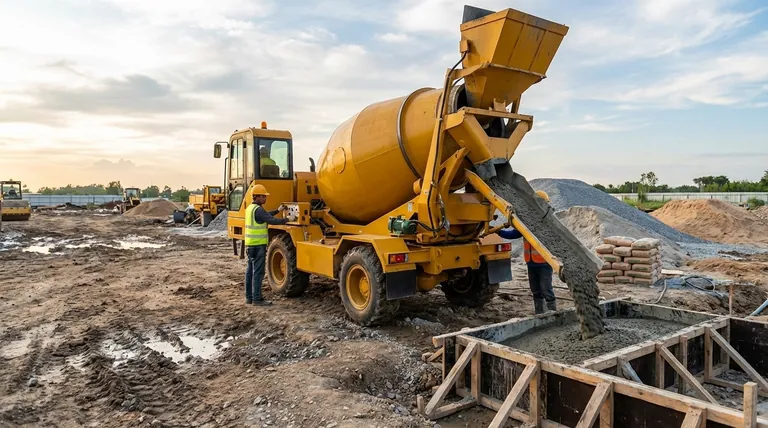
A self-loading mixer reclaims that control. It’s not just a truck that mixes. It's a complete, mobile batching plant—an integrated system designed for precision and discipline, right where you need it. To understand its value, you have to look beyond the steel and see it as a system in four acts.
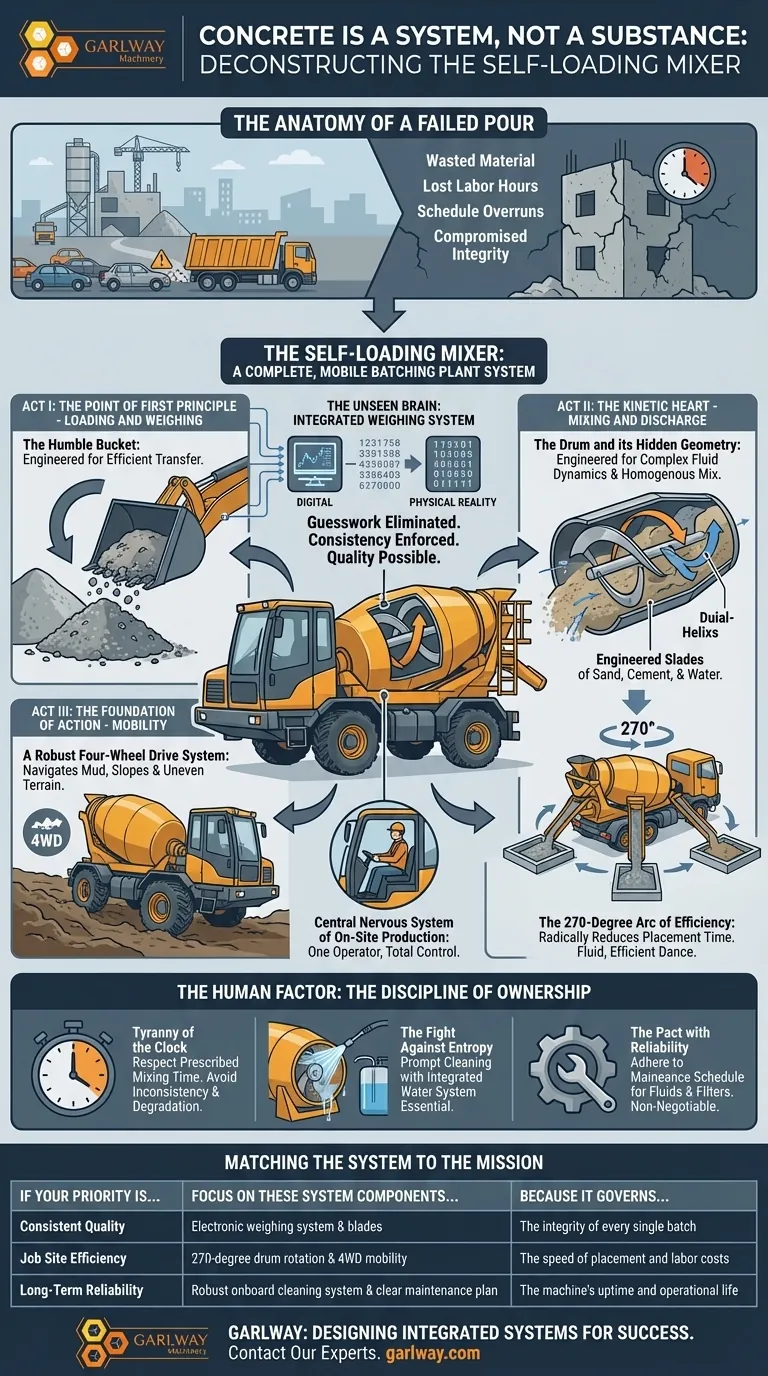
Act I: The Point of First Principle - Loading and Weighing
Every failure in a concrete pour can be traced back to a deviation from the mix design. The system's first job is to eliminate that deviation from the very start.
The Humble Bucket
The process begins with the hydraulic loading bucket scooping aggregates. This seems simple, but its design—often rounded—is a subtle piece of engineering meant to ensure a clean, efficient transfer into the drum. It's the first physical point of contact in a chain of precise events.
The Unseen Brain: The Integrated Weighing System
As the bucket lifts, the machine's most critical, and often least appreciated, component comes online: the computer-controlled weighing system. This isn't just a scale; it's the system's conscience.
It measures the exact weight of the materials, translating the abstract numbers of a mix design into physical reality. Guesswork is eliminated. Consistency is enforced. Getting this stage right makes quality possible. Getting it wrong makes everything that follows irrelevant.
Act II: The Kinetic Heart - Mixing and Discharge
Once the ingredients are validated, the transformation begins. The quality of the final product depends entirely on the mechanical choreography inside the drum.
The Drum and its Hidden Geometry
The mixing drum is where the chemistry happens. But the magic is in the physics. Welded to its interior walls are spiral blades, typically in a dual-helix design.
This isn't an arbitrary pattern. It's an engineered solution to a complex fluid dynamics problem, ensuring every grain of sand and particle of cement is folded, lifted, and tumbled into a homogenous mixture. It guarantees a fast, complete, and even mix, every single time.
The 270-Degree Arc of Efficiency
Many high-performance mixers feature a drum that can rotate up to 270 degrees. This isn't a gimmick; it’s a profound understanding of worksite logistics.
It allows a single operator to discharge concrete on three sides of the vehicle without constantly repositioning it. This simple feature radically reduces placement time, turning a cumbersome process into a fluid, efficient dance.
Act III: The Foundation of Action - Mobility
A perfect mix is useless if you can't get it to the forms. The mixer's final act is to overcome the physical constraints of the job site.
A robust four-wheel drive system is standard, giving the machine the agility to navigate the mud, slopes, and uneven terrain that would strand a conventional concrete truck. It transforms job site logistics from a limitation into a strategic advantage, placing concrete exactly where it's needed, not just where a road allows.
From the operator's cabin, a single person commands this entire system—driving, loading, weighing, mixing, and discharging. It's the central nervous system of on-site production.
The Human Factor: The Discipline of Ownership
The machine provides the potential for perfect concrete. But it's human discipline that unlocks it. Ownership requires a pact with the machine's operational realities.
- The Tyranny of the Clock: Insufficient mixing time yields inconsistent concrete. Excessive mixing can degrade the aggregates. The operator must respect the prescribed time.
- The Fight Against Entropy: Concrete begins to harden immediately. The drum must be cleaned promptly after use. An integrated water tank and high-pressure system are not conveniences; they are essential tools for preserving the machine's capacity and effectiveness.
- The Pact with Reliability: A complex hydraulic and mechanical system demands respect. Adhering to the manufacturer's maintenance schedule for fluids and filters is non-negotiable for long-term reliability.
Matching the System to the Mission
When selecting a self-loading mixer, you're not buying a feature list; you're investing in a production system. The key is to match the system's strengths to your primary goal.
| If Your Priority Is... | Focus On These System Components... | Because It Governs... |
|---|---|---|
| Consistent Quality | The precision of the electronic weighing system & blades | The integrity of every single batch. |
| Job Site Efficiency | 270-degree drum rotation & 4WD mobility | The speed of placement and labor costs. |
| Long-Term Reliability | A robust onboard cleaning system & clear maintenance plan | The machine's uptime and operational life. |
Understanding this systemic interplay is what separates a good investment from a great one. At GARLWAY, we design our self-loading mixers with this philosophy at their core. We build integrated systems for construction companies and contractors who understand that control over the concrete production process is control over their project's success.
By viewing the machine not as a piece of equipment, but as a comprehensive system for on-site production, you change the way you work. You eliminate dependencies, reduce waste, and guarantee quality from the ground up.
If you're ready to adopt a more systematic approach to concrete production, we can help you specify the right machine for your mission. Contact Our Experts
Visual Guide
Related Products
- Skid Steer Self Loading Concrete Mixers for Construction
- Belle Mixer Drum Self Loading Mortar Mixers JS3000
- Portable Cement Mixer with Lift Concrete Machine
- Portable Ready Mix Concrete Mixer Equipment
- Portable Concrete Mixer Machine Equipment for Mixing Concrete
Related Articles
- The Physics of a Faster Pour: Why Bucket Shape Defines Concrete Mixer Productivity
- Beyond Gravity: The Engineering of a Perfect Concrete Pour
- Beyond the Barrel: The Physics and Psychology of a Perfect Concrete Mix
- The Unseen Engine: How Integrated Mobility Solves Construction's Cognitive Load Problem
- The One-Machine Revolution: Deconstructing the Physics and Psychology of On-Site Concrete Production