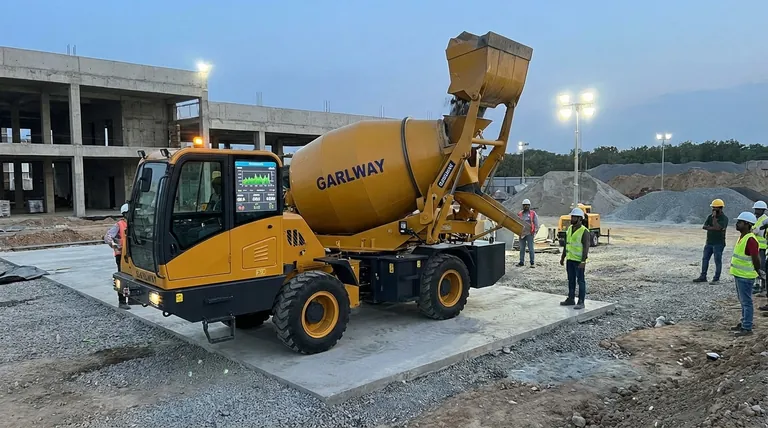
The Anatomy of a Bad Batch
Every construction project rests on a foundation of trust. Trust in materials, trust in measurements, trust in the final structure. A bad batch of concrete undermines that trust completely. It’s more than wasted material; it’s a potential structural flaw, a costly delay, and a blow to a project's integrity.
In the chaotic environment of a job site, how do you guarantee something as fundamental as the right concrete mix? The answer isn't about better guesswork. It's about better systems.
A System, Not a Guess
The genius of a modern self-loading concrete mixer isn't just its ability to mix on-site. It's the ability to act as a precision, mobile batching plant. The secret lies in a simple, powerful engineering principle: isolation.
To achieve a perfect outcome, you must first control each input. The mixer’s weighing system is designed around this single idea. It physically separates the act of measuring from the act of mixing. By ensuring each component is correct before it's combined, the system removes the guesswork that plagues manual or volumetric methods.
The Principle of Pre-Weighing
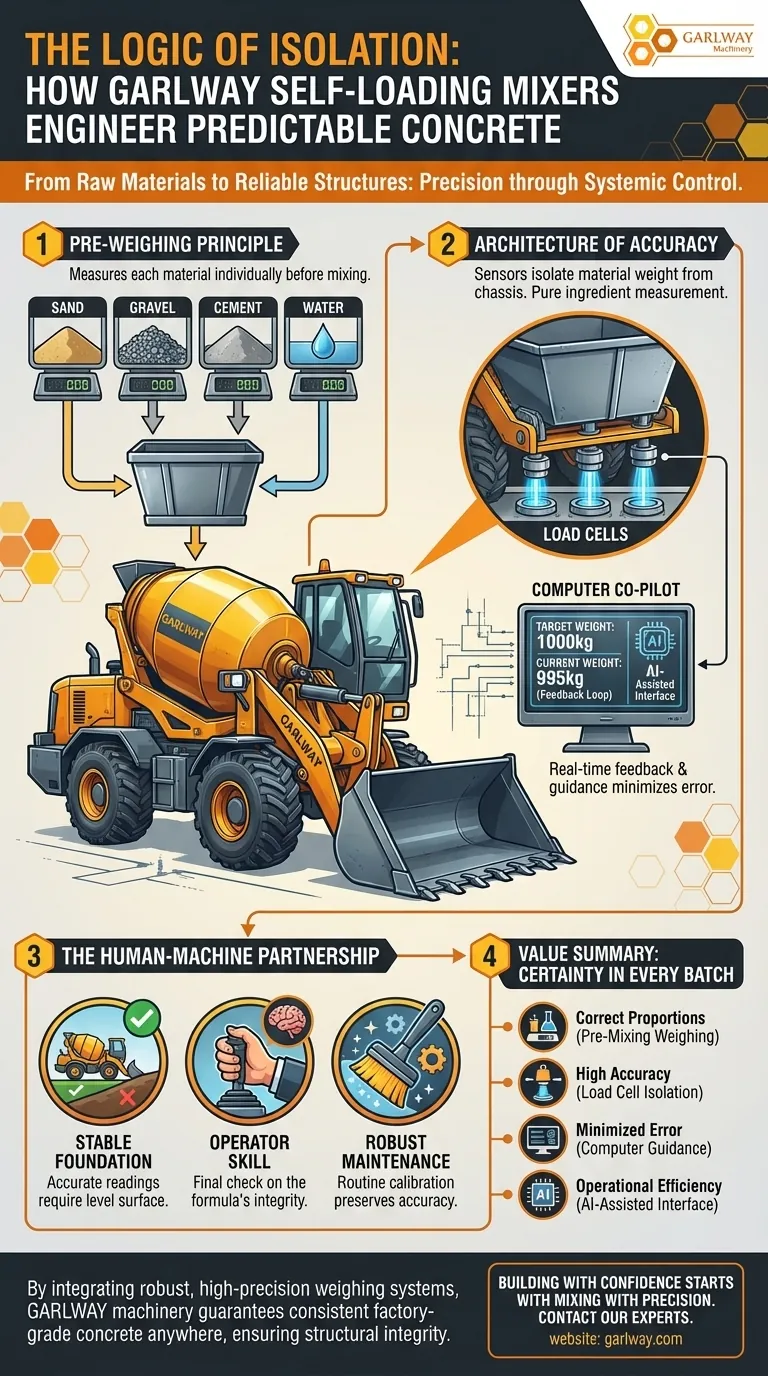
The core mechanism is disarmingly simple. Raw materials—sand, gravel, cement, water—are loaded into the bucket and weighed individually. Only after a component's precise target weight is confirmed does it get tipped into the mixing drum.
This sequential, isolated measurement guarantees that the pre-set formula is respected down to the last kilogram. It's a closed loop of control in an open, unpredictable world.
The Architecture of Accuracy
This process is made possible by a few key components working in concert. It’s a small ecosystem of hardware and software dedicated to one task: getting the numbers right.
Load Cells: The System's Silent Adjudicator
The foundation of the system is a set of high-precision sensors, or load cells. Strategically placed between the loading bucket and the mixer’s chassis, their sole purpose is to measure the downward force exerted by the material in the bucket—and nothing else.
This placement is critical. It isolates the measurement from the weight of the chassis, the drum, and any other external forces, ensuring a pure reading of the ingredient.
The Digital Co-Pilot: Real-Time Feedback
The operator isn't flying blind. A computer control system with a high-definition screen acts as a co-pilot, displaying the target weight and the current weight in real-time.
This creates an immediate feedback loop. The operator can add material with precision, slowing down as they approach the target to avoid overshooting. What used to be an art based on feel is now a science based on data. Some systems even feature an "AI"—an intelligent, user-friendly interface that simplifies the process with clear instructions and on-the-fly diagnostics.
The Human-Machine Partnership
Even the most advanced system is a tool, and its effectiveness depends on the person and the environment it operates in. The pursuit of precision is a partnership between robust engineering and disciplined operation. Several factors can influence the outcome.
The Constant of Gravity vs. The Variable of Ground
Load cells are calibrated to measure vertical force. If the mixer is on a steep incline or unstable ground, that force is distributed unevenly, leading to inaccurate readings. For the system to tell the truth, it must start from a stable, level foundation. Physics is non-negotiable.
The Operator's Final Say
The system provides the data, but the operator controls the input. Skill is still required to load materials smoothly and stop at the precise moment. The machine measures what's in the bucket, making the operator’s diligence the final check on the formula's integrity.
Fighting Entropy with Maintenance
A construction site is a harsh environment. Caked-on concrete, mud, or debris can interfere with the load cells' function. Like any precision instrument, the weighing system requires routine calibration and cleaning to counteract the slow drift of time and wear. This isn't just a chore; it's the act of preserving the system's promise of accuracy.
From Raw Materials to Reliable Structures
Ultimately, a weighing system isn't about numbers on a screen. It's about transforming a variable process into a predictable outcome. It allows contractors to produce factory-grade concrete anywhere, ensuring every batch meets the same exacting standards.
This level of control and consistency is the cornerstone of modern construction. A machine built for this reality, like the self-loading mixers from GARLWAY, is more than just equipment. It's an essential tool for managing risk and guaranteeing quality. By integrating robust, high-precision weighing systems into our machinery, we provide the reliability your projects depend on.
The table below summarizes how this system creates value:
| Key Feature | Function | Benefit |
|---|---|---|
| Pre-Mixing Weighing | Measures each material in the loading bucket before mixing. | Ensures correct proportions for the concrete formula. |
| Load Cell Sensors | Precisely measure weight between the bucket and chassis. | Isolates the material weight for high accuracy. |
| Computer Control | Provides real-time weight data and on-screen guidance. | Minimizes operator error and allows for adjustments. |
| AI-Assisted Interface | Simplifies operation with diagnostics and instructions. | Enhances operational efficiency and reduces downtime. |
Building with confidence starts with mixing with precision. If your projects demand consistent quality and operational efficiency, the right equipment is not an expense—it's an investment in certainty. Contact Our Experts
Visual Guide
Related Products
- Skid Steer Self Loading Concrete Mixers for Construction
- Belle Mixer Drum Self Loading Mortar Mixers JS3000
- Portable Cement Mixer with Lift Concrete Machine
- Portable Ready Mix Concrete Mixer Equipment
- Portable Concrete Mixer Machine Equipment for Mixing Concrete
Related Articles
- The Physics of a Faster Pour: Why Bucket Shape Defines Concrete Mixer Productivity
- Beyond Gravity: The Engineering of a Perfect Concrete Pour
- Beyond the Barrel: The Physics and Psychology of a Perfect Concrete Mix
- The Unseen Engine: How Integrated Mobility Solves Construction's Cognitive Load Problem
- The One-Machine Revolution: Deconstructing the Physics and Psychology of On-Site Concrete Production