The Failure We've All Seen
Picture the scene at any boat ramp on a busy afternoon. A boat, glistening with water, sits halfway on its trailer. The winch, a small metal box on the trailer's post, is groaning. The steel cable is wound tight, vibrating with tension. The owner is cranking a handle with all their might, or worse, the electric motor is emitting a high-pitched whine that signals imminent failure.
This isn't a failure of brute force. It's a failure of understanding.
The owner likely bought the winch based on a single number—its pound rating—believing it was the only metric that mattered. This is a common and dangerous cognitive shortcut. We fixate on the most obvious specification, ignoring the context that gives it meaning. The real problem isn't that the winch is too weak; it's that it may be the wrong tool entirely.
The Deceptive Simplicity of "Boat Winch"
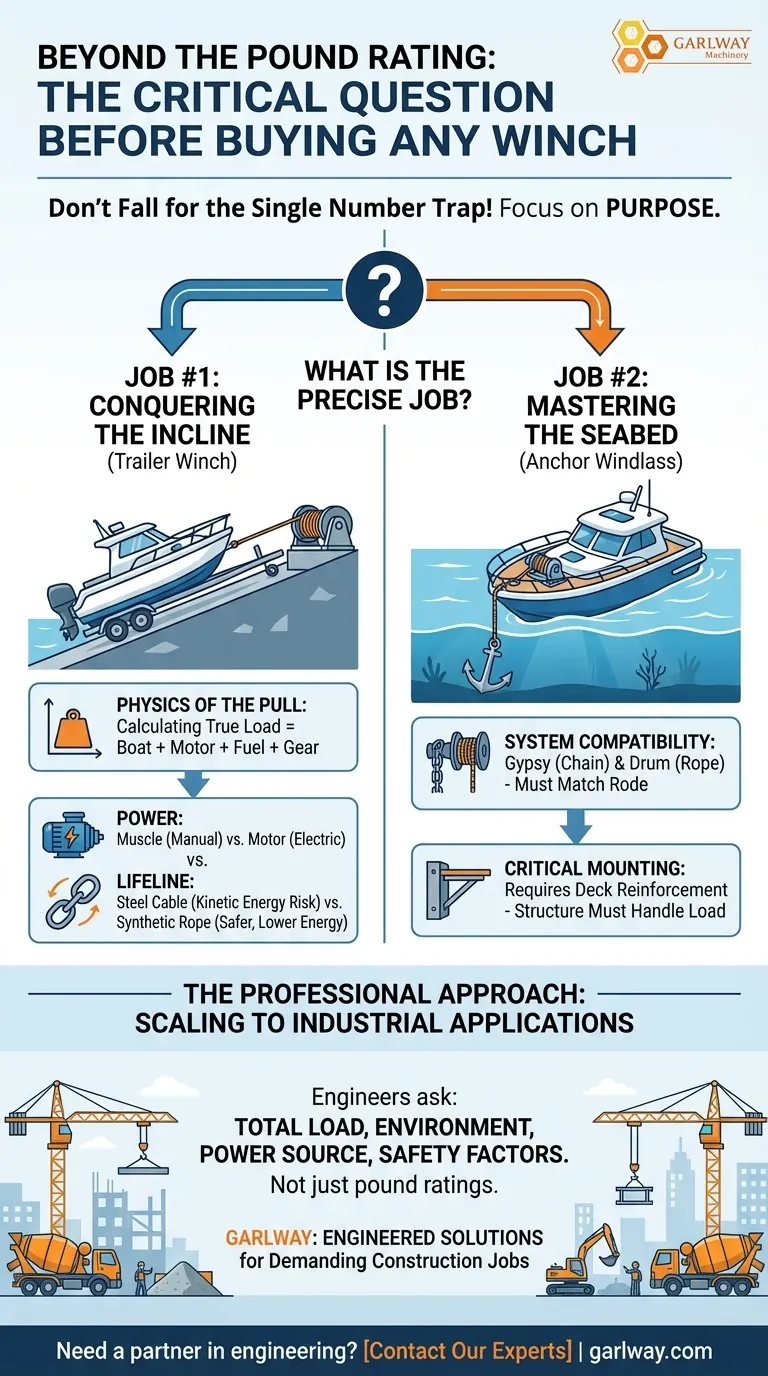
The term "boat winch" creates a psychological trap. It lumps two fundamentally different machines into one category.
- A Trailer Winch: A tool designed to overcome rolling friction and gravity over a short distance to pull a boat onto an inclined trailer.
- An Anchor Windlass: A tool designed to lift a dead weight vertically from the seabed, managing a long length of rope or chain.
Their jobs are as different as a sprinter's and a weightlifter's. Asking one to do the other's job without the right training—or in this case, the right engineering—invites disaster.
Before you look at a single feature, you must answer one question: What is the precise job this machine needs to do?
Job #1: Conquering the Incline (The Trailer Winch)
This is the task most people imagine. Its success hinges on one thing: capacity calculated against a specific physical reality.
The Physics of the Pull: Calculating True Load
The winch isn't lifting your boat; it's pulling it up a ramp. The "rule of thumb" is to choose a winch rated for at least 75% of your boat's total weight.
This isn't just the boat's dry weight. It's a system weight:
- Boat: The manufacturer's listed weight.
- Motor: An often significant addition.
- Fuel: Water is about 8 lbs/gallon; gasoline is about 6 lbs/gallon. A full tank adds up.
- Gear: Everything you keep on board, from coolers to safety equipment.
Under-specifying this is a bet against physics. It’s a bet you will eventually lose.
Power: Muscle vs. Motor
- Manual Winch: Simple, reliable, and requires no power. For smaller boats, it is an elegant solution. Its limit is your physical strength and patience.
- Electric Winch: Transforms the task from a physical struggle into a process of control. It's not about laziness; it's about safety and repeatable, smooth operation, especially with larger vessels.
The Lifeline: Steel vs. Synthetic
This choice is a direct reflection of your attitude toward risk.
- Steel Cable: Traditional and durable. Its great weakness is how it stores kinetic energy. If it snaps under extreme load, it becomes a devastating projectile.
- Synthetic Rope: Lighter and stronger for its diameter. Crucially, it stores far less energy. If it fails, it tends to fall to the ground rather than whipping back. It is the modern, safer choice.
Job #2: Mastering the Seabed (The Anchor Windlass)
If your job is anchoring, the entire decision-making process changes. You are no longer thinking about incline, but about deadlift capacity and system integration.
A System, Not Just a Motor
The primary factor for a windlass is its compatibility with your anchor rode (the line connecting the anchor to the boat).
- Gypsy: A special notched wheel designed to grip the links of a chain.
- Drum: A smooth cylinder for winding rope.
Using the wrong one is like trying to use a screwdriver as a hammer. It might work for a moment, but failure is inevitable. The windlass must be matched perfectly to the type and size of your rode.
The Critical Question of Mounting
A trailer winch bolts onto a dedicated post. An anchor windlass puts immense strain directly onto your boat's deck. You must consider not just where it fits, but whether the structure beneath can handle the load. This often requires reinforcing the deck—an engineering task in itself.
The Mental Model That Scales: From Boats to Buildings
This process of forensic questioning—defining the job before choosing the tool—is what separates amateurs from professionals. The scenario at the boat ramp is a perfect microcosm of the high-stakes decisions made on construction sites every day.
When engineers select a winch for a construction project, they don't start with a catalog of pound ratings. They start with questions:
- What is the total load, including dynamic forces?
- What is the operational environment—is it dusty, wet, or corrosive?
- What is the power source, and how reliable is it?
- What are the safety factors and failure modes we must account for?
This is the world of industrial machinery, where a miscalculation doesn't just mean a frustrating afternoon, but can result in catastrophic financial and human cost. It's why specialists like GARLWAY don't just sell equipment; they provide engineered solutions. Their winches, concrete mixers, and batching plants are built not just to be strong, but to be right for the specific, demanding jobs of global construction contractors.
The lesson from the struggling boater is universal. The right tool is never just about power; it's about purpose. Whether you're securing a small boat or a critical component on a work site, start by ignoring the specifications and defining the job.
For industrial applications where precision and reliability are non-negotiable, you need more than a product—you need a partner in engineering. Contact Our Experts
Visual Guide
Related Products
- Warn Winch Windlass Boat Trailer Winch
- Electric and Hydraulic Winch for Heavy Duty Applications
- Small Electric Winch 120V and 240V for Compact Applications
- 12000 lb Electric Boat Trailer Winch with Windlass Anchor Warn
- Quick Windlass Portable Winch for Truck and Boat Best Boat Winch
Related Articles
- Beyond the Bumper: The Critical System Choice in Powering Your Trailer Winch
- Force vs. Mass: The Critical Difference in Sizing a Boat Winch
- Lines of Force: The Unseen Geometry of a Boat Winch
- More Than a Number: The Engineering Psychology of Choosing a Boat Winch
- How to Choose and Optimize Winch Speed for Maximum Efficiency