A Moment of Truth on the Job Site
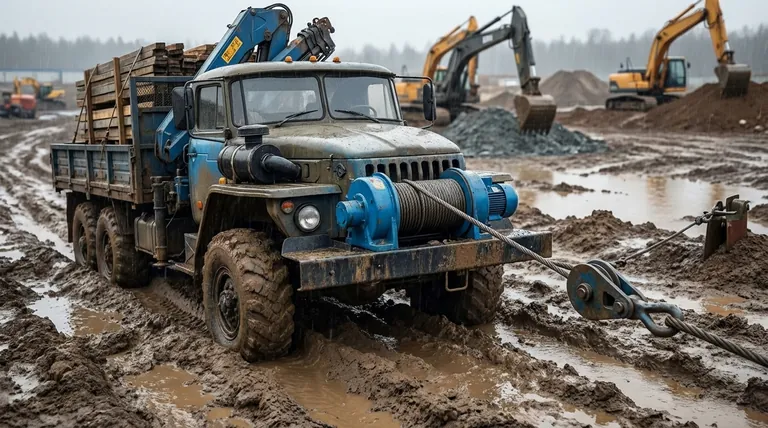
A heavy-duty truck, loaded with materials, sits motionless. An unexpected downpour has turned the access road into a quagmire. The wheels spin uselessly, digging deeper. On a construction site, this isn't an inconvenience; it's a cascade of costly delays. The entire project is held hostage by a few feet of mud.
This is the moment when a winch transforms from a piece of equipment into the singular tool that stands between progress and paralysis. But its effectiveness depends entirely on a decision made weeks or months earlier in an office, not in the field.
That decision often starts with a simple, reassuringly neat formula. And that's the problem.
The Allure of the Simple Formula
The industry standard for selecting a winch is beautifully straightforward: take your vehicle's Gross Vehicle Weight Rating (GVWR) and multiply it by 1.5.
- GVWR: The maximum safe operating weight of your vehicle, including its chassis, fuel, passengers, and all cargo. You can find it on a sticker in the driver-side door jamb.
- The 1.5x Multiplier: This accounts for the baseline resistance a vehicle encounters when it’s not rolling freely.
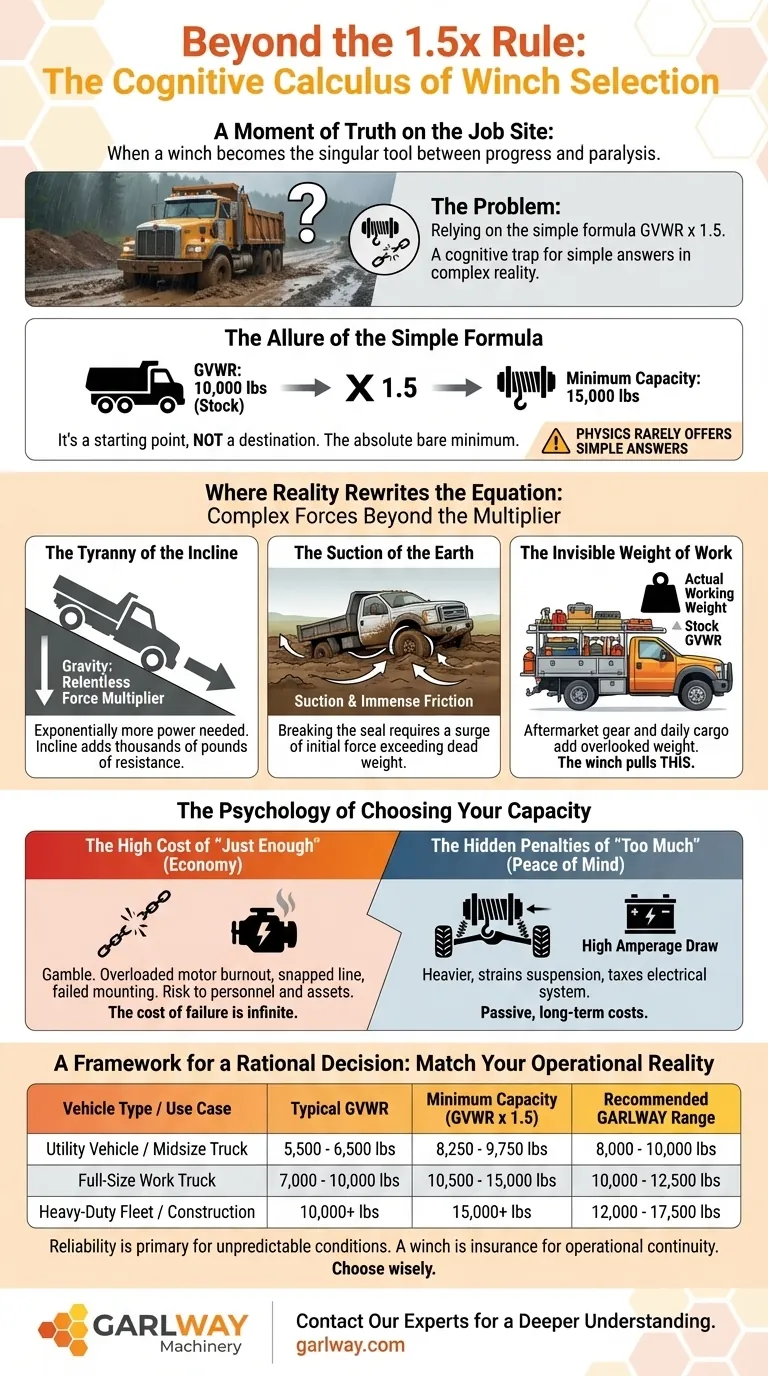
For a truck with a GVWR of 10,000 lbs, the calculation suggests a minimum winch capacity of 15,000 lbs. It’s a clean number. It feels definitive. But in reality, it's the absolute bare minimum—a starting point, not a destination. Relying on it alone is a cognitive trap. We crave simple answers, but physics rarely offers them.
Where Reality Rewrites the Equation
The forces at play in a real-world recovery effort are far more complex and unforgiving than a simple multiplier can capture. The baseline formula assumes a gentle, straight pull on flat, firm ground. The field is never that kind.
The Tyranny of the Incline
Gravity is a relentless force multiplier. Winching a vehicle up a slope requires exponentially more power than pulling it across a level surface. The gentle incline of a service ramp or a ditch wall can easily add thousands of pounds of effective resistance, pushing a seemingly adequate winch past its breaking point.
The Suction of the Earth
A vehicle stuck in deep mud or wet sand isn't just heavy; it's being held by suction and immense friction. The mud creates a vacuum effect around the tires and undercarriage. Breaking this seal requires a surge of initial force that can far exceed the vehicle's dead weight. The 1.5x multiplier provides a buffer, but it may not account for a vehicle buried to its frame.
The Invisible Weight of Work
The GVWR is a stock figure. A work truck is never stock. Aftermarket bumpers, toolboxes, racks, and the day's cargo add hundreds, if not thousands, of pounds. This "actual working weight" is what the winch must pull, yet it's often overlooked in favor of the cleaner, official GVWR number on the door sticker.
The Psychology of Choosing Your Capacity
The decision isn't just about math; it's about risk management and understanding our own biases.
The High Cost of "Just Enough"
Choosing an undersized winch is often driven by a desire for economy. It feels like a savvy cost-saving measure. In reality, it’s a gamble. An overloaded winch motor can burn out, a line can snap, or a mounting point can fail catastrophically. The failure not only jeopardizes the recovery but puts personnel and expensive assets at risk. The cost of "just enough" becomes infinite the moment it fails.
The Hidden Penalties of "Too Much"
The opposite impulse—to buy the biggest winch available for ultimate peace of mind—also has consequences. A vastly oversized winch is heavier, placing constant strain on the vehicle's front suspension. It draws significantly more amperage, taxing the electrical system. It's a solution that carries its own set of passive, long-term costs.
A Framework for a Rational Decision
The right winch isn't the one that meets a formula. It's the one that matches your operational reality. Start with the baseline, then honestly assess your most common and worst-case scenarios.
| Vehicle Type / Use Case | Typical GVWR | Minimum Capacity (GVWR x 1.5) | Recommended GARLWAY Range |
|---|---|---|---|
| Utility Vehicle / Midsize Truck | 5,500 - 6,500 lbs | 8,250 - 9,750 lbs | 8,000 - 10,000 lbs |
| Full-Size Work Truck | 7,000 - 10,000 lbs | 10,500 - 15,000 lbs | 10,000 - 12,500 lbs |
| Heavy-Duty Fleet / Construction | 10,000+ lbs | 15,000+ lbs | 12,000 - 17,500 lbs |
This table provides a more grounded starting point. For construction companies and contractors, where conditions are unpredictable and downtime is unacceptable, reliability is the primary concern. A winch isn't just a recovery tool; it's insurance for operational continuity.
Choosing the right winch is an investment in safety, efficiency, and preparedness. It requires moving beyond simple formulas to a deeper understanding of the forces your equipment will face. We can help you navigate that complexity. Contact Our Experts
Visual Guide
Related Products
- Warn Winch Windlass Boat Trailer Winch
- Electric and Hydraulic Winch for Heavy Duty Applications
- Small Electric Winch 120V and 240V for Compact Applications
- 12000 lb Electric Boat Trailer Winch with Windlass Anchor Warn
- Quick Windlass Portable Winch for Truck and Boat Best Boat Winch
Related Articles
- Beyond the Bumper: The Critical System Choice in Powering Your Trailer Winch
- Force vs. Mass: The Critical Difference in Sizing a Boat Winch
- Lines of Force: The Unseen Geometry of a Boat Winch
- More Than a Number: The Engineering Psychology of Choosing a Boat Winch
- How to Choose and Optimize Winch Speed for Maximum Efficiency