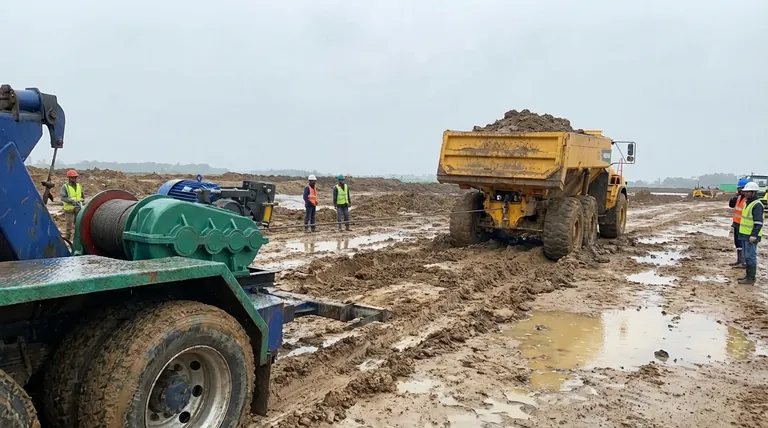
The Anatomy of a Critical Failure
Imagine a fully-loaded dump truck, its wheels sunk deep in the rain-softened soil of a construction site. The entire workflow grinds to a halt. Every minute of delay costs money, pushing deadlines and straining resources. In this moment, the winch mounted on your recovery vehicle is not just a tool; it is the critical node that determines whether this is a minor hiccup or a catastrophic, day-long shutdown.
Choosing that winch, months before this predictable crisis, was the real test. And the decision rested on more than just picking the biggest number in a catalog. It required a disciplined understanding of physics and an awareness of common psychological traps.
First Principles: Calculating Necessary Force
The foundation of any correct winch selection is a simple, non-negotiable calculation. It's the engineering equivalent of "measure twice, cut once."
The Deceptive Simplicity of GVWR
First, you must know the Gross Vehicle Weight Rating (GVWR) of your machine. This isn't just the curb weight; it's the maximum operating weight specified by the manufacturer, including the chassis, attachments, fuel, and operator. For a construction vehicle, this is your baseline reality.
The 1.5x Multiplier: A Rule Forged by Physics
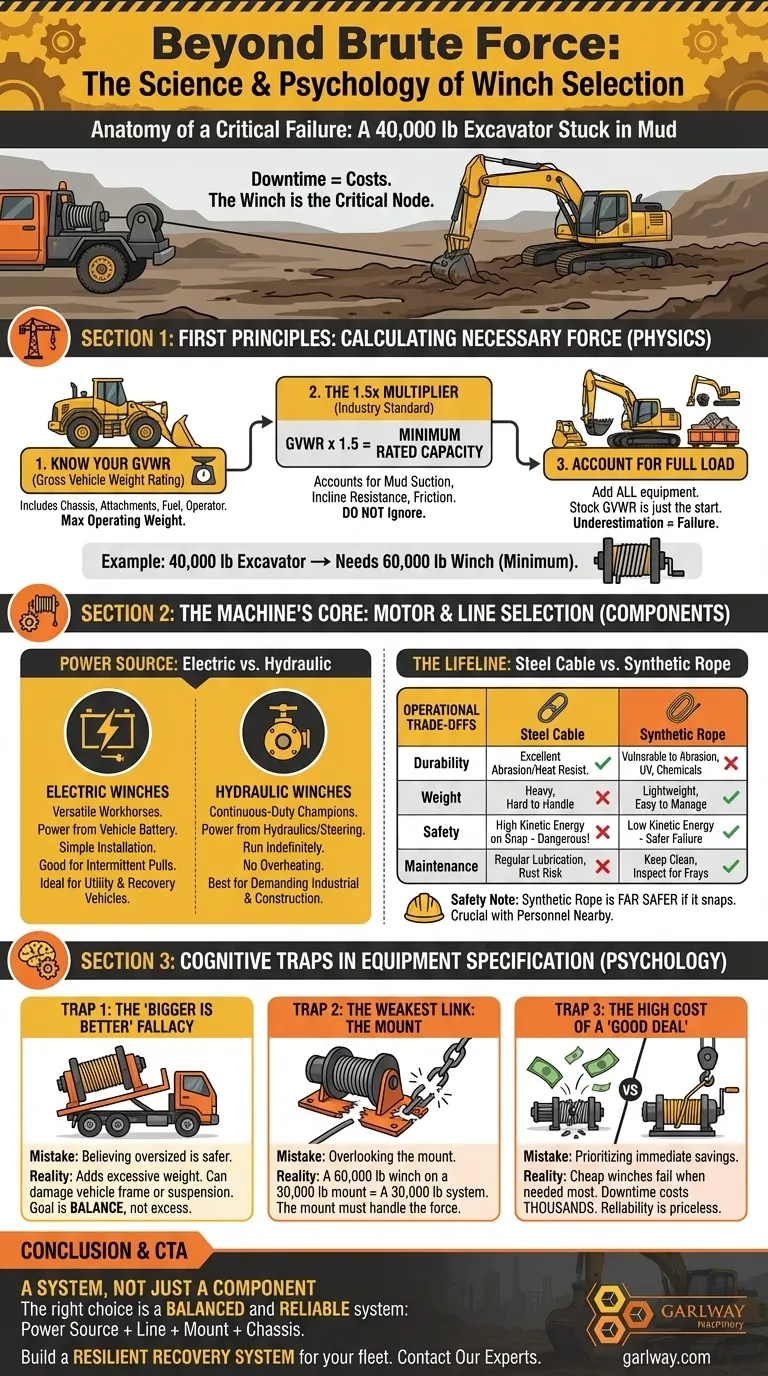
The industry standard is to select a winch with a rated capacity of at least 1.5 times the GVWR. A 40,000-pound excavator doesn't need a 40,000-pound winch; it needs a 60,000-pound winch, minimum.
This multiplier isn’t arbitrary padding. It is a sober acknowledgment of unseen forces. It accounts for the immense suction of mud, the resistance of pulling a dead weight up an incline, and the simple friction of a machine that does not want to move. Ignoring this multiplier is betting against physics.
Accounting for the Full Load
Stock GVWR is only the starting point. Construction equipment is rarely "stock." Buckets, hammers, rippers, and cargo add significant weight. You must calculate the vehicle's true operational weight before applying the 1.5x rule. Underestimation is the first step toward failure.
The Machine's Core: Motor and Line Selection
With the minimum required force established, the focus shifts to the components that deliver it. This choice dictates the winch's performance, safety, and lifespan under job-site conditions.
The Power Source: Electric vs. Hydraulic
-
Electric Winches: These are the versatile workhorses, drawing power from the vehicle's electrical system. They are simpler to install and ideal for a wide range of applications, providing powerful, intermittent pulling. They represent the go-to solution for many utility and recovery vehicles.
-
Hydraulic Winches: For heavy-duty, continuous-duty cycles, hydraulic winches are the undisputed champions. They tap into the vehicle's power steering or a dedicated hydraulic pump, allowing them to run indefinitely without the risk of overheating. In demanding industrial or construction environments where the winch is a primary tool, hydraulics are often the only professional choice.
The Lifeline: Steel Cable vs. Synthetic Rope
The choice of line is a direct trade-off between raw durability and operational safety.
| Feature | Steel Cable | Synthetic Rope |
|---|---|---|
| Durability | Excellent resistance to abrasion & heat. | Vulnerable to abrasion, chemicals, and UV damage. |
| Weight | Heavy and can be difficult to handle. | Extremely lightweight and easy to manage. |
| Safety | Stores immense kinetic energy; dangerous if it snaps. | Stores very little energy; far safer if it fails. |
| Maintenance | Requires regular lubrication to prevent rust. | Must be kept clean and inspected for frays. |
On a debris-strewn construction site, steel's resilience is a major advantage. However, in any environment with personnel nearby, the safety benefits of synthetic rope cannot be overstated.
Cognitive Traps in Equipment Specification
The biggest mistakes in winch selection are often rooted in human psychology, not technical miscalculation.
The "Bigger is Better" Fallacy
There's a natural inclination to believe that an oversized winch is a safer winch. This is wrong. An unnecessarily large winch adds immense weight to the front of a vehicle, negatively impacting its suspension and handling. More critically, it can generate forces that exceed what the vehicle's frame or mounting structure was designed to withstand, turning the mount into the point of failure. The goal is balance, not excess.
The Weakest Link: The Psychology of the Mount
We tend to focus on the active component—the winch motor—while overlooking the passive one: the mount. A 60,000-pound winch on a mounting plate rated for 30,000 pounds is a 30,000-pound winch. A powerful winch is useless if the structure it's bolted to rips away from the vehicle.
The High Cost of a "Good Deal"
A winch is a critical piece of safety and recovery equipment. On a construction project, downtime is measured in thousands of dollars per hour. A low-cost winch that fails during its first critical use is infinitely more expensive than a reliable, high-quality unit that performs every time. It's a classic case of prioritizing a small, immediate saving over the mitigation of a massive, long-term risk.
A System, Not Just a Component
A winch is not an isolated accessory. It is an integrated system comprising the power source, the line, the mount, and the vehicle's chassis. The right choice is not the strongest or the cheapest, but the one that creates a balanced and reliable system.
For equipment designed to meet the rigorous demands of modern construction, where reliability is non-negotiable, a correctly specified winch is paramount. GARLWAY specializes in industrial-grade winches and construction machinery engineered for these exact scenarios, ensuring that you have the right force when you need it most.
If you are ready to build a truly resilient recovery system for your fleet, Contact Our Experts.
Visual Guide
Related Products
- Warn Winch Windlass Boat Trailer Winch
- Electric and Hydraulic Winch for Heavy Duty Applications
- Small Electric Winch 120V and 240V for Compact Applications
- 12000 lb Electric Boat Trailer Winch with Windlass Anchor Warn
- Quick Windlass Portable Winch for Truck and Boat Best Boat Winch
Related Articles
- Beyond the Bumper: The Critical System Choice in Powering Your Trailer Winch
- Force vs. Mass: The Critical Difference in Sizing a Boat Winch
- Lines of Force: The Unseen Geometry of a Boat Winch
- More Than a Number: The Engineering Psychology of Choosing a Boat Winch
- How to Choose and Optimize Winch Speed for Maximum Efficiency





