We are psychologically drawn to big numbers. A 12,000-pound rating feels objectively better than a 9,500-pound one. It suggests more power, more capability, and a greater margin of safety.
But in the world of engineering and high-stakes operations, the most important number is often the one we overlook. When selecting a winch, the headline capacity is where the conversation starts, but it's the last place a professional should look. The real decision hinges on a question of fundamental physics.
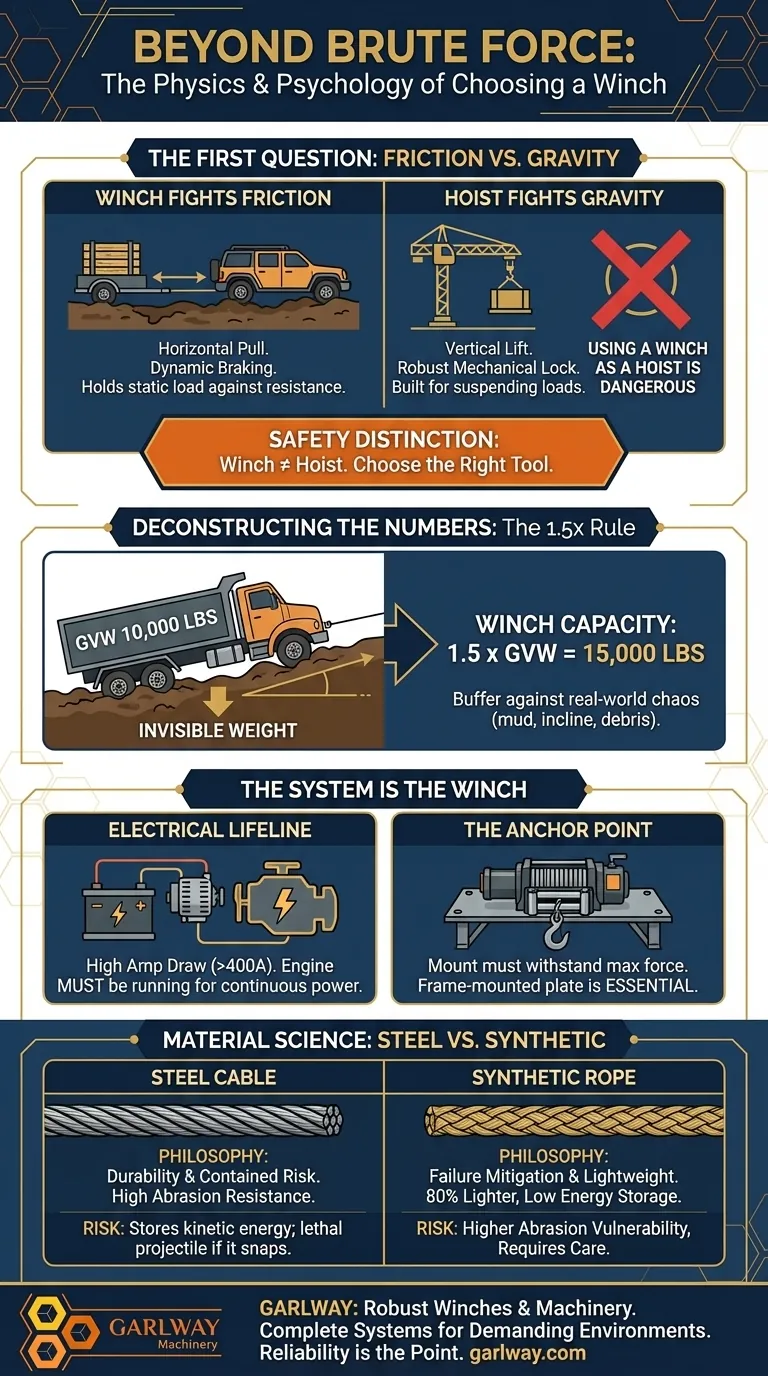
The First Question: Are You Fighting Friction or Gravity?
Before you calculate a single pound of force, you must answer one question: are you pulling something horizontally, or are you lifting it vertically?
This isn't a semantic detail; it's the most critical safety distinction you can make. It defines the boundary between two entirely different tools: the winch and the hoist.
- A Winch Fights Friction. It is designed to drag a load across a surface. Its braking system is dynamic, engineered to hold a static load against rolling or sliding resistance.
- A Hoist Fights Gravity. It is designed to lift, suspend, and lower a load. Its braking system is far more robust, a mechanical lock built with the assumption that failure means a catastrophic fall.
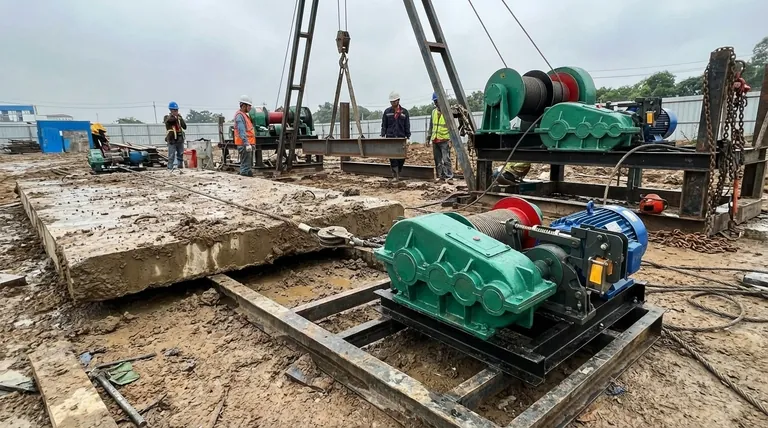
Using a winch as a hoist is like using a car's parking brake to stop it on the highway. It fundamentally misunderstands the forces at play and invites disaster. For any construction site application involving vertical lifting, the only answer is a dedicated hoist.
Deconstructing the Numbers: A Buffer Against Chaos
Once you've confirmed you need a winch, the numbers come into play. For vehicle recovery, the rule of thumb is a capacity of 1.5 times the vehicle's Gross Vehicle Weight (GVW).
This isn't an arbitrary multiplier. It's a calculated admission that the real world is messy.
A 10,000-pound truck doesn't weigh 10,000 pounds when it's buried up to its axles in wet clay. The suction of the mud, the angle of the incline, the resistance of debris—these forces add "invisible weight." The 1.5x factor is a buffer against the chaos of reality, ensuring you have the power not just to move the vehicle, but to overcome the environment itself.
The System is the Winch, Not the Motor
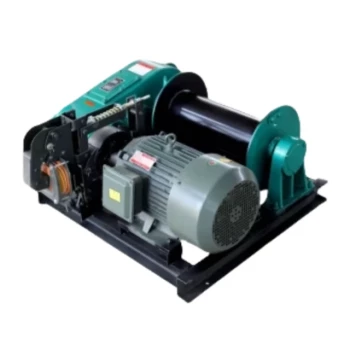
A winch is not a self-contained object. It is the heart of a system, and its performance is dictated by the weakest link in that system. A powerful motor is useless if the system supporting it fails.
The Electrical Lifeline
An electric winch under load can draw over 400 amps from a vehicle's electrical system. This is an immense strain. A weak battery or an inadequate alternator won't just result in a slow pull; it can lead to a stalled winch at the most critical moment.
The engine must always be running during a winching operation. This isn't just about preventing a dead battery; it's about supplying the continuous power the winch motor demands to operate within its design specifications.
The Anchor Point
A 12,000-pound winch is only a 12,000-pound winch if it's mounted to something that can withstand 12,000 pounds of force. Bolting it to a thin bumper or an unreinforced part of a vehicle's body is a recipe for failure.
The mount is a non-negotiable part of the winch system. For industrial applications, this means a purpose-built, frame-mounted steel plate or bumper. The winch is merely a component; the mount is its foundation.
Material Science as a Safety Philosophy
The choice between steel cable and synthetic rope is more than a matter of preference. It's a choice between two different philosophies of risk management.
| Rope Type | Philosophy & Characteristics |
|---|---|
| Steel Cable | Durability & Contained Risk. It's incredibly resistant to abrasion and UV light. However, it stores tremendous kinetic energy. If it snaps, it becomes a lethal projectile. |
| Synthetic Rope | Failure Mitigation & Lightweight Safety. It's 80% lighter and stores far less energy. If it fails, it simply falls to the ground. The trade-off is a higher vulnerability to abrasion and a need for more diligent care. |
For many modern construction and recovery operations, the safety advantage of synthetic rope is becoming the deciding factor.
Choosing Your Tool
Ultimately, selecting the right winch is an exercise in foresight. It requires looking past the single, seductive number on the box and analyzing the entire operational environment. It means respecting the physics of the task and understanding the psychology of being in a situation where you need that tool to work flawlessly.
At GARLWAY, we provide robust winches and machinery engineered as complete systems, designed for the demanding environments of construction sites and industrial projects. We understand that reliability is not a feature; it is the entire point.
When you're ready to build a system based on sound engineering principles rather than just numbers, we can help you specify the right tool for the job. Contact Our Experts
Visual Guide
Related Products
- Warn Winch Windlass Boat Trailer Winch
- Electric and Hydraulic Winch for Heavy Duty Applications
- Small Electric Winch 120V and 240V for Compact Applications
- 12000 lb Electric Boat Trailer Winch with Windlass Anchor Warn
- Quick Windlass Portable Winch for Truck and Boat Best Boat Winch
Related Articles
- Beyond the Bumper: The Critical System Choice in Powering Your Trailer Winch
- Force vs. Mass: The Critical Difference in Sizing a Boat Winch
- Lines of Force: The Unseen Geometry of a Boat Winch
- More Than a Number: The Engineering Psychology of Choosing a Boat Winch
- How to Choose and Optimize Winch Speed for Maximum Efficiency