
Relying solely on your trailer winch to secure your boat is a critical mistake. A winch is engineered to pull a boat onto a trailer, not to restrain the immense and unpredictable forces of road transport. Under sudden braking, the winch strap can stretch or snap, and its internal gears are not designed to handle the violent, jarring shock loads of a moving vehicle.
Your trailer winch is a pulling tool, not a securing device. True safety on the road comes from using dedicated tie-downs, like a bow safety chain or turnbuckle, that are designed to handle the multi-directional forces of transport.
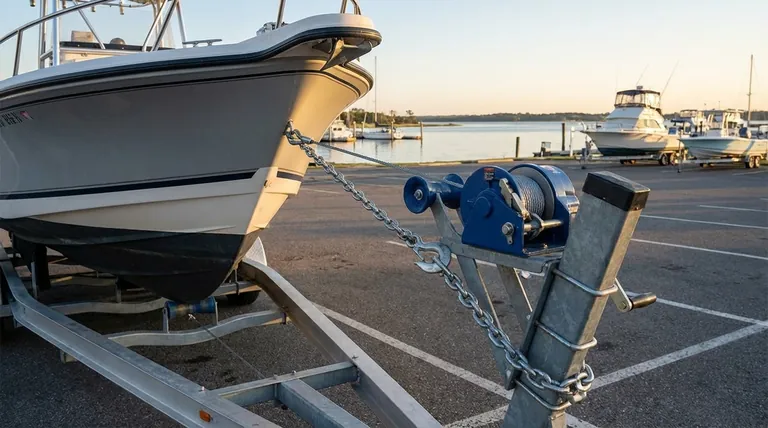
The Critical Difference: Pulling vs. Securing
To understand why the winch is insufficient, you must first distinguish between the task it was designed for and the task you are asking it to do. These two functions involve completely different types of force.
Your Winch's Primary Job
A winch uses a system of gears to provide a mechanical advantage for a single, specific task: pulling your boat up the trailer bunks with a slow, steady, and predictable force. It is exceptionally good at this job.
The Demands of Road Transport
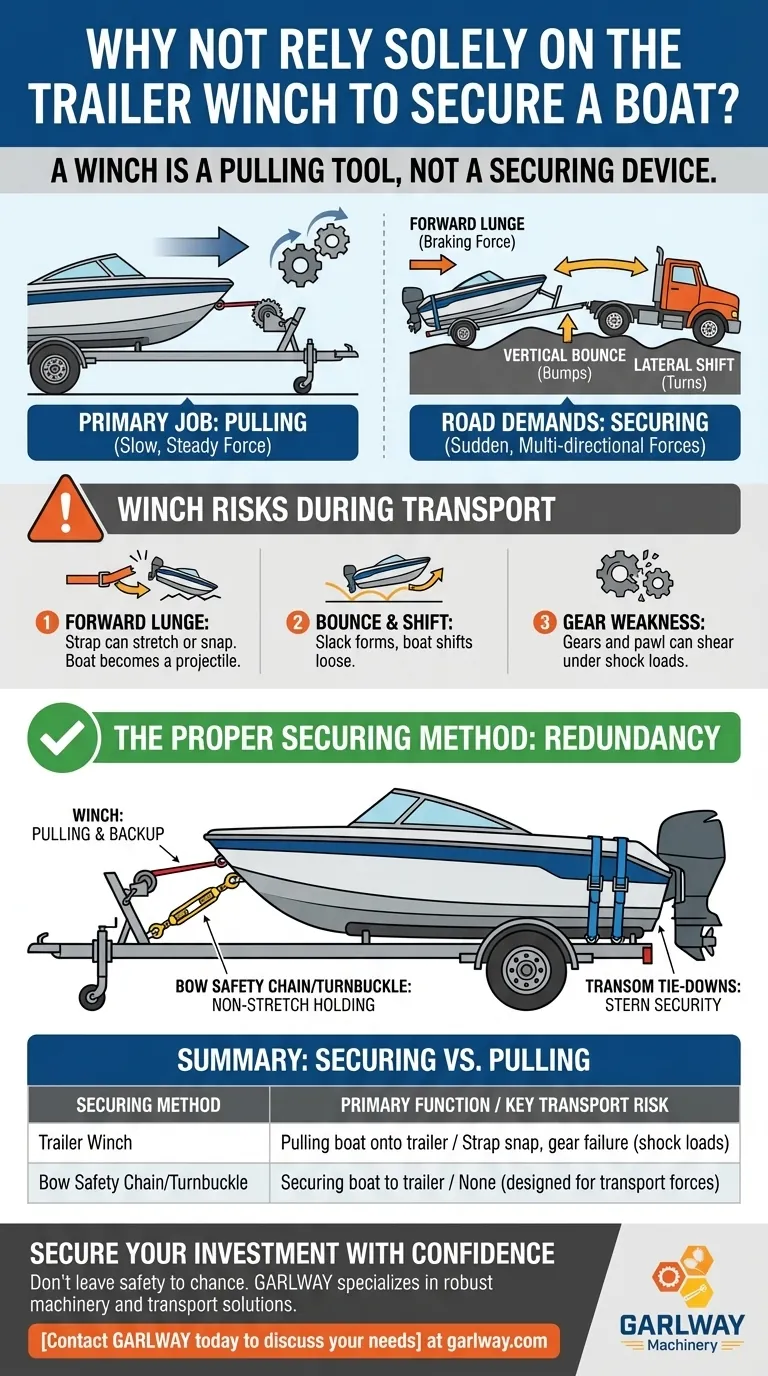
Securing a boat for transport involves managing dynamic, multi-directional forces. Your boat will be subjected to forward lunges during braking, vertical bouncing over bumps, and lateral shifting during turns. These forces are sudden, powerful, and far exceed the steady pulling force a winch is built to handle.
The Forces Your Winch Can't Handle
Relying on the winch pawl (the small metal piece that clicks to prevent the strap from unspooling) and the strap itself is asking for failure. These components are the weakest link in the system when faced with road forces.
The Risk of Forward Lunge
During a sudden stop, the entire mass of your boat wants to continue moving forward due to inertia. This creates an immense shock load on the winch post. A winch strap, especially a nylon one, will stretch under this load. In a worst-case scenario, it can snap, or the shock can shear the winch pawl, turning your boat into a projectile aimed at your tow vehicle.
The Problem of "Bounce and Shift"
Every bump in the road can cause the boat to lift slightly off its bunks. This momentary lift creates slack in the winch strap. When the boat settles back down, it may not be in the exact same position, allowing it to shift over time and work the winch strap loose.
The Weakness of Winch Gears
The gears and the locking pawl inside a winch are designed to hold against the steady load of the boat's weight on an incline. They are not engineered to absorb the thousands of pounds of sudden, jarring force from an emergency braking maneuver. Consistently using it for this purpose can cause premature wear and catastrophic failure.
The Proper Method for Securing the Bow
The correct way to secure the bow is to supplement the winch with a device made specifically for holding, not pulling. This ensures the boat and trailer move as a single, unified mass.
The Bow Safety Chain or Turnbuckle
The industry standard for safety is to use a separate, non-stretch connection from the boat's bow eye directly to the trailer frame or winch post. The best tools for this are a heavy-duty safety chain or, even better, a turnbuckle.
How It Works
A turnbuckle or tightly secured chain removes all slack and prevents any forward motion. It effectively triangulates the bow, locking it firmly to the trailer. This secondary device takes the entire securing load, allowing the winch strap to simply act as a redundant backup.
Making the Right Choice for Your Boat
Securing your boat properly only takes a few extra moments and is the most important thing you can do to ensure a safe trip. Your approach should be based on creating a redundant and robust system.
- If your primary focus is maximum safety: Use a heavy-duty turnbuckle to connect the bow eye directly to the trailer frame, in addition to snugging the winch strap and using two separate transom straps to secure the stern.
- If you need a reliable and effective solution: A short, heavy-duty safety chain pulled tight between the bow eye and trailer is a non-negotiable minimum to back up the winch.
- For every single trip: Always perform a pre-flight check—confirming the winch is snug, the bow safety chain is tight, and the transom tie-downs are secure before you pull away.
Taking these simple steps ensures that the forces of the road are managed by equipment designed for the task, protecting your boat, your vehicle, and everyone else on the road.
Summary Table:
| Securing Method | Primary Function | Key Risk When Used for Transport |
|---|---|---|
| Trailer Winch | Pulling boat onto trailer | Strap can snap or stretch; gears can fail under shock loads |
| Bow Safety Chain/Turnbuckle | Securing boat to trailer | None when used correctly; designed for multi-directional forces |
Secure Your Investment with Confidence
Don't leave your boat's safety to chance. GARLWAY specializes in robust construction and machinery solutions, including winches and transport equipment designed for demanding applications. Our expertise ensures your assets are protected from the workshop to the worksite.
Let us help you build a safer, more reliable transport system. Contact GARLWAY today to discuss your specific needs and discover the right equipment for your operation.
Visual Guide
Related Products
- 12000 lb Electric Boat Trailer Winch with Windlass Anchor Warn
- Portable Small Trailer Winch
- Best 18000 Pound Drum Anchor Trailer Winch
- Warn Winch Windlass Boat Trailer Winch
- Quick Windlass Portable Winch for Truck and Boat Best Boat Winch
People Also Ask
- How does an electric boat trailer winch differ from a manual one? Effort vs. Control Explained
- What size winch do I need for my boat? Get the Right Capacity for Safe Hauling
- How should a boat trailer winch be properly used? A Step-by-Step Guide for Safe Loading
- What maintenance steps are specific to boat trailer winches? Ensure Safety & Reliability at the Ramp
- How strong of a winch do I need for my boat? Get the Right Pulling Power for Trailering & Anchoring





