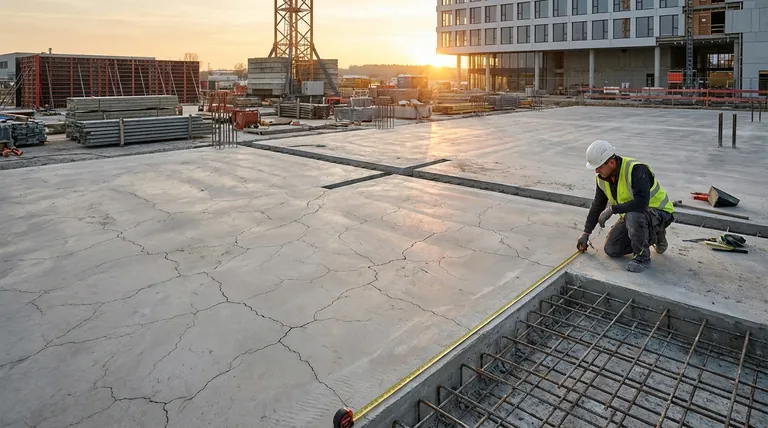
In all concrete construction, shrinkage is an unavoidable physical reality. As newly placed concrete cures and dries, it naturally reduces in volume. This change creates internal tensile stresses, and when these forces exceed the concrete's strength, it cracks. These cracks can impact the structure's durability, water-tightness, and aesthetic appearance.
The core challenge in construction is not to eliminate shrinkage, but to control the cracking it inevitably causes. Effective engineering turns a few large, unpredictable cracks into a distributed network of fine, manageable cracks, or it pre-determines their location through planned joints.
The Root Cause: Why Concrete Shrinks
To manage shrinkage, we must first understand its origins. The phenomenon is not a single process but a combination of factors, with one being the most significant driver of long-term effects.
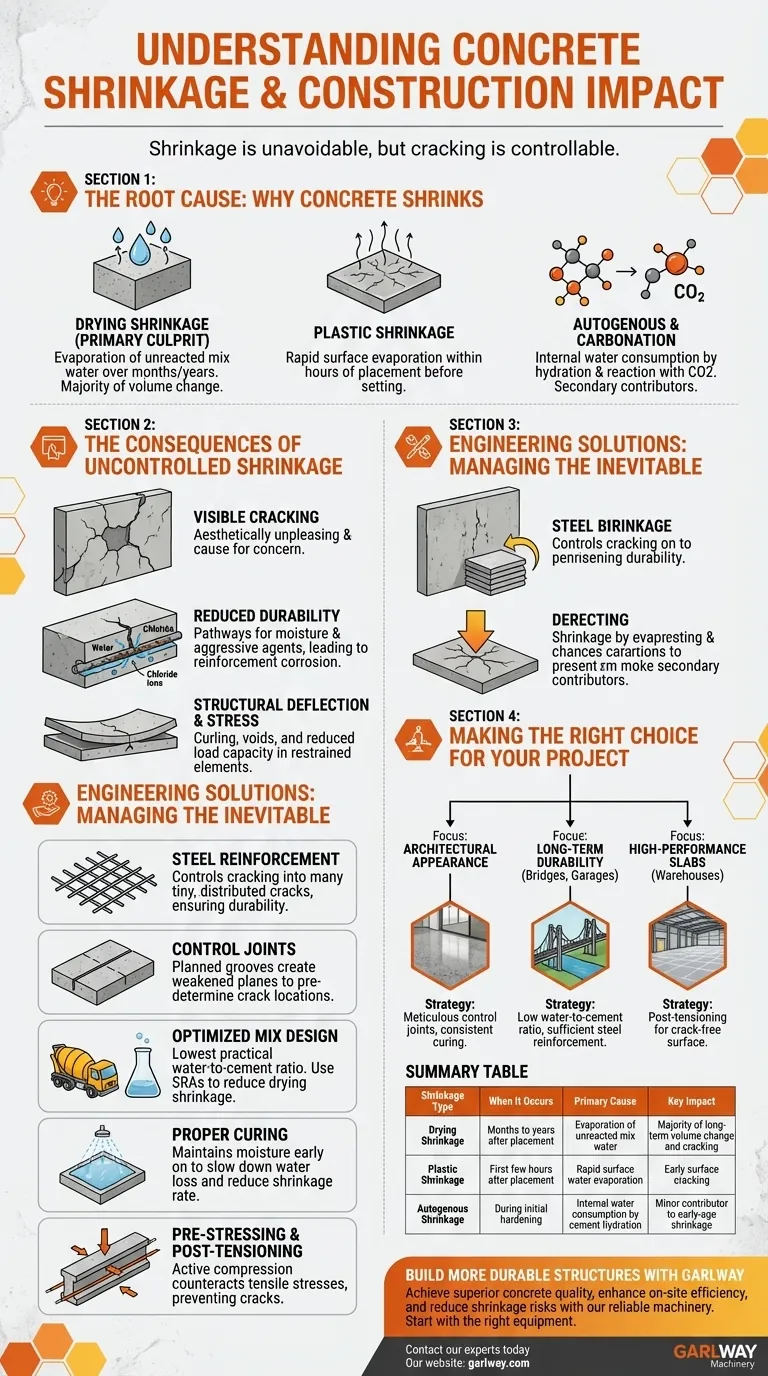
Drying Shrinkage (The Primary Culprit)
Drying shrinkage is responsible for the majority of volume change in hardened concrete. It occurs as the mix water that was not consumed in the chemical hydration process gradually evaporates from the concrete over months or even years.
Plastic Shrinkage
This type of shrinkage happens within the first few hours after concrete is placed, while it is still in a plastic or semi-hardened state. If surface water evaporates faster than it can be replaced by bleed water rising from below, rapid cracking can occur on the surface.
Autogenous and Carbonation Shrinkage
These are secondary contributors. Autogenous shrinkage is a result of the chemical reaction of cement and water itself, consuming water internally. Carbonation shrinkage is a very slow process caused by a chemical reaction with carbon dioxide in the air.
The Consequences of Uncontrolled Shrinkage
Failing to account for shrinkage can have significant negative effects on a structure's performance and service life.
Visible Cracking
The most obvious consequence is the formation of cracks. These can be aesthetically unpleasing and a source of concern for owners, even when they are not structurally significant.
Reduced Durability
Cracks act as direct pathways for moisture, chlorides, and other aggressive agents to penetrate the concrete. This can lead to the corrosion of steel reinforcement, which is the primary cause of long-term concrete deterioration.
Structural Deflection and Stress
In slabs-on-ground, uncontrolled shrinkage can cause the edges and corners to curl upwards. This curling creates voids beneath the slab, leading to cracking when heavy loads are applied. In restrained elements, shrinkage induces tensile stresses that can reduce the component's load-carrying capacity.
Engineering Solutions: Managing the Inevitable
Engineers use a multi-faceted approach to mitigate the negative effects of concrete shrinkage, focusing on both the material itself and the structural design.
Steel Reinforcement
The primary role of standard steel rebar is not to prevent shrinkage but to control the cracking that results from it. By holding the concrete together, reinforcement ensures that instead of one or two large cracks, the shrinkage results in many tiny, well-distributed cracks that do not compromise durability.
Control Joints
Control joints are planned grooves cut into a concrete slab. These joints create a weakened plane, essentially telling the concrete where to crack. This method allows the inevitable cracking to occur in a straight, clean line rather than in a random, unsightly pattern.
Optimized Mix Design
A key principle is that less water means less shrinkage. Engineers specify concrete with the lowest practical water-to-cement ratio. Special admixtures, known as Shrinkage Reducing Admixtures (SRAs), can also be used to chemically reduce the magnitude of drying shrinkage.
Proper Curing
Curing is the process of maintaining adequate moisture in concrete during its early stages to ensure proper hydration. Proper curing (such as by applying a curing compound or keeping the surface wet) slows down moisture loss, reducing the rate and severity of both plastic and drying shrinkage.
Pre-Stressing and Post-Tensioning
In high-performance structures, steel tendons can be tensioned to put the concrete into a state of compression. This pre-compression actively counteracts the tensile stresses from shrinkage, effectively preventing cracks from forming in the first place.
Making the Right Choice for Your Project
The strategy for managing shrinkage depends entirely on the performance requirements of the structure.
- If your primary focus is architectural appearance: Your strategy should center on meticulous placement of control joints and ensuring proper, consistent curing to minimize visible, random cracking.
- If your primary focus is long-term durability (e.g., bridges, parking garages): Prioritize a low water-to-cement ratio mix and sufficient steel reinforcement for excellent crack-width control.
- If your primary focus is high-performance slabs (e.g., warehouses, large-span floors): Post-tensioning is often the most effective method to create a nearly crack-free surface capable of withstanding heavy loads.
Understanding and proactively managing shrinkage is the difference between a structure that simply functions and one that endures.
Summary Table:
| Shrinkage Type | When It Occurs | Primary Cause | Key Impact |
|---|---|---|---|
| Drying Shrinkage | Months to years after placement | Evaporation of unreacted mix water | Majority of long-term volume change and cracking |
| Plastic Shrinkage | First few hours after placement | Rapid surface water evaporation | Early surface cracking |
| Autogenous Shrinkage | During initial hardening | Internal water consumption by cement hydration | Minor contributor to early-age shrinkage |
Build More Durable Structures with GARLWAY
Effectively managing concrete shrinkage is critical for the longevity and performance of your construction projects. GARLWAY specializes in providing robust construction machinery—including concrete mixers and batching plants—that help you produce high-quality, consistent concrete with optimal water-to-cement ratios, a key factor in minimizing shrinkage.
Let us support your project's success:
- Achieve superior concrete quality with our reliable mixing and batching equipment.
- Enhance on-site efficiency and ensure proper material consistency from the start.
- Reduce the risk of shrinkage-related issues by starting with the right machinery.
Ready to build with confidence? Contact our experts today to discuss the best equipment solutions for your specific project needs and ensure durable, crack-resistant results.
Visual Guide
Related Products
- Portable Concrete Mixer Machine Equipment for Mixing Concrete
- Portable Cement Mixer with Lift Concrete Machine
- Portable Ready Mix Concrete Mixer Equipment
- HZS180 Ready Mix Concrete Plant for Foundations with Sand and Cement
- Construction Products Concrete Plant Machine Mixing Concrete Mixer
People Also Ask
- Why is it necessary to use a portable concrete mixer? Gain Total Control & Efficiency
- How much concrete can you pour with a portable mixer? Find the Perfect Fit for Your Project
- What types of projects are portable concrete mixers suitable for? Ideal for DIY & Small-Scale Construction
- How much does a portable concrete mixer hold? A Guide to Choosing the Right Capacity
- What types of portable concrete mixers exist? Find the Perfect Mixer for Your Project