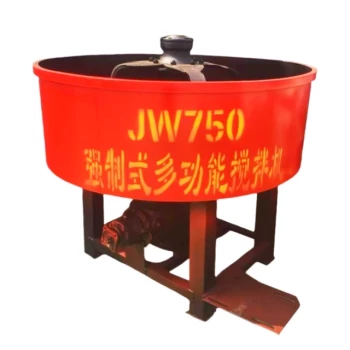
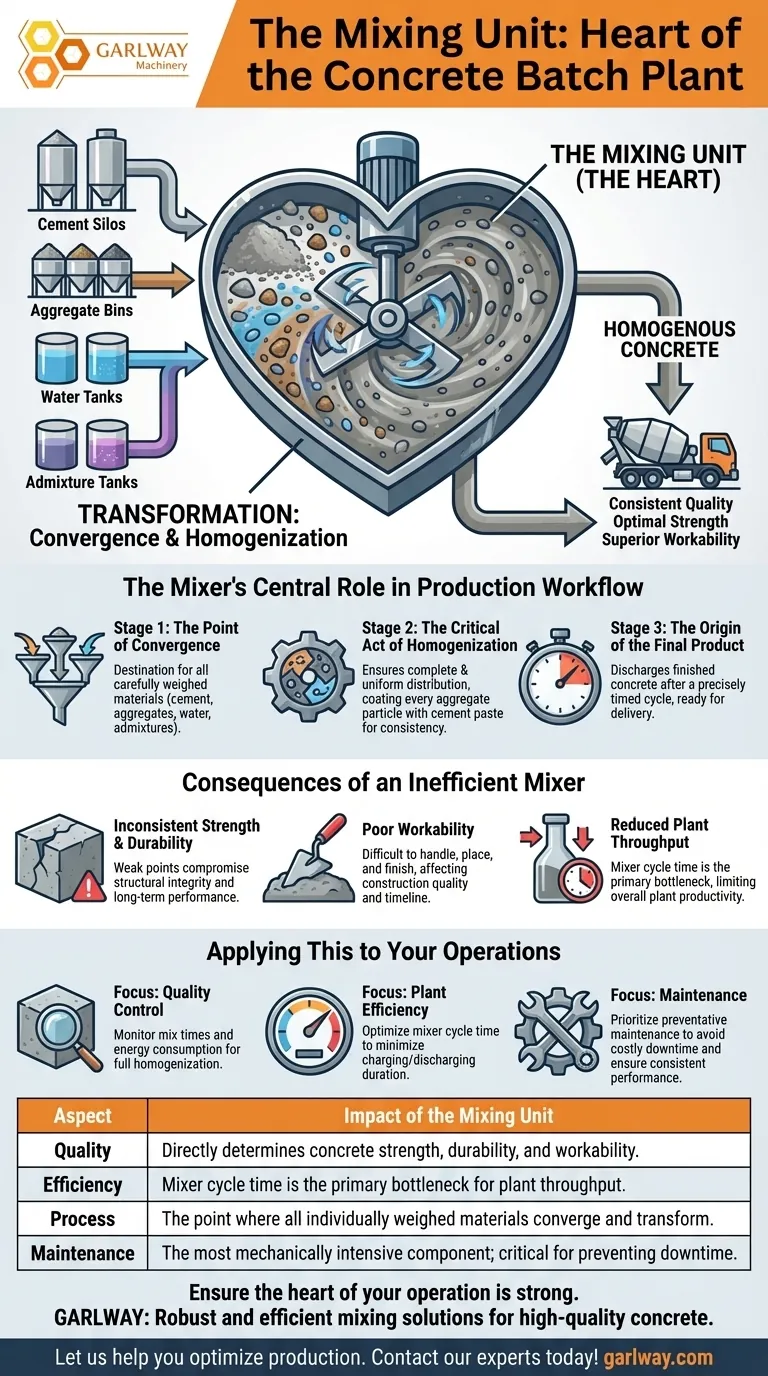
The mixing unit is justifiably called the heart of the concrete batch plant because it is the central component where all individual raw materials converge and are transformed into a single, homogeneous product. It receives precisely weighed amounts of cement, aggregates, water, and admixtures, and its sole purpose is to combine them thoroughly before discharging the final concrete.
While other plant components handle, store, or weigh individual ingredients, the mixing unit is the only system responsible for the critical transformation into concrete. The quality of its performance directly dictates the strength, durability, and workability of the final product.
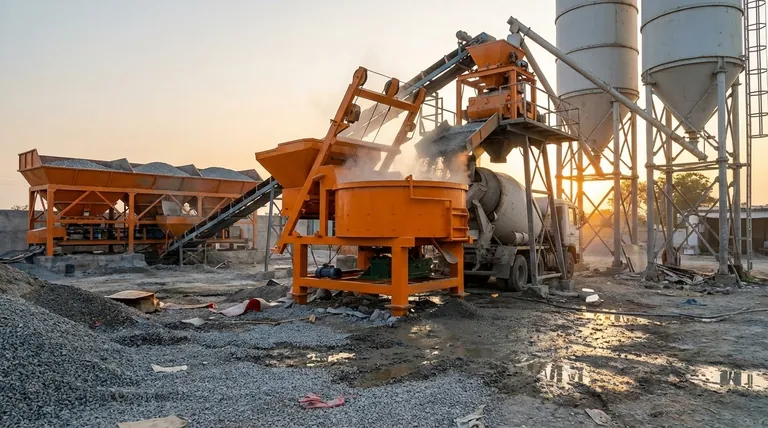
The Mixer's Central Role in the Production Workflow
To understand why the mixer is so critical, it's helpful to see it within the context of the plant's operational sequence. Every preceding step leads to the mixer, and every subsequent step depends on its output.
Stage 1: The Point of Convergence
Before mixing, the plant operates as a collection of separate systems. Aggregates are stored in bins, cement in silos, and water in tanks.
Each ingredient is weighed or metered to exact specifications for a given batch design. The mixer is the destination where all these carefully prepared materials are finally brought together.
Stage 2: The Critical Act of Homogenization
This is the mixer's primary and most crucial function. It doesn't just stir the ingredients; it forces them together under mechanical action to ensure complete and uniform distribution.
The goal is to coat every particle of aggregate with cement paste, creating a consistent mixture. Without this thorough homogenization, the resulting concrete would have weak spots and inconsistent properties.
Stage 3: The Origin of the Final Product
Once the mixing cycle is complete—a process timed precisely to achieve the desired consistency—the mixer discharges the finished concrete.
This homogenous material is then loaded into a transit mixer or concrete pump for delivery. The plant's function is now complete, having successfully transformed raw materials into a usable construction product.
The Consequences of an Inefficient Mixer
The importance of the mixing unit becomes even clearer when you consider the consequences of poor performance. A failure at this central stage undermines the entire production process.
Inconsistent Strength and Durability
If mixing is incomplete, the final concrete will not be uniform. Some areas may have too much water, while others have too much aggregate, leading to weak points that can compromise the structural integrity and long-term durability of a project.
Poor Workability
Improperly mixed concrete is difficult to handle. It can be too stiff or too fluid, making it challenging for construction crews to place, compact, and finish correctly, ultimately affecting the surface quality and overall construction timeline.
Reduced Plant Throughput
The mixer's cycle time—the total time it takes to charge, mix, and discharge a batch—is often the primary bottleneck that determines the entire plant's maximum output. An inefficient or slow mixer directly limits the plant's productivity and profitability.
Applying This to Your Operations
Understanding the mixer's central role allows you to focus your efforts on the areas that have the greatest impact on quality and efficiency.
- If your primary focus is quality control: The mixing process is your most critical checkpoint. Monitor mix times and mixer energy consumption to ensure every batch achieves full homogenization.
- If your primary focus is plant efficiency: Optimizing the mixer's cycle time provides the greatest return. Minimizing the time between charging and discharging is key to increasing your plant's overall throughput.
- If your primary focus is maintenance: The mixer is the most mechanically intensive component and should be the top priority for preventative maintenance to avoid costly downtime and ensure consistent performance.
Ultimately, by treating the mixing unit as the heart of your operation, you ensure the health and quality of your entire concrete production system.
Summary Table:
| Aspect | Impact of the Mixing Unit |
|---|---|
| Quality | Directly determines concrete strength, durability, and workability. |
| Efficiency | Mixer cycle time is the primary bottleneck for plant throughput. |
| Process | The point where all individually weighed materials converge and transform. |
| Maintenance | The most mechanically intensive component; critical for preventing downtime. |
Ensure the heart of your operation is strong.
At GARLWAY, we specialize in providing robust and efficient mixing solutions for construction companies and contractors globally. Our concrete batching plants are engineered with high-performance mixers at their core to guarantee consistent, high-quality concrete batch after batch.
Let us help you optimize your production for superior quality and maximum efficiency.
Contact our experts today to discuss your specific needs!
Visual Guide
Related Products
- HZS120 Ready Mix Concrete Batching Plant Commercial Mud Cement Mixer
- HZS75 Concrete Batching Plant Cement Mixer Price Concrete Mixer Bunnings Mixing Plant
- HZS180 Ready Mix Concrete Plant for Foundations with Sand and Cement
- HZS35 Small Cement Concrete Mixing Batch Plant
- HZS90 Large Multiquip Concrete Mixers for Construction
People Also Ask
- What is a ready mix concrete batching plant? The Engine of Modern Construction
- What is the name of the machine used in ready mix? Unpacking the Complete Concrete System
- What is the core component of a concrete batching plant? The Mixer Unit Defines Your Concrete Quality
- What are the types of concrete mixers used in batching plants? Choose the Right Mixer for Your Project
- What are the advantages and disadvantages of concrete batching plants? Maximize Quality & Efficiency