At their core, volumetric concrete mixers offer significant advantages in flexibility, waste reduction, and concrete quality over traditional drum mixers. Because they function as mobile batch plants that mix materials on-site, they allow you to produce the exact amount and specification of concrete needed, precisely when and where you need it.
The fundamental distinction is simple: a volumetric mixer manufactures fresh concrete on the job site, while a drum mixer transports pre-mixed concrete from a central plant. This single difference is the source of every major advantage and trade-off.
The Operational Difference: Manufacturing vs. Transporting
To understand the benefits, you must first grasp how each system operates. Their core functions are entirely different, leading to vastly different outcomes for your project.
How Volumetric Mixers Work
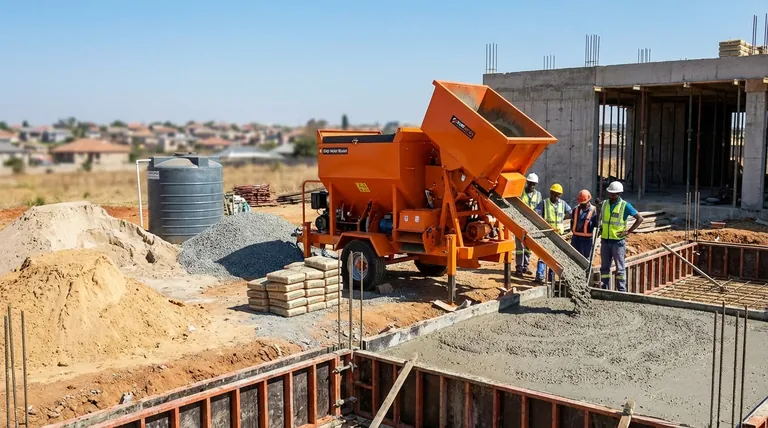
A volumetric mixer is a self-contained unit carrying unmixed materials—sand, stone, cement, and water—in separate compartments.
These raw materials are metered and mixed into fresh concrete on-site, to the exact specifications required. This process gives the operator complete control over the final product at the point of delivery.
How Drum Mixers Work
A drum mixer, often called a ready-mix truck, is filled with concrete that has already been mixed at a batch plant.
Its primary job is to transport this perishable product to the job site while continuously agitating it to prevent it from hardening. The concrete's properties are fixed the moment it leaves the plant.
Key Advantages of Volumetric Mixing
The on-demand manufacturing process of a volumetric mixer directly translates into four primary advantages for many projects.
Advantage 1: Eliminating Material Waste
You mix only what you need. This eliminates the common problem of over-ordering from a batch plant to ensure you don't run short, which can save up to 40% in material costs.
Any unmixed raw materials remain in their bins, ready for the next job, rather than becoming expensive waste.
Advantage 2: Guaranteed Fresh Concrete
Because mixing happens moments before the pour, the concrete is always fresh. This prevents the issue of "hot loads"—concrete that has been in a drum mixer too long and has begun to set.
Freshly mixed concrete ensures maximum strength, workability, and predictable performance.
Advantage 3: Unmatched Flexibility and Control
Need to change the mix design halfway through a job? A volumetric mixer allows for on-the-fly adjustments to meet different project requirements.
This is ideal for projects with multiple small, distinct pours or unexpected needs, as you are not locked into the single batch provided by a drum mixer.
Advantage 4: Enhanced Site Accessibility
Volumetric mixers can serve remote or hard-to-access locations that are too far from a traditional batch plant.
Since the materials are transported raw, there is no risk of the concrete hardening during a long journey, providing a reliable solution for infrastructure or rural projects.
Understanding the Trade-offs
While volumetric mixers offer compelling advantages, they are not the superior choice for every scenario. An objective assessment requires acknowledging where drum mixers excel.
Large-Scale, Continuous Pours
For massive, standardized projects like a large foundation or highway paving, drum mixers are often more efficient.
Batch plants can produce high volumes of concrete very quickly, and a fleet of drum mixers can deliver a continuous, uninterrupted supply that may exceed the output rate of a single volumetric truck.
Simplicity of Operation
Drum mixers are fundamentally simpler machines. They require less specialized operator training for the mixing process itself, as the complex batching is handled centrally.
This can translate to lower operating and maintenance costs, a key consideration for large-scale ready-mix suppliers.
Making the Right Choice for Your Project
The best choice depends entirely on your project's specific constraints and goals.
- If your primary focus is minimizing waste and cost on varied jobs: The precise, on-demand nature of a volumetric mixer is unmatched.
- If your primary focus is project flexibility and remote site access: A volumetric mixer provides control and reach that drum mixers cannot offer.
- If your primary focus is high-volume, continuous pouring for a single large job: A traditional drum mixer supplied by a high-capacity batch plant is likely the more efficient solution.
Ultimately, choosing the right tool requires understanding that you are deciding between a mobile factory and a delivery vehicle.
Summary Table:
| Advantage | Volumetric Mixer | Drum Mixer |
|---|---|---|
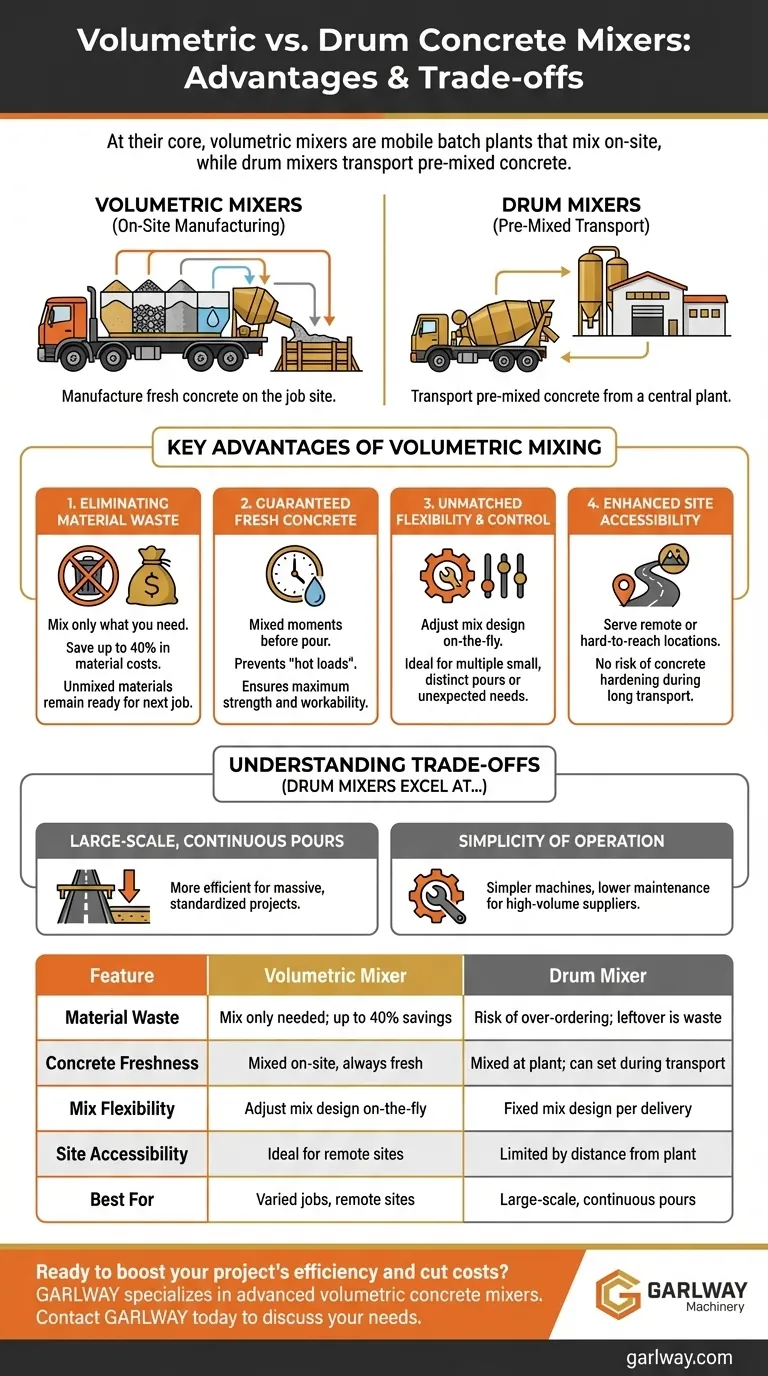
| Material Waste | Mix only what's needed; up to 40% savings | Risk of over-ordering; leftover concrete is waste |
| Concrete Freshness | Mixed on-site, always fresh | Mixed at plant; can set during transport |
| Mix Flexibility | Adjust mix design on-the-fly | Fixed mix design per delivery |
| Site Accessibility | Ideal for remote or hard-to-reach sites | Limited by distance from batch plant |
| Best For | Multiple small pours, varied jobs, remote sites | Large-scale, continuous, high-volume pours |
Ready to boost your project's efficiency and cut costs?
GARLWAY specializes in providing high-performance construction machinery, including advanced volumetric concrete mixers, for construction companies and contractors globally. Our solutions are designed to give you precise control over your concrete, eliminate material waste, and tackle projects in any location.
Contact GARLWAY today to discuss how our volumetric mixers can be the mobile batch plant your business needs.
Visual Guide
Related Products
- Belle Cement Mixer JS2000 Volumetric Concrete Mixer for Harbor Freight
- JS1000 Volumetric Concrete Mortar Mixer for Sale Skid Steer Cement Mixer
- Harbor Freight JS1500 On Site Concrete Mixing Volumetric Cement Mixer
- Portable Concrete Mixer Machine Equipment for Mixing Concrete
- HZS90 Large Multiquip Concrete Mixers for Construction
People Also Ask
- What is a volumetric concrete mixer? A Mobile Concrete Batch Plant for On-Demand Mixing
- What is the predicted future for volumetric concrete mixers? Growth Driven by On-Demand Efficiency
- How does a volumetric concrete mixer contribute to sustainability? Reduce Waste, Water, and Emissions On-Site
- How does volumetric concrete compare to ready-mix concrete? Choose the Right Method for Your Project
- What types of concrete can be produced with volumetric mixers? Achieve On-Demand Mixing for Any Project