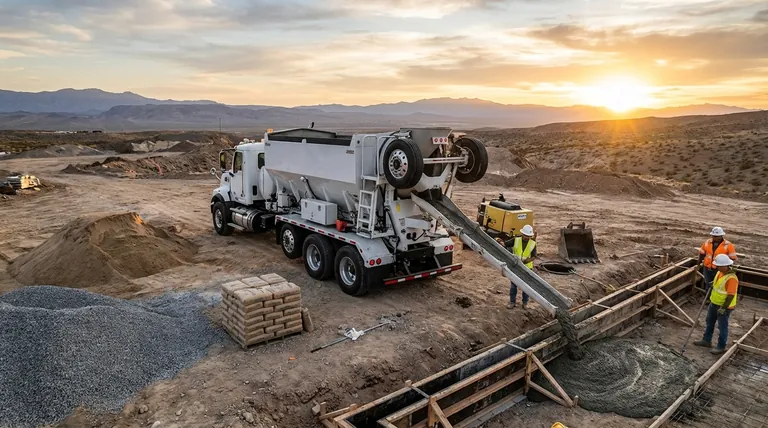
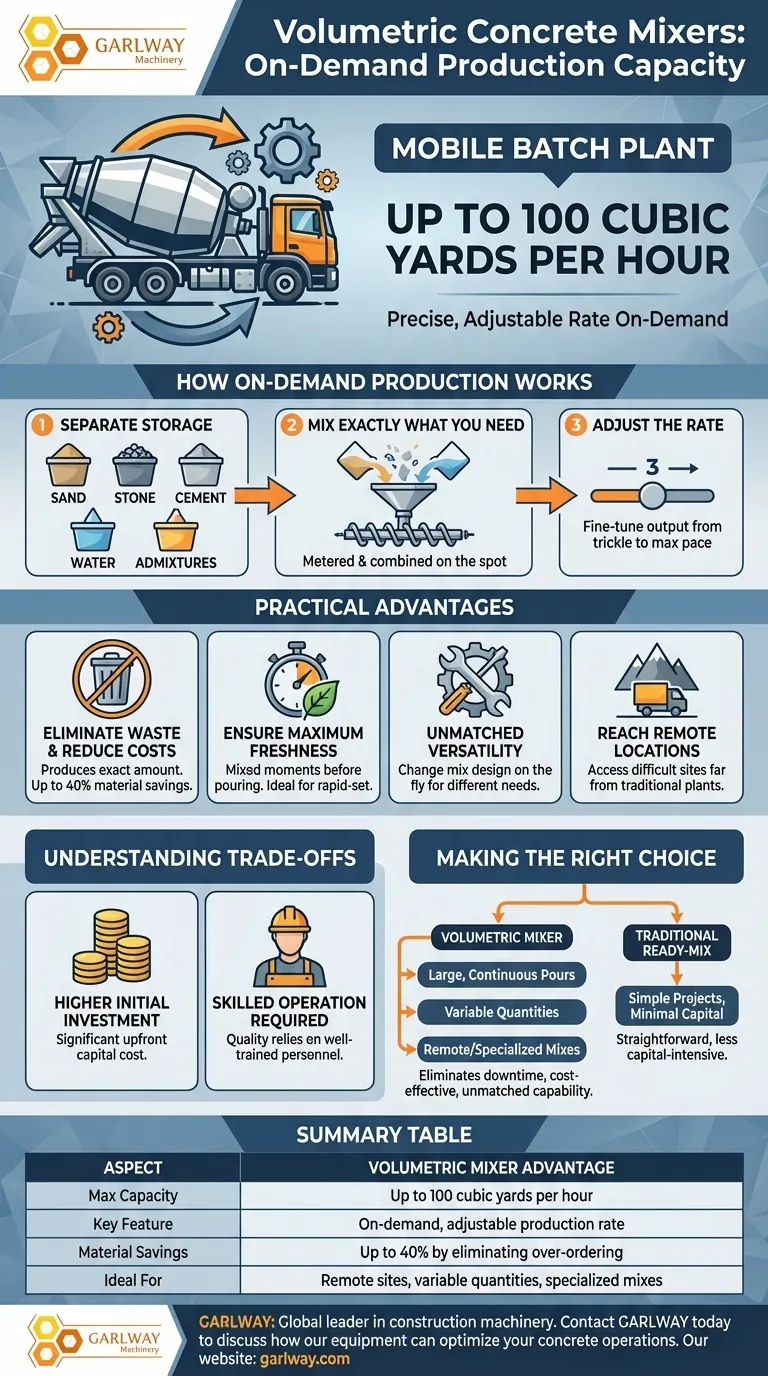
A volumetric concrete mixer can produce up to 100 cubic yards of concrete per hour. This high-volume output is a key feature, but its true value lies in the ability to precisely adjust this rate on-demand, matching the specific needs of any job site in real time.
The core advantage of a volumetric mixer isn't just its potential speed, but its function as a mobile batch plant. This provides complete control over the production rate, mix design, and quantity, directly at the point of use, fundamentally changing how concrete is managed.
How On-Demand Production Works
A volumetric mixer operates fundamentally differently than a traditional ready-mix drum truck. It is, in essence, a self-contained batch plant on wheels that gives the operator total control over the manufacturing process.
Storing Raw Materials Separately
The unit carries unmixed components—sand, stone, cement powder, water, and admixtures—in separate, designated bins. This ensures materials remain stable and do not interact until the moment they are needed.
Mixing Exactly What You Need
When concrete is required, the operator initiates the mixing process. The raw materials are metered and combined according to a specific mix design, producing fresh concrete on the spot. This eliminates the risk of over-ordering and paying for unused material.
Adjusting the Production Rate
The output can be finely tuned from a slow trickle for small forms to the maximum rate of 100 cubic yards per hour for large slab pours. This adaptability ensures the production pace matches the crew's working speed, preventing costly delays or wasted material.
The Practical Advantages of Volumetric Mixing
This on-demand capability creates several significant operational and financial benefits, making it ideal for a wide range of applications from infrastructure to remote construction.
Eliminating Waste and Reducing Costs
Since you only produce the exact amount of concrete required, waste from over-ordering is completely eliminated. Unused raw materials remain in their bins for the next job, potentially saving up to 40 percent on material costs.
Ensuring Maximum Freshness
Concrete is mixed moments before it is poured. This guarantees maximum freshness and workability, which is especially critical for specialized or rapid-set concrete mixes used in urgent repairs.
Unmatched Versatility
An operator can change the mix design on the fly. This allows a single unit to pour a standard foundation mix in the morning and a specialized, high-strength mix for precast elements in the afternoon without returning to a plant.
Reaching Remote Locations
Mobile volumetric mixers can access job sites that are remote, difficult to reach, or too far from a traditional batch plant. This capability is invaluable for infrastructure, utility, mining, and military projects.
Understanding the Trade-offs
While powerful, the volumetric mixing model carries its own set of considerations that differ from ordering traditional ready-mix concrete.
Higher Initial Investment
Acquiring a volumetric mixer represents a significant capital investment. This upfront cost is higher than simply sourcing concrete from a third-party ready-mix supplier on a per-project basis.
Requirement for Skilled Operation
The quality of the final product rests entirely on the operator. Ensuring correct mix designs, proper calibration, and consistent ratios requires skilled, well-trained personnel. Unlike receiving certified concrete from a plant, the quality control process is managed at the job site.
Making the Right Choice for Your Project
Choosing between volumetric mixing and traditional ready-mix depends entirely on your project's specific demands for control, flexibility, and location.
- If your primary focus is large, continuous pours with no downtime: A volumetric mixer is ideal, as it eliminates the wait time between ready-mix truck deliveries.
- If your primary focus is projects with unknown or variable quantities: The ability to produce the exact amount needed makes a volumetric mixer the most cost-effective option.
- If your primary focus is remote work or specialized, on-demand mixes: The mobility and versatility of a volumetric mixer provide a capability that traditional methods cannot match.
- If your primary focus is a simple project with minimal capital outlay: Sourcing certified concrete from a local ready-mix plant may be the more straightforward and less capital-intensive choice.
Ultimately, volumetric mixers shift control over concrete production directly to the job site, offering unparalleled flexibility for the right application.
Summary Table:
| Aspect | Volumetric Mixer Advantage |
|---|---|
| Max Capacity | Up to 100 cubic yards per hour |
| Key Feature | On-demand, adjustable production rate |
| Material Savings | Up to 40% by eliminating over-ordering |
| Ideal For | Remote sites, variable quantities, specialized mixes |
Ready to take control of your concrete production?
As a global leader in construction machinery, GARLWAY specializes in providing high-performance volumetric concrete mixers, winches, and batching plants for construction companies and contractors. Our solutions deliver the on-demand flexibility and material efficiency your projects demand, saving you time and money.
Contact GARLWAY today to discuss how our equipment can optimize your concrete operations.
Visual Guide
Related Products
- Belle Cement Mixer JS2000 Volumetric Concrete Mixer for Harbor Freight
- Harbor Freight JS1500 On Site Concrete Mixing Volumetric Cement Mixer
- JS1000 Volumetric Concrete Mortar Mixer for Sale Skid Steer Cement Mixer
- Portable Concrete Mixer Machine Equipment for Mixing Concrete
- HZS90 Large Multiquip Concrete Mixers for Construction
People Also Ask
- What is a volumetric concrete mixer? A Mobile Concrete Batch Plant for On-Demand Mixing
- What is the predicted future for volumetric concrete mixers? Growth Driven by On-Demand Efficiency
- How does a volumetric concrete mixer contribute to sustainability? Reduce Waste, Water, and Emissions On-Site
- How does volumetric concrete compare to ready-mix concrete? Choose the Right Method for Your Project
- What types of concrete can be produced with volumetric mixers? Achieve On-Demand Mixing for Any Project