
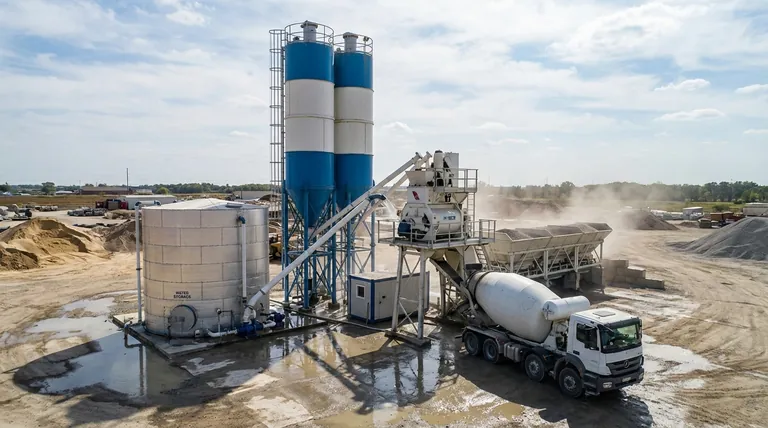
In a concrete batching plant, the water tank is essential for providing an immediate and precisely controlled supply of water, which is a critical ingredient for producing consistent, high-quality concrete. It acts as a ready reservoir that allows the plant's automated system to add the exact amount of water required for each batch according to the specified mix design.
The water tank is not merely for storage; it is a fundamental component of the plant's quality control system. Its purpose is to decouple the concrete mixing process from the inconsistencies of an external water supply, ensuring every batch has the precise water-to-cement ratio necessary for predictable strength and durability.
The Core Function: Guaranteeing Consistency
A concrete batching plant’s primary goal is to produce homogenous and uniform batches of concrete, one after another. Water is one of the most critical variables in this process.
Water as a Chemical Reactant
Water does more than just make the mix workable; it triggers a chemical reaction with cement called hydration. This reaction is what gives concrete its strength.
An incorrect amount of water can ruin the entire batch, leading to a final product that is either too weak or unworkable.
The Critical Water-to-Cement Ratio
The ratio of water to cement by weight is the single most important factor determining the final strength and durability of the concrete.
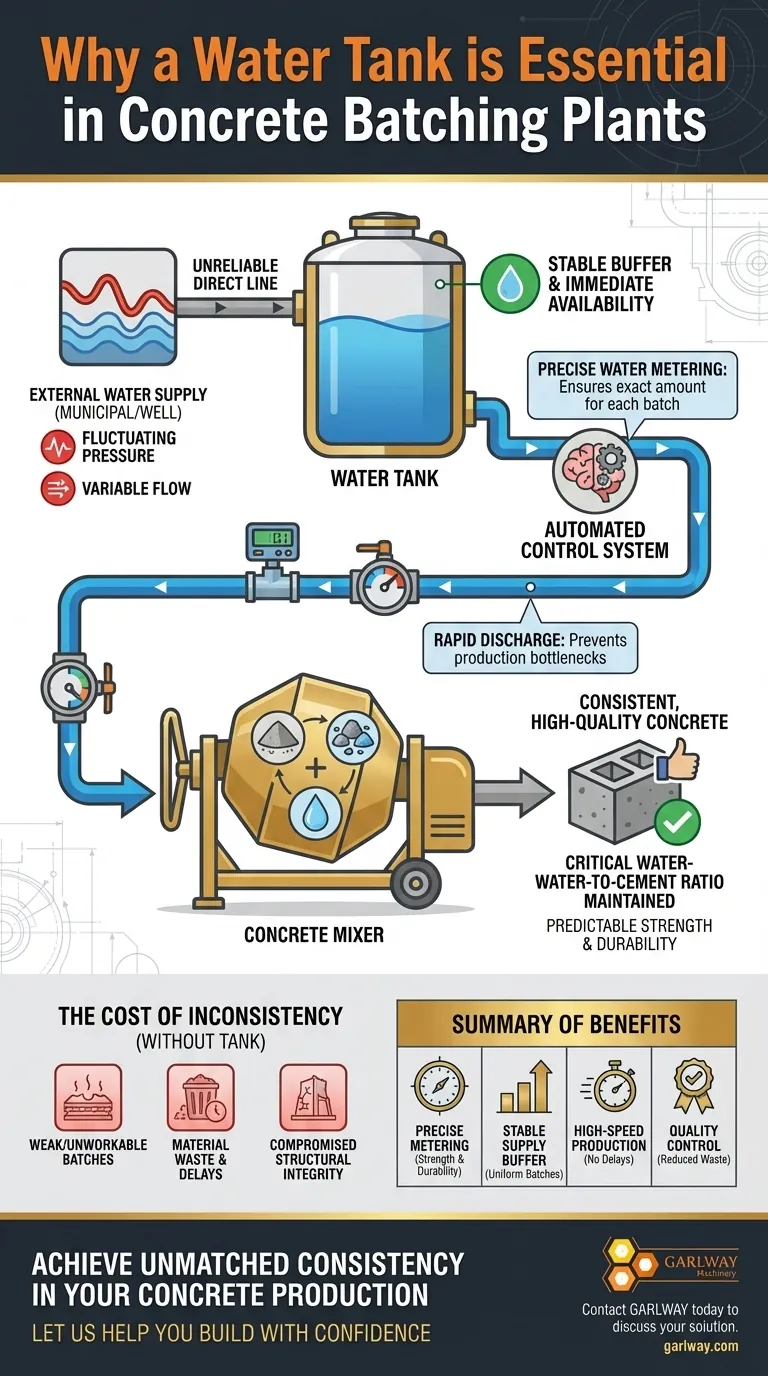
A dedicated water tank allows the plant's automated control system to meter the water with extreme precision, ensuring this ratio is perfectly maintained for every batch.
Why a Direct Water Line is Insufficient
Relying on a direct water line from a municipal source or well is not a viable option for professional concrete production due to its inherent variability.
Buffering Against Supply Fluctuations
External water supplies can have fluctuating pressure and flow rates. These variations would make it impossible for an automated system to consistently draw the exact same amount of water in a short period.
The water tank acts as a stable buffer, providing a consistent head pressure and immediate availability, regardless of what is happening with the external supply.
Enabling Precise Measurement
The control system, which acts as the brain of the plant, relies on a predictable source. It sends a signal to open a valve for a specific duration or until a flow meter measures a target volume.
This precision is only possible when drawing from a stable, on-site reservoir like a water tank.
Supporting High-Speed Production
The batching process is designed for speed and efficiency. The aggregates, cement, and water are all added to the mixer in a rapid, coordinated sequence.
A water tank ensures that the required volume of water can be discharged into the mixer in seconds, preventing a production bottleneck that would occur if waiting for a slow or variable water line.
Understanding the Cost of Inconsistency
Without a stable water supply managed by a tank, a batching plant would face significant operational and quality control failures.
Weak or Unworkable Batches
Even minor variations in water content can lead to concrete that fails to meet strength specifications. Too much water weakens the final product, while too little makes it impossible to pour and finish correctly.
Project Delays and Material Waste
A bad batch of concrete must be discarded, wasting expensive cement, aggregates, and additives. This not only increases costs but can also lead to significant delays on a construction site.
Compromised Structural Integrity
The ultimate risk of inconsistent water measurement is structural failure. For any critical application, from foundations to bridges, the reliability guaranteed by a proper batching process is non-negotiable.
Applying This Principle to Your Goal
The water system is a direct reflection of the plant's commitment to quality.
- If your primary focus is producing high-strength, specification-grade concrete: A water tank integrated with a precise, automated control system is the only way to guarantee the required consistency.
- If your primary focus is efficiency and high-volume output: The water tank's capacity must be large enough to ensure the mixing process is never delayed waiting for water.
- If your primary focus is reducing operational costs: Preventing wasted batches through accurate water measurement provides one of the most significant returns on investment in a plant.
Ultimately, the water tank is a cornerstone of the modern concrete batching plant, enabling the reliability and precision that the construction industry depends on.
Summary Table:
| Function | Benefit |
|---|---|
| Precise Water Metering | Guarantees the correct water-to-cement ratio for strength and durability. |
| Stable Supply Buffer | Eliminates inconsistencies from external water lines for uniform batches. |
| High-Speed Production | Enables rapid water discharge, preventing bottlenecks in the batching cycle. |
| Quality Control | Prevents weak or unworkable batches, reducing material waste and project delays. |
Achieve Unmatched Consistency in Your Concrete Production
For construction companies and contractors, the precision of your batching plant directly impacts project quality, timelines, and budget. GARLWAY specializes in high-performance construction machinery, including concrete batching plants engineered with integrated water systems for ultimate reliability.
Let us help you build with confidence. Our experts can guide you to the right solution for your specific production goals.
Contact GARLWAY today to discuss how our batching plants can enhance your operation's efficiency and output quality.
Visual Guide
Related Products
- HZS180 Ready Mix Concrete Plant for Foundations with Sand and Cement
- HZS120 Ready Mix Concrete Batching Plant Commercial Mud Cement Mixer
- HZS35 Small Cement Concrete Mixing Batch Plant
- HZS75 Concrete Batching Plant Cement Mixer Price Concrete Mixer Bunnings Mixing Plant
- Commercial Electric Concrete Mixer Machine HZS 50 Small Batch Plant for Sale
People Also Ask
- What is a ready mix concrete batching plant? The Engine of Modern Construction
- What is the name of the machine used in ready mix? Unpacking the Complete Concrete System
- What systems are included in a ready-mix concrete plant? A Guide to the 6 Core Systems
- How does a ready-mix concrete plant work? A Guide to Efficient, High-Quality Production
- What are the components of a ready mix concrete plant? A Guide to Precision and Efficiency



