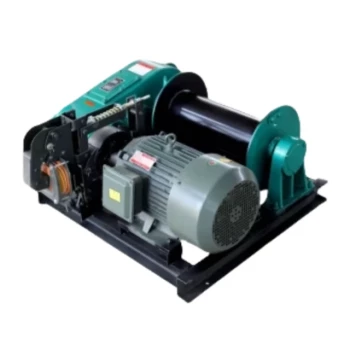
At their core, winches are indispensable tools because they act as force multipliers. They provide the controlled mechanical advantage needed to pull, lift, or position loads far beyond human or standard vehicular capability. This ability to apply immense, precise force is what makes them critical for improving efficiency, ensuring safety, and enabling complex operations in sectors like construction, marine, and defense.
A winch is not merely a tool for pulling; it is a system for applying controlled, amplified force. Its true value lies in making operations safer, more efficient, and fundamentally possible in environments where raw power alone is insufficient.
The Fundamental Principle: Mechanical Advantage in Action
To understand why winches are so important, you must first understand the core problem they solve: applying force safely and efficiently.
What is a Winch?
A winch is a mechanical device that uses a wound cable or rope on a drum (or spool) to pull a load. By rotating the drum, the winch winds the cable, creating a powerful and steady pulling force.
How It Multiplies Force
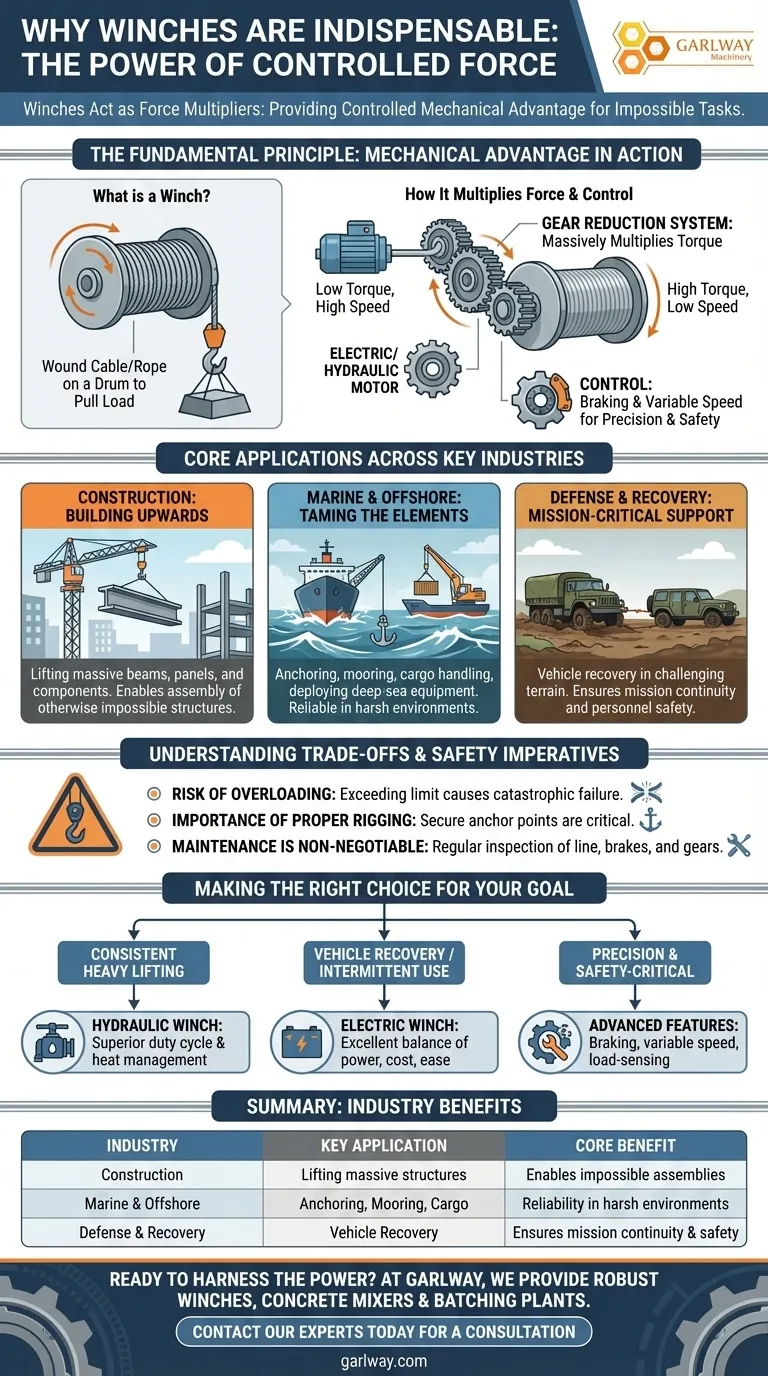
The magic of a winch comes from its gear reduction system. An electric or hydraulic motor spins very quickly with low torque (rotational force). The winch's internal gears reduce this speed significantly, which in turn massively multiplies the torque, creating the powerful pull needed to move heavy objects.
The Critical Role of Control
Raw power is useless without control. Winches provide a braking system and often variable speed control, allowing operators to position heavy loads with immense precision. This prevents sudden movements that could damage equipment or endanger personnel.
Core Applications Across Key Industries
The principle of controlled force application is a universal need, which explains why winches are found everywhere.
In Construction: Building Upwards
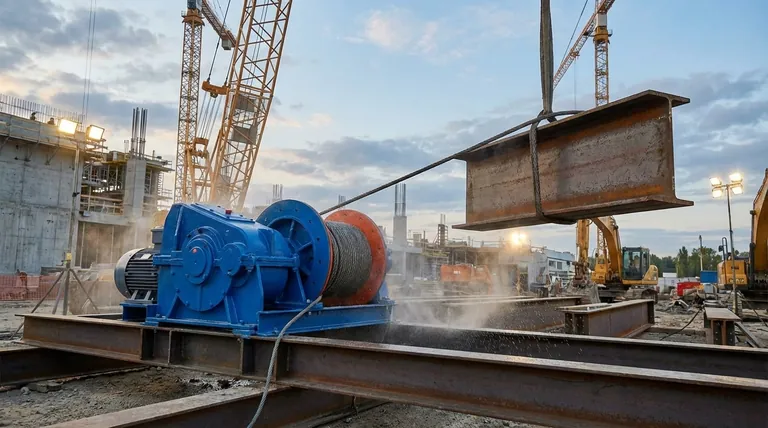
In modern construction, winches are essential for lifting steel beams, pre-fabricated concrete panels, and other massive components into place. They enable the assembly of structures that would be impossible to build otherwise.
In Marine & Offshore: Taming the Elements
The marine environment demands robust and reliable equipment. Winches are used for anchoring massive vessels, mooring them securely to docks, handling heavy cargo, and deploying scientific or commercial equipment into the deep sea.
In Defense & Recovery: Mission-Critical Support
Military and emergency services rely on winches for vehicle recovery in challenging terrain. A heavy truck stuck in mud can be quickly and safely extracted, ensuring missions continue and personnel remain safe.
Understanding the Trade-offs and Safety Imperatives
While powerful, winches are not without risk. Their effectiveness is entirely dependent on proper use and maintenance.
The Risk of Overloading
Every winch has a specified load rating. Exceeding this limit can cause catastrophic failure of the cable, gears, or mounting points, creating an extremely dangerous situation.
The Importance of Proper Rigging
A winch is only as strong as its anchor point and rigging. Using an insecure anchor or improper techniques can turn a controlled pull into a hazardous event. The forces involved are immense and unforgiving.
Maintenance is Non-Negotiable
Regular inspection of the winch line for fraying, ensuring the braking system is functional, and checking gear lubrication are critical. A poorly maintained winch is a liability, not an asset.
Making the Right Choice for Your Goal
Selecting the right winch depends entirely on the intended application.
- If your primary focus is consistent heavy lifting: A hydraulic winch is typically the best choice due to its superior duty cycle and heat management.
- If your primary focus is vehicle recovery or intermittent use: An electric winch offers an excellent balance of power, cost, and ease of installation.
- If your primary focus is precision and safety-critical operations: Prioritize winches with advanced braking systems, variable speed control, and load-sensing features.
Ultimately, a winch provides the controlled power necessary to move the immovable, making ambitious projects possible and difficult situations manageable.
Summary Table:
| Industry | Key Application | Core Benefit |
|---|---|---|
| Construction | Lifting steel beams, concrete panels | Enables assembly of massive structures |
| Marine & Offshore | Anchoring, mooring, cargo handling | Provides reliability in harsh environments |
| Defense & Recovery | Vehicle recovery in challenging terrain | Ensures mission continuity and personnel safety |
Ready to harness the power of a reliable winch for your projects?
At GARLWAY, we specialize in providing robust construction machinery, including high-performance winches, concrete mixers, and batching plants. Our equipment is engineered to deliver the controlled power and safety your construction company or contracting business needs to operate efficiently and meet demanding deadlines.
Let us help you select the perfect winch for your specific application. Contact our experts today for a personalized consultation and discover the GARLWAY difference in quality and performance.
Visual Guide
Related Products
- Warn Winch Windlass Boat Trailer Winch
- Small Electric Winch 120V and 240V for Compact Applications
- Electric and Hydraulic Winch for Heavy Duty Applications
- Quick Windlass Portable Winch for Truck and Boat Best Boat Winch
- Portable Small Trailer Winch
People Also Ask
- What are the main components of a boat trailer winch? A Guide to Safe & Efficient Boat Loading
- What factors should be considered when choosing a boat trailer winch? Ensure Safe and Effortless Boat Loading
- What is the purpose of boat trailer winches? Safely and Efficiently Load Your Boat
- What are the two main types of boat trailer winches? Manual vs. Electric Explained
- How often should a boat trailer winch be replaced? Your Guide to Safety and Longevity