At its core, a front-discharge mixer is uniquely suited for limited space sites because the driver has direct, forward-facing visibility and control over the concrete chute from inside the cab. This allows for exceptionally precise maneuvering and placement of concrete without relying on a spotter, drastically improving efficiency and safety in congested areas.
The fundamental advantage isn't just the location of the chute, but the integration of driving and pouring operations. The driver becomes a single-person operator who can see, position, and pour with pinpoint accuracy, a critical capability when every inch matters.
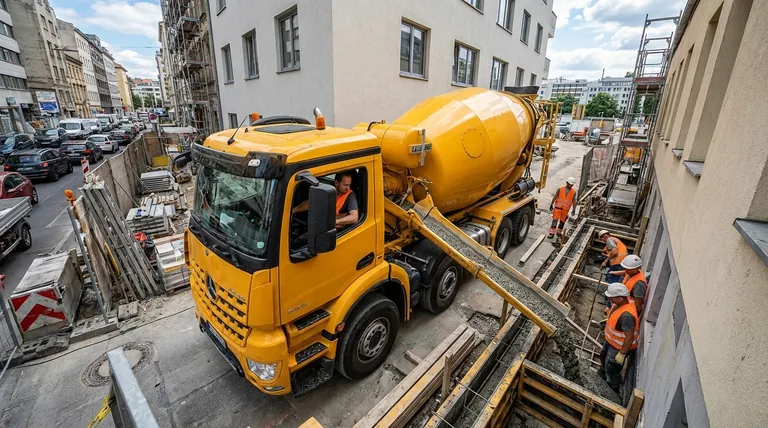
The Core Advantage: Unified Control and Visibility
The design of a front-discharge mixer directly addresses the primary challenges of a constrained construction site: lack of space, poor visibility, and the need for precision.
The Driver is the Operator
Unlike rear-discharge models, the driver controls all functions—driving, chute positioning, and discharge rate—from their seat. This eliminates the need for a separate "chute man" at the back of the truck.
This consolidation of roles is key on a tight site where fewer personnel means less congestion and clearer communication.
Unobstructed Line of Sight
The most significant benefit is the driver's direct line of sight to the pour. They can see the formwork, the rebar, and the crew without needing mirrors or hand signals.
This clear view allows the driver to respond instantly, preventing over-pours and ensuring concrete is placed exactly where it's needed.
Enhanced Maneuverability
Front-discharge mixers allow the operator to "drive into the pour." The driver can make subtle adjustments to the truck's position while simultaneously managing the chute's extension and angle.
This dynamic control enables them to reach difficult spots around obstructions or in tight corners that would be nearly impossible for a rear-discharge truck to service efficiently.
How This Translates to On-Site Efficiency
The design advantages of a front-discharge mixer have tangible impacts on the speed, safety, and cost of a concrete pour in a limited space.
Reduced Labor Requirements
By eliminating the need for a dedicated banksman or chute operator, you reduce the number of people required on site. This not only cuts labor costs but also improves safety by minimizing foot traffic in a confined area.
Faster, More Accurate Pours
The precision offered by direct control leads to less spillage and waste. Time is not lost on repositioning the truck or correcting miscommunication between a driver and a spotter, leading to a faster overall pour.
Increased Safety
On a congested site, blind spots are a major hazard. The forward-facing operator has a much clearer view of the entire work area, significantly reducing the risk of accidents involving crew members or equipment.
Understanding the Trade-offs
While ideal for precision in tight spaces, front-discharge mixers are not the universal solution for every scenario.
Complexity and Maintenance
These vehicles are mechanically more complex than their rear-discharge counterparts. The additional hydraulics and controls for the front-mounted chute system can lead to higher initial purchase costs and more involved maintenance.
Not Ideal for All Pour Types
For large, open slab-on-grade pours where precision is less critical than volume and speed, a traditional rear-discharge mixer can often be more cost-effective.
Alternative Solutions for High Volume
For continuous, high-volume pours into a single constrained area, other equipment like a high-incline belt conveyor might be a more efficient choice. The mixer excels at precision placement at multiple points, not necessarily high-volume static delivery.
Making the Right Choice for Your Site
Your decision should be based on the specific constraints and goals of your project.
- If your primary focus is precision and safety in a congested area: The front-discharge mixer is the definitive choice for its unmatched visibility and control.
- If your primary focus is continuous, high-volume pouring into a fixed, tight spot: An alternative like a concrete pump or a specialized conveyor system may be more suitable.
- If your primary focus is maximum cost-efficiency on an open, easily accessible site: A standard rear-discharge mixer will likely provide the best value.
Ultimately, selecting the right equipment comes down to matching the machine's core strengths to the unique challenges of your job site.
Summary Table:
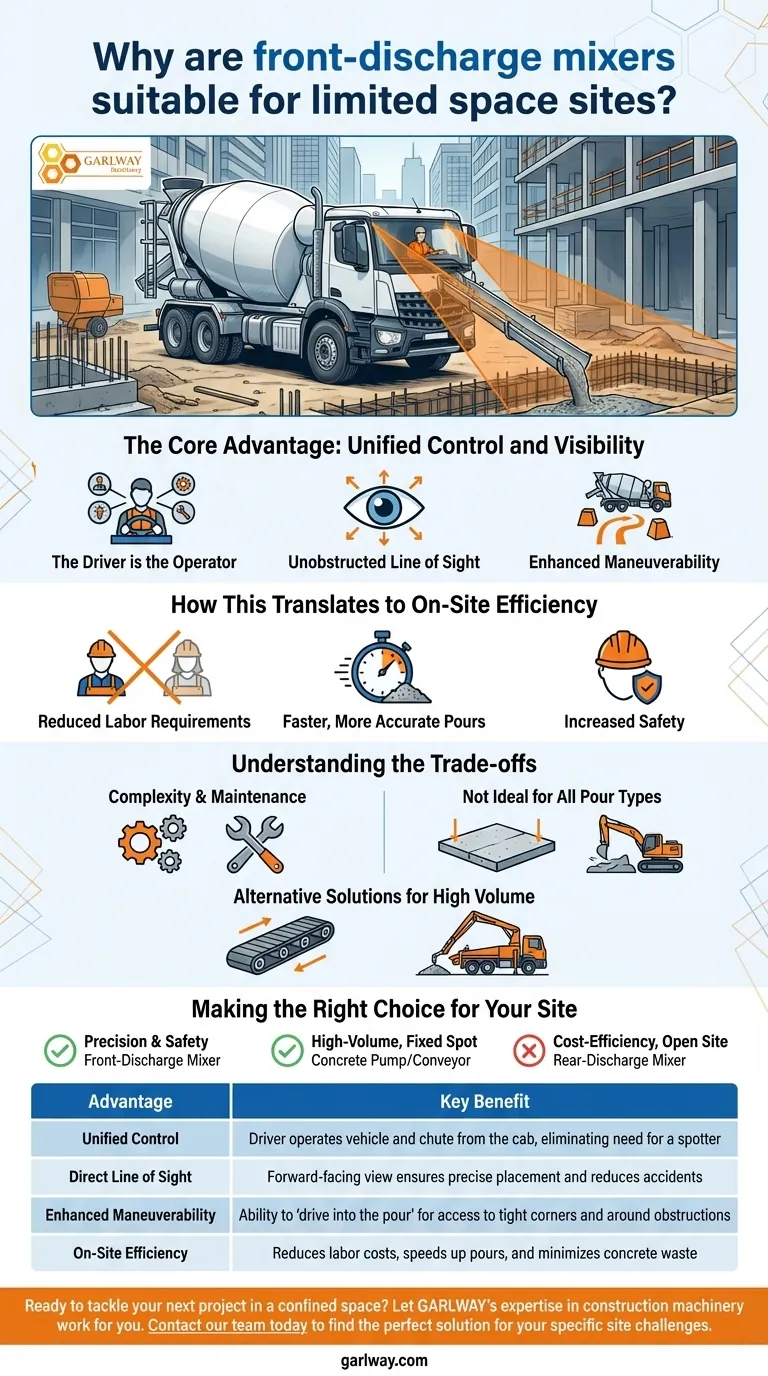
| Advantage | Key Benefit |
|---|---|
| Unified Control | Driver operates vehicle and chute from the cab, eliminating need for a spotter. |
| Direct Line of Sight | Forward-facing view ensures precise placement and reduces accidents. |
| Enhanced Maneuverability | Ability to 'drive into the pour' for access to tight corners and around obstructions. |
| On-Site Efficiency | Reduces labor costs, speeds up pours, and minimizes concrete waste. |
Ready to tackle your next project in a confined space? Let GARLWAY's expertise in construction machinery work for you. Our range of high-performance concrete mixers is designed to deliver the precision and efficiency your project demands. Contact our team today to find the perfect solution for your specific site challenges.
Visual Guide
Related Products
- Harbor Freight JS1500 On Site Concrete Mixing Volumetric Cement Mixer
- Portable Cement Mixer with Lift Concrete Machine
- HZS25 Best Cement Mixer for Quick Mix Concrete at Bunnings
- JDY350 Electric Hydraulic Mortar Mud Concrete Mixer
- JDC350 Small Cement Concrete Mortar Mixer
People Also Ask
- What is the basic working principle of volumetric concrete mixers? On-Demand Mixing for Zero Waste
- How does a volumetric concrete mixer contribute to sustainability? Reduce Waste, Water, and Emissions On-Site
- What is a volumetric concrete mixer? A Mobile Concrete Batch Plant for On-Demand Mixing
- What is the predicted future for volumetric concrete mixers? Growth Driven by On-Demand Efficiency
- How does volumetric concrete compare to ready-mix concrete? Choose the Right Method for Your Project