
Choosing the right winch involves looking beyond simple lifting capacity and understanding how its power source dictates its performance. The primary types of winches are categorized by how they are powered: manual (hand-crank), electric, hydraulic, and pneumatic, each designed for vastly different operational demands, from small workshop tasks to heavy industrial applications.
The most effective winch is not simply the strongest one; it's the one whose power source, capacity, and operational characteristics are precisely aligned with the demands of your specific task and working environment.
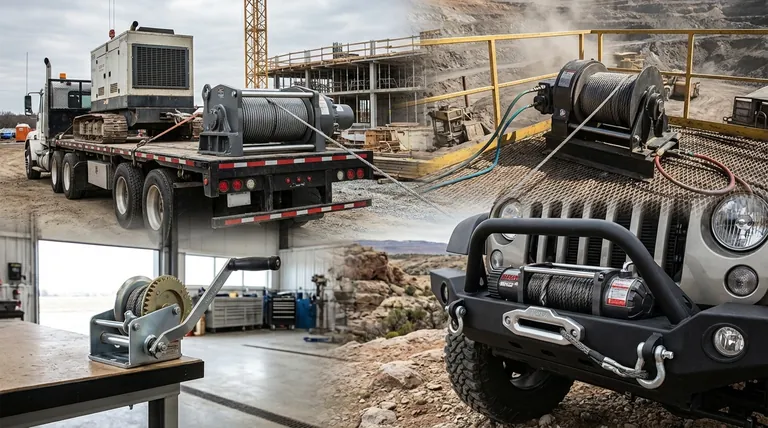
The Primary Differentiator: Power Source
The single most important factor in selecting a winch is its power source. This determines its strength, speed, endurance, and suitability for the environment in which it will operate.
Manual Winches
A manual winch is powered by physical effort, typically through a hand-crank mechanism. They are the simplest form of winch.
Their key advantage is their portability and independence from any external power source, making them ideal for remote or temporary use. However, their capacity is limited by human strength, and they are very slow.
Electric Winches
Electric winches are the most common type, using an electric motor powered by either a direct current (DC) source like a vehicle battery or an alternating current (AC) source from a main power supply.
They offer an excellent balance of power, speed, and ease of use. Their main limitation is a duty cycle, meaning they can only operate for short periods before needing to cool down to prevent motor damage.
Hydraulic Winches
These winches are driven by a hydraulic motor powered by a hydraulic pump, often tapped from a vehicle's power steering pump or a dedicated power take-off (PTO) system.
Hydraulic winches deliver immense and consistent pulling power. Critically, they can run continuously without overheating, making them the standard for heavy commercial, industrial, and recovery applications.
Pneumatic Winches (Air Winches)
Pneumatic winches run on compressed air, powered by a large air compressor. Their mechanics are simple and extremely durable.
Their most significant advantage is safety. Because they have no electrical components, they are intrinsically safe and produce no sparks, making them the only choice for use in explosive or hazardous environments like mines or oil and gas platforms.
Key Specifications Beyond Power
Once you determine the right power source for your needs, you must evaluate these critical performance metrics to select a specific model.
Load Capacity (Rated Line Pull)
This is the maximum force the winch can pull, but this rating only applies to the first layer of rope on the drum. As the rope wraps onto the drum, the effective diameter increases and the pulling power decreases significantly with each subsequent layer.
A common rule of thumb for vehicle recovery is to choose a winch with a capacity of at least 1.5 times the gross vehicle weight.
Duty Cycle
This metric is exclusive to electric winches and is fundamentally important. It defines how long a winch can run under load before it must be rested to cool down.
Ignoring the duty cycle is the most common cause of electric winch failure. For sustained, heavy use, a hydraulic or pneumatic winch is a more appropriate and reliable tool.
Line Speed
Line speed indicates how fast the winch can pull in its rope, usually measured in feet per minute (FPM).
This is a direct trade-off with power. A winch pulling a heavy load will be much slower than when it is pulling a light load or no load at all.
Understanding the Trade-offs
Choosing a winch involves balancing competing factors. Understanding these compromises is key to making an intelligent decision.
Portability vs. Power
Manual winches offer maximum portability with minimal power. In contrast, powerful hydraulic and pneumatic winches are typically part of a permanent, heavy installation. Electric winches occupy the middle ground, offering significant power in a relatively compact form.
Initial Cost vs. Long-Term Reliability
While a cheap electric winch might seem appealing, it may have a poor duty cycle or use lower-quality components that fail under stress. For mission-critical or continuous industrial work, the higher upfront cost of a hydraulic system buys unparalleled reliability and safety.
The Hidden Requirement: The Power System
A winch is not a standalone tool. An electric winch requires a robust battery and alternator, a hydraulic winch needs a running engine and pump, and a pneumatic winch is useless without a powerful air compressor. You must account for the capability of the entire system, not just the winch itself.
Making the Right Choice for Your Goal
Select your winch type based on the primary demand of your application.
- If your primary focus is light-duty, portable pulling: A manual or small 12V DC electric winch is your most practical and cost-effective solution.
- If your primary focus is vehicle recovery or intermittent heavy lifting: An electric winch (DC for vehicles, AC for workshops) offers the best balance of power and convenience.
- If your primary focus is continuous, heavy industrial operation: A hydraulic winch is the only reliable choice for its ability to handle sustained high-power demand without overheating.
- If your primary focus is safety in a hazardous environment: A pneumatic (air) winch is non-negotiable to eliminate ignition risks from sparks.
By matching the winch's core characteristics to your specific task, you ensure safe, efficient, and reliable performance.
Summary Table:
| Power Source | Best For | Key Advantage | Key Limitation |
|---|---|---|---|
| Manual | Light-duty, portable tasks | No external power needed | Slow, limited by human strength |
| Electric | Vehicle recovery, workshops | Good balance of power & ease of use | Limited duty cycle (overheats) |
| Hydraulic | Heavy industrial, continuous use | High power, can run continuously | Requires hydraulic system |
| Pneumatic | Hazardous environments (mines, oil/gas) | Intrinsically safe (no sparks) | Requires large air compressor |
Still unsure which winch is right for your project? GARLWAY specializes in providing robust construction machinery, including winches, concrete mixers, and batching plants, tailored for construction companies and contractors worldwide. Our experts can help you select the ideal winch based on your specific lifting needs, environment, and budget. Contact us today for a personalized consultation and ensure your operations are safe, efficient, and reliable!
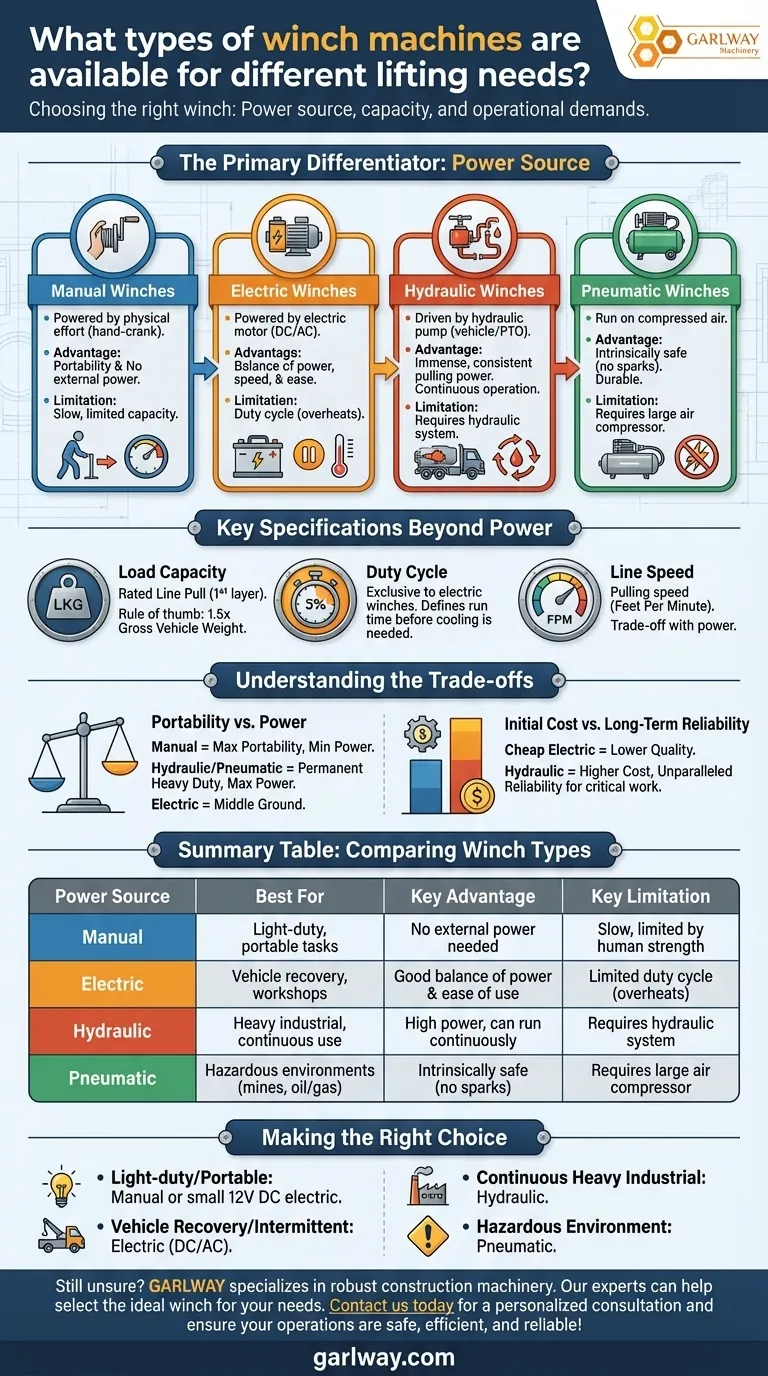
Visual Guide
Related Products
- Warn Winch Windlass Boat Trailer Winch
- Electric and Hydraulic Winch for Heavy Duty Applications
- Small Electric Winch 120V and 240V for Compact Applications
- 12000 lb Electric Boat Trailer Winch with Windlass Anchor Warn
- Quick Windlass Portable Winch for Truck and Boat Best Boat Winch
People Also Ask
- What are the main components of a boat trailer winch? A Guide to Safe & Efficient Boat Loading
- What factors should be considered when choosing a boat trailer winch? Ensure Safe and Effortless Boat Loading
- What is the purpose of boat trailer winches? Safely and Efficiently Load Your Boat
- What are the two main types of boat trailer winches? Manual vs. Electric Explained
- How often should a boat trailer winch be replaced? Your Guide to Safety and Longevity





