
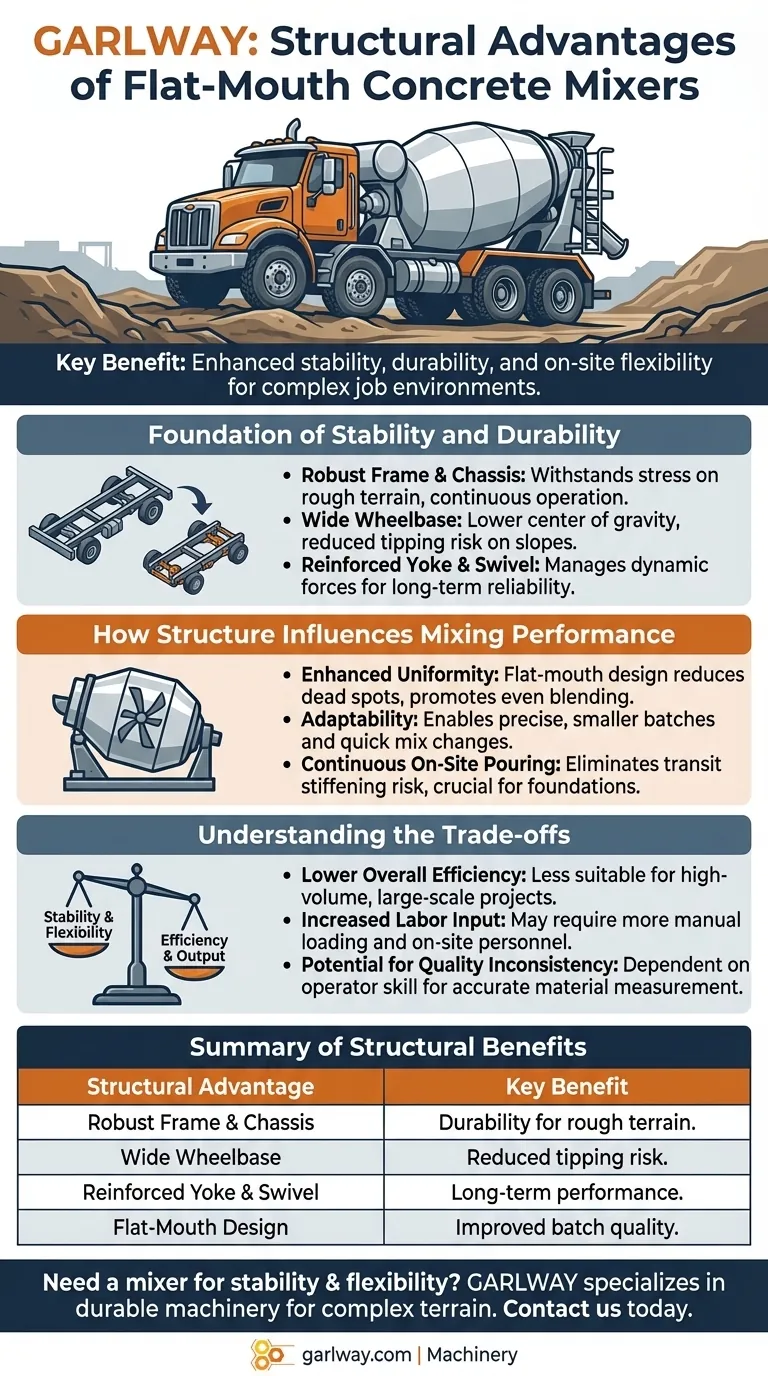
At its core, the primary structural advantage of a flat-mouth concrete mixer is its robust design, which directly enhances the vehicle's stability and durability. This construction makes it exceptionally well-suited for navigating and operating in complex, uneven, or demanding job site environments where balance and resilience are paramount.
The key takeaway is that a flat-mouth mixer's structural integrity provides superior stability for on-site flexibility, but this design inherently involves trade-offs in terms of large-scale efficiency and operational consistency compared to other mixer types.
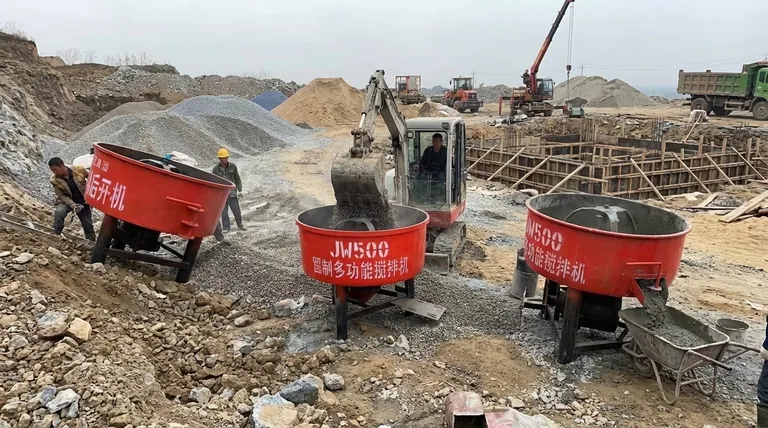
The Foundation of Stability and Durability
The defining characteristics of a flat-mouth mixer are not just about the opening but the entire platform it's built upon. The design philosophy prioritizes resilience for on-site work over the high-volume transport focus of traditional drum mixers.
Robust Frame and Chassis
These mixers are typically built with a heavy-duty frame and a strong, transportable chassis. This foundational strength is what allows the vehicle to withstand the stresses of rough terrain and continuous operation without compromising its structural integrity.
Wide Wheelbase for Balance
A key design feature is a wide wheelbase. This provides a lower center of gravity and a more stable base, significantly reducing the risk of tipping when maneuvering on uneven ground or slopes, a common challenge in many construction environments.
Reinforced Yoke and Swivel
The mixer often includes a heavy-duty, fabricated yoke and a reliable swivel arrangement. These components are critical structural points that manage the dynamic forces of the rotating drum, ensuring both optimum performance and long-term durability.
How Structure Influences Mixing Performance
The physical design of the mixer directly impacts its functional capabilities. The structural choices are not just for stability; they enable a specific kind of operational flexibility.
Enhanced Mixing Uniformity
The flat-mouth design itself facilitates a more even and effective mixing action. By its nature, this shape helps reduce the dead spots where concrete can accumulate, promoting a more uniform blend and improving the final quality of a single batch.
Adaptability to Job Demands
The robust build supports operational flexibility. These mixers are often used for projects requiring precise quantities, smaller batches, or the ability to alternate between different concrete mix designs on the fly without significant waste.
Continuous On-Site Pouring
The structure is well-suited for continuous pouring applications. Because it can be loaded and operated on-site, it eliminates the risk of concrete beginning to stiffen during transit from a batching plant, which is crucial for certain types of foundation or repair work.
Understanding the Trade-offs
No design is without its compromises. The focus on on-site stability and flexibility brings inherent limitations that must be considered.
Lower Overall Efficiency
Compared to large, transit-style drum mixers, flat-mouth models generally have a lower output volume. This makes them less efficient for large-scale construction projects that require a constant, high-volume supply of concrete.
Increased Labor Input
Operating these mixers can be more labor-intensive. The process may require more manual input for loading raw materials and can increase the number of personnel needed on-site to manage production.
Potential for Quality Inconsistency
While a single batch is mixed uniformly, the overall quality can be less stable than concrete from a computer-controlled batching plant. The final result is highly dependent on the operator's skill in accurately measuring and loading the raw materials for each batch.
Making the Right Choice for Your Project
Selecting the appropriate mixer requires aligning its structural advantages and limitations with your specific goals.
- If your primary focus is stability on difficult terrain and job-site flexibility: The robust chassis and wide wheelbase of a flat-mouth mixer make it the superior choice for complex or remote projects.
- If your primary focus is high-volume output for large-scale construction: A traditional transit drum mixer fed by a dedicated batching plant will deliver far greater efficiency and consistency.
- If your primary focus is controlling waste and handling small, specific pours: A flat-mouth mixer's ability to produce exact quantities on-site offers significant advantages in cost and material management.
Ultimately, understanding these structural benefits and operational trade-offs empowers you to select the right tool for the specific demands of your job.
Summary Table:
| Structural Advantage | Key Benefit |
|---|---|
| Robust Frame & Chassis | Enhanced durability for rough terrain and continuous operation. |
| Wide Wheelbase | Lower center of gravity, reducing tipping risk on uneven ground. |
| Reinforced Yoke & Swivel | Manages dynamic forces for long-term performance and reliability. |
| Flat-Mouth Design | Promotes uniform mixing, reduces dead spots, and improves batch quality. |
Need a concrete mixer built for stability and flexibility on your job site?
GARLWAY specializes in durable construction machinery designed for contractors and construction companies facing complex terrain. Our flat-mouth concrete mixers deliver the robust structural integrity you need for reliable on-site performance.
Contact us today to discuss how our mixers can enhance your project's efficiency and durability.
Visual Guide
Related Products
- HZS25 Best Cement Mixer for Quick Mix Concrete at Bunnings
- Portable Concrete Mixer Machine Equipment for Mixing Concrete
- JDC350 Small Cement Concrete Mortar Mixer
- Portable Ready Mix Concrete Mixer Equipment
- JDY350 Electric Hydraulic Mortar Mud Concrete Mixer
People Also Ask
- How do cement mixers enhance safety on construction sites? Reduce Strain, Hazards, and Accidents
- What are the main components of a cement mixer? A Guide to Core Parts & Functions
- What are some tips for using a cement mixer effectively? Maximize Your Mixer's Performance & Concrete Quality
- How does cleaning a cement mixer after use benefit its performance? Maximize Lifespan and Mix Quality
- Why is it important to clean the cement mixer after use? Prevent Costly Damage and Ensure Quality Concrete





