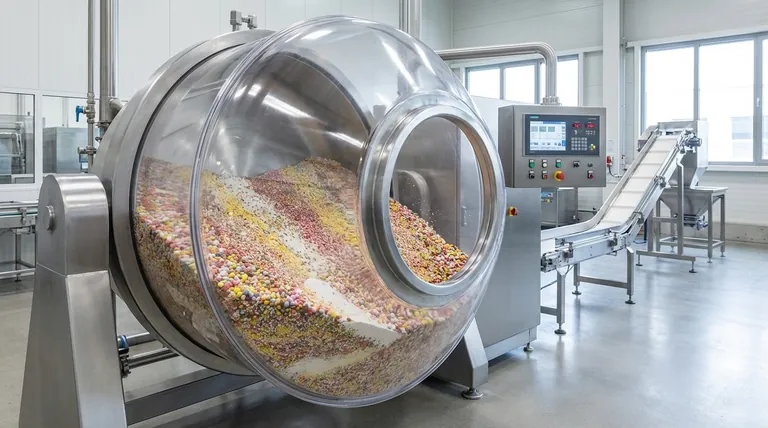
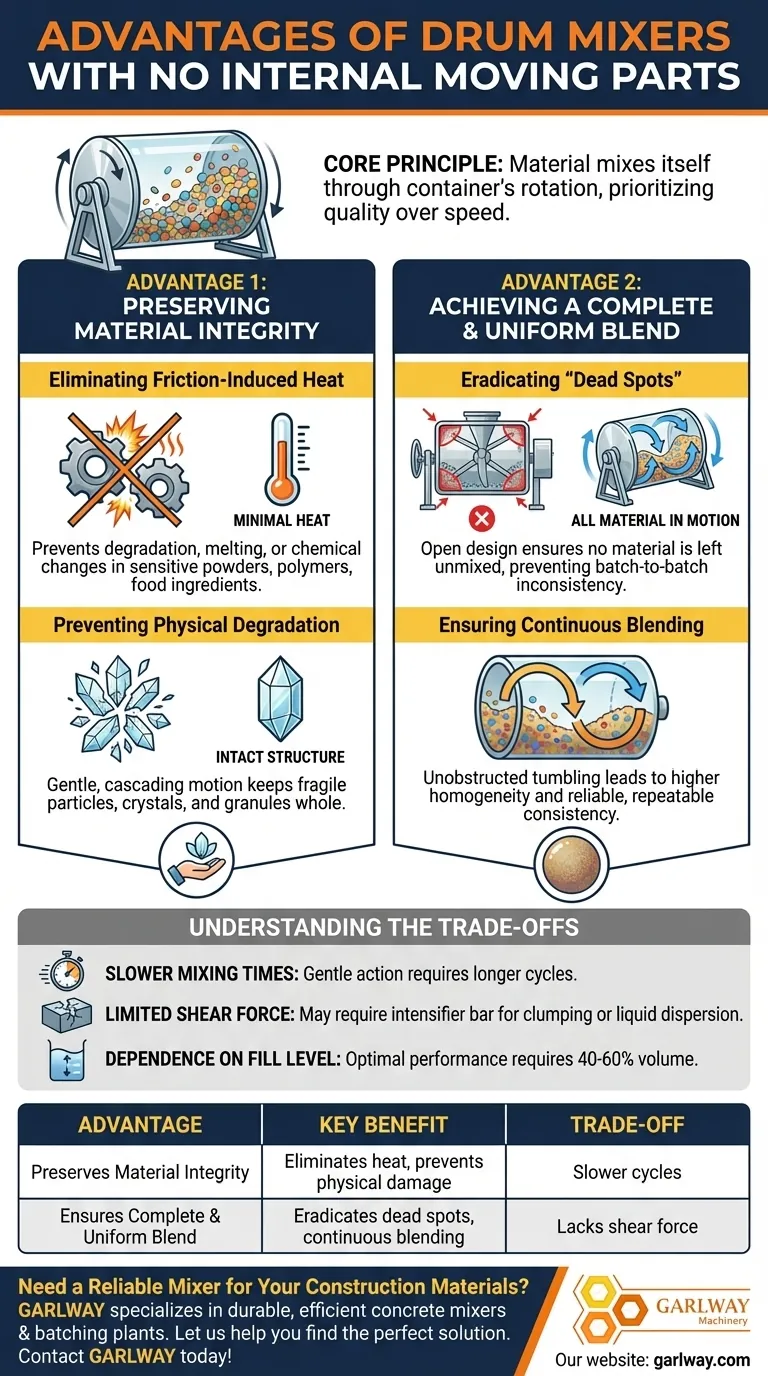
In short, a drum mixer with no internal moving parts offers two critical advantages: it protects sensitive materials from damage and ensures a more complete, uniform blend. This is achieved by fundamentally changing how the mixing occurs, eliminating friction-induced heat from blades and preventing material from getting trapped in stagnant "dead spots."
The core principle is simple but powerful: by removing internal components, the mixer uses the container's gentle rotation to make the material mix itself. This prioritizes the quality and integrity of the final product over the aggressive, high-speed action of conventional mixers.
Advantage 1: Preserving Material Integrity
The most significant benefit of this design is its gentle handling of the product. Agitators like paddles or ribbons can be surprisingly destructive to the materials they are supposed to be mixing.
Eliminating Friction-Induced Heat
Internal blades moving at high speeds generate significant friction as they shear through the material. This friction creates heat, which can easily degrade, melt, or alter the chemical properties of sensitive powders, polymers, or food ingredients. A drum mixer's gentle tumbling action generates minimal heat, preserving the product's intended state.
Preventing Physical Degradation
Beyond heat, internal agitators can physically break down fragile particles. This is a major concern when mixing crystals, granules, or coated particles where maintaining a specific size and shape is critical. The cascading, low-impact motion within a drum mixer keeps the original particle structure intact.
Advantage 2: Achieving a Complete and Uniform Blend
The second key advantage relates to the efficiency and completeness of the mix. The simple, unobstructed geometry of the drum solves a common problem that plagues many other mixer designs.
Eradicating "Dead Spots"
In mixers with internal parts, "dead spots" are a constant challenge. These are areas—typically around shafts, seals, or in corners—where material fails to move and does not get incorporated into the blend. The open design of a drum mixer ensures all material is constantly in motion, preventing any portion of the batch from being left unmixed.
Ensuring Continuous Blending
With no obstructions, the material flows in a continuous and predictable path as it tumbles. This leads to a higher degree of homogeneity and ensures that batch-to-batch consistency is reliable and repeatable.
Understanding the Trade-offs
While highly effective, this design is not the universal solution for every mixing task. Understanding its limitations is key to making an informed decision.
Slower Mixing Times
The gentle action that protects materials also means that mixing cycles can be longer compared to high-shear mixers. This is the fundamental trade-off: speed versus gentleness.
Limited Shear Force
Some applications require high shear to break up stubborn agglomerates (clumps) or to effectively disperse a liquid into a solid. A standard drum mixer lacks this aggressive action and may not be suitable for these tasks without modifications like an internal intensifier bar.
Dependence on Fill Level
The efficiency of a drum mixer is highly dependent on the fill volume. For the ideal cascading and tumbling motion to occur, the drum must be filled to the correct level, typically between 40% and 60% of its total volume. Over or under-filling can severely compromise mixing performance.
Making the Right Choice for Your Process
Selecting the right mixer depends entirely on the specific goals of your application.
- If your primary focus is material integrity: A drum mixer with no internal parts is the superior choice, as it prevents heat damage and physical degradation of sensitive or fragile materials.
- If your primary focus is complete homogeneity: The drum mixer's lack of dead spots gives it a distinct advantage in achieving a highly uniform and consistent final product.
- If your primary focus is raw speed: A mixer with internal agitators, such as a ribbon or paddle blender, will likely provide faster cycle times but at the risk of damaging the product.
- If you need to break up clumps or add liquids: You may require a high-shear mixer or a drum mixer equipped with an optional intensifier bar to provide the necessary force.
Ultimately, choosing a drum mixer with no internal parts is a strategic decision to prioritize the final quality and uniformity of your blend.
Summary Table:
| Advantage | Key Benefit |
|---|---|
| Preserves Material Integrity | Eliminates friction-induced heat and prevents physical degradation of fragile particles. |
| Ensures Complete & Uniform Blend | Eradicates dead spots and provides continuous, predictable blending action. |
| Trade-off to Consider | Mixing cycles can be slower and it lacks the shear force for breaking up stubborn clumps. |
Need a Reliable Mixer for Your Construction Materials?
Choosing the right equipment is critical to the quality and efficiency of your project. GARLWAY specializes in construction machinery, offering durable and efficient concrete mixers and batching plants designed for the rigorous demands of construction companies and contractors globally.
Let us help you find the perfect mixing solution to protect your materials and ensure a consistent, high-quality result. Contact GARLWAY today to discuss your specific needs and get a quote!
Visual Guide
Related Products
- Belle Mixer Drum Self Loading Mortar Mixers JS3000
- Concrete Cement Mixer Machine Drum Mixer for Construction
- JDY350 Electric Hydraulic Mortar Mud Concrete Mixer
- JS1000 Volumetric Concrete Mortar Mixer for Sale Skid Steer Cement Mixer
- JDC350 Small Cement Concrete Mortar Mixer
People Also Ask
- What are the features of mobile transporting in a self loading mixer? Boost On-Site Efficiency
- Why is timely cleaning important for a self loading mixer? Prevent Costly Downtime and Mix Failure
- How is discharging accomplished in a self loading mixer? Master Precise Concrete Placement
- What is the purpose of keeping the drum rotating during transportation in a self loading concrete mixer? Ensure Quality & Consistency
- What components are involved in the loading process of a self loading concrete mixer? A Guide to the Key Systems