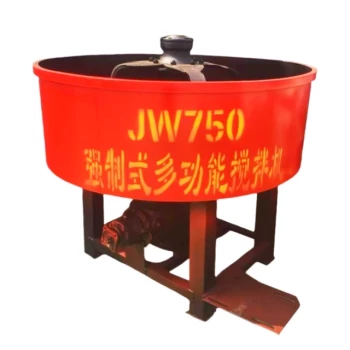
The primary limitations of non-tilting drum mixers are their slow discharge process, a higher risk of concrete segregation, and unsuitability for very large aggregates. Because the drum does not tilt to empty its contents, it must rely on an internal chute or a reversal of rotation, both of which are slower and less forceful than the rapid pour from a tilting mixer.
The core issue with non-tilting drum mixers stems from their discharge mechanism. While their horizontal design is stable and mechanically simple, the slower, less-direct emptying process creates efficiency bottlenecks and potential quality control issues, defining their use case for specific project types.
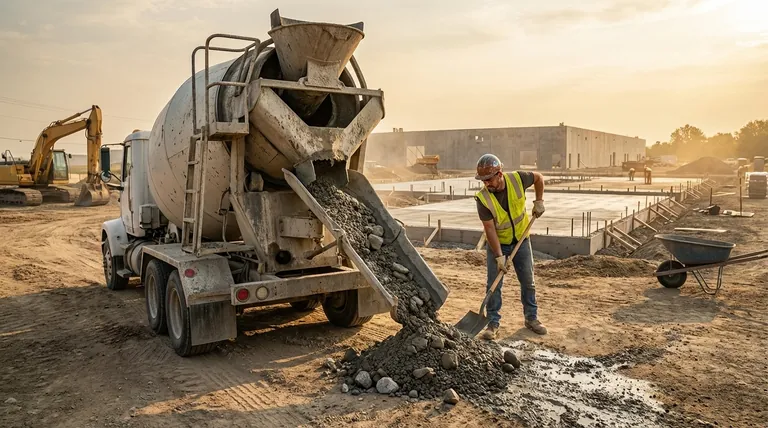
Understanding the Non-Tilting Mechanism
To grasp the limitations, we must first understand how these mixers operate. Unlike their tilting counterparts, non-tilting mixers maintain a fixed drum position, rotating on a horizontal axis to mix materials.
The Horizontal Rotation
The drum has openings at both ends: one for loading raw materials (the charging chute) and one for unloading mixed concrete (the discharge chute). The entire mixing process happens while the drum remains horizontal.
The Role of Internal Blades
Inside the drum, fixed blades are designed to lift and tumble the aggregates, cement, and water as the drum rotates. This action ensures a consistent blending of all components.
The Chute-Based Discharge
When mixing is complete, an inclined chute is inserted into the drum. The same internal blades that performed the mixing then carry the concrete up and drop it onto the chute, guiding it out of the mixer.
Key Limitations Explained
The operational design of non-tilting mixers leads directly to several practical constraints on a job site.
Slow Discharge and Segregation Risk
Discharging via a chute is a relatively slow and passive process. This lack of speed can become a significant bottleneck on large projects. More importantly, this slow discharge increases the risk of segregation, where heavier aggregates separate from the cement paste, compromising the final strength and consistency of the concrete.
Unsuitability for Large Aggregates
These mixers perform best with aggregates no larger than 7.5cm (approximately 3 inches). The internal blade and chute system is not designed to efficiently handle or discharge oversized materials without causing blockages or poor mixing.
Potential for Material Sticking
A common issue is the tendency for wet concrete and mortar to stick to the bottom of the drum. This requires a mitigation practice known as "buttering," where a small batch of cement mortar is mixed first to coat the drum's interior before the main concrete production begins.
A Key Variation: The Reversing Drum Mixer
It's important to distinguish between simple non-tilting mixers and a more advanced subtype known as the reversing drum mixer.
How Reversing Mixers Work
A reversing drum mixer is technically a non-tilting mixer, but it uses a different discharge method. It features two sets of internal blades. When the drum rotates in one direction, the blades mix the concrete. To discharge, the drum's rotation is reversed, and the second set of blades efficiently pushes the mix toward the discharge opening.
Key Advantages
This reversing action provides a more controlled and powerful discharge than a simple chute system. It is particularly effective for handling dry or low-slump concrete mixes and can produce a very uniform final product. Large-capacity reversing mixers are sometimes used on larger projects where these specific mix types are required.
Understanding the Trade-offs: Simplicity vs. Efficiency
The choice to use a non-tilting mixer involves a clear trade-off between its simple design and its operational efficiency.
The Benefit of Simplicity
The primary advantage is mechanical simplicity. With fewer moving parts than a tilting mixer, non-tilting models generally have lower maintenance requirements and are easier to operate, making them a cost-effective choice for smaller operations.
The Cost of Inefficiency
The trade-off for this simplicity is speed. The slower mixing and discharge cycle makes these mixers less suitable for high-volume, time-sensitive projects. The potential for segregation also requires more diligent quality control from the operator.
Choosing the Right Mixer for Your Project
Your decision should be guided by the specific demands of your project, including scale, mix design, and timeline.
- If your primary focus is small-scale projects or general utility work: The simple design and low maintenance of a standard non-tilting mixer make it a reliable and economical choice.
- If your primary focus is high-volume production and speed: A tilting mixer's rapid discharge capability is far more suitable for minimizing cycle times and meeting demanding schedules.
- If your primary focus is producing very uniform, dry, or low-slump concrete: A reversing drum mixer offers the control and discharge power needed for these specialized applications.
Ultimately, matching the equipment's inherent strengths and weaknesses to your project's goals ensures the most efficient and successful outcome.
Summary Table:
| Limitation | Key Impact |
|---|---|
| Slow Discharge | Creates bottlenecks on large projects, increases cycle time. |
| Segregation Risk | Compromises concrete strength and consistency due to slow pour. |
| Small Aggregate Size Limit | Unsuitable for aggregates larger than 7.5cm (3 inches). |
| Material Sticking | Requires 'buttering' process, adding time and complexity. |
Don't Let Mixer Limitations Slow Your Project Down
Choosing the right concrete mixer is critical for efficiency, quality, and meeting project deadlines. While non-tilting mixers have their place, their limitations in speed and discharge control can be a major hindrance.
GARLWAY specializes in providing robust and efficient construction machinery solutions for contractors and construction companies worldwide. We offer a range of concrete mixers and batching plants designed to overcome these common challenges, ensuring fast, consistent, and high-quality concrete production.
Let us help you select the perfect equipment for your specific needs.
Contact GARLWAY today for a consultation and discover how our reliable machinery can power your success.
Visual Guide

Related Products
- Concrete Cement Mixer Machine Drum Mixer for Construction
- Belle Mixer Drum Self Loading Mortar Mixers JS3000
- JDY350 Electric Hydraulic Mortar Mud Concrete Mixer
- Commercial Construction Mixer Machine for Soil Cement Mixing Concrete
- Construction Products Concrete Plant Machine Mixing Concrete Mixer
People Also Ask
- What are the key advantages of using drum mixers in concrete mixing? Boost Volume & Efficiency on Your Site
- What are the key components that maintain concrete mix consistency in the drum? Ensure Uniform Quality from Plant to Site
- How do cement mixers enhance safety on construction sites? Reduce Strain, Hazards, and Accidents
- When was the first concrete mixer developed and by whom? Discover the 1900 Breakthrough
- What is the average lifespan of a concrete mixer? Maximize Your Equipment's Lifespan & ROI