
At its core, quality assurance for concrete lift machines involves a two-pronged approach: manufacturing in strict adherence to established engineering standards like IS 1791:1968 and conducting a series of rigorous functional tests before the machine is dispatched. This ensures the equipment is not only built correctly but also performs reliably and safely from the moment it arrives on your site.
The goal of pre-delivery quality assurance is to move beyond simple inspection. It's about systematically verifying that the machine's materials, construction, and operational performance meet a proven engineering benchmark, thereby minimizing the risk of receiving faulty or unsafe equipment.
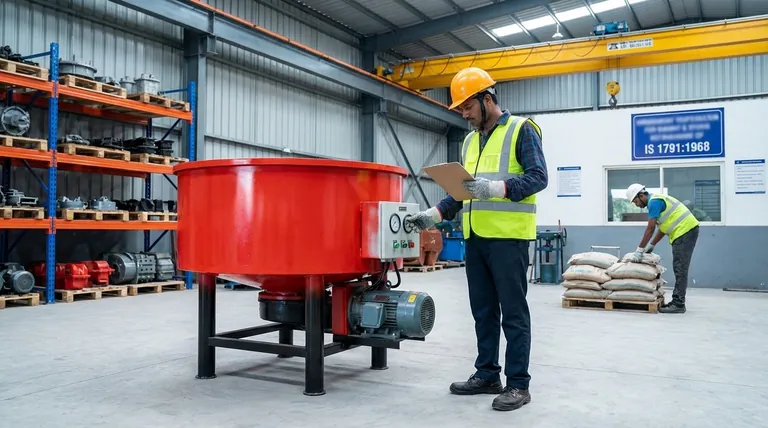
The Foundation of Quality: Adherence to IS 1791:1968
The claim that a machine adheres to a standard like IS 1791:1968 is the most significant quality guarantee. This standard provides a comprehensive framework for manufacturing, dictating the minimum acceptable quality for every critical aspect of the machine.
What This Standard Governs
IS 1791:1968 is an Indian Standard specifically for batch-type concrete mixers. Compliance means the manufacturer is following established specifications for key areas.
Material Integrity and Grade
The standard dictates the quality and thickness of the steel used for the mixing drum, chassis, and other structural components. This ensures the machine has the foundational strength to withstand the stresses of mixing and lifting heavy materials over its service life.
Construction and Workmanship
Adherence to the standard governs the quality of manufacturing itself. This includes specifications for welding, fastening, and the precise alignment of components, which are crucial for the machine's structural integrity and operational smoothness.
Component Performance
The standard ensures that critical components, such as the power unit (motor) and transmission system, are appropriately rated for the machine's capacity. This prevents under-powered or over-stressed systems that lead to premature failure.
Pre-Delivery Testing: From Assembly to Operation
Beyond building the machine to a specific standard, manufacturers perform extensive functional tests on the fully assembled unit. This is the final verification that all components work together as intended.
No-Load Functional Test
The first step is to run the machine without any materials. Technicians check for the smooth operation of the motor, gearbox, and drum rotation, listening for any unusual noises and ensuring all moving parts function without obstruction.
Simulated Load and Stress Test
The machine is then tested under conditions that mimic real-world use. This confirms that the motor can handle the required torque, the lifting mechanism operates correctly under weight, and the frame remains stable during a full operational cycle.
Safety System Verification
A critical part of the final inspection is ensuring all safety features are fully functional. This includes checking emergency stop buttons, safety guards for moving parts, and any overload protection mechanisms.
What to Verify Before Accepting Delivery
While manufacturers perform these checks, understanding them empowers you to verify the quality for yourself. True assurance comes from documented proof, not just verbal claims.
Insist on Documentation
A reputable manufacturer will be able to provide documentation certifying that the machine conforms to IS 1791:1968. You should also request the quality control checklist or report from its final pre-delivery inspection.
Link a Standard to a Specific Component
Ask specific questions. Instead of "Is it high quality?," ask, "What grade of steel is the drum made from, and does it meet the specification in IS 1791?" This demonstrates your technical knowledge and elicits a more precise answer.
The Role of Post-Delivery Care
Remember that quality assurance does not end at the factory gate. Proper installation, operator training, and a consistent maintenance schedule are essential to preserving the machine's safety and reliability throughout its working life.
Making the Right Choice for Your Goal
When procuring a concrete lift machine, use this knowledge to ask targeted questions that align with your primary needs.
- If your primary focus is safety and compliance: Demand the manufacturer's certificate of conformity to IS 1791:1968 and the documented results of the pre-delivery safety system checks.
- If your primary focus is operational reliability: Inquire about the specific load testing protocols used and the brands of critical components like the motor and gearbox.
- If your primary focus is long-term durability: Ask for the material specifications for the mixing drum and chassis to ensure they meet the standard's requirements for thickness and grade.
By understanding the standards and testing protocols, you can confidently verify the quality of your concrete lift machine before it ever reaches your site.
Summary Table:
| Quality Assurance Measure | Key Focus | Benefit to You |
|---|---|---|
| Adherence to IS 1791:1968 | Material grade, construction, component specs | Guarantees structural integrity and compliance |
| No-Load & Load Testing | Motor, gearbox, drum operation under stress | Verifies real-world performance and reliability |
| Safety System Verification | Emergency stops, guards, overload protection | Ensures operator safety from day one |
Ensure your next project starts with reliable, safe, and compliant equipment.
GARLWAY specializes in construction machinery, offering robust concrete mixers and batching plants built to strict standards like IS 1791:1968. Our rigorous pre-delivery testing ensures every machine delivers maximum uptime and safety for construction companies and contractors.
Contact GARLWAY today for a machine you can trust.
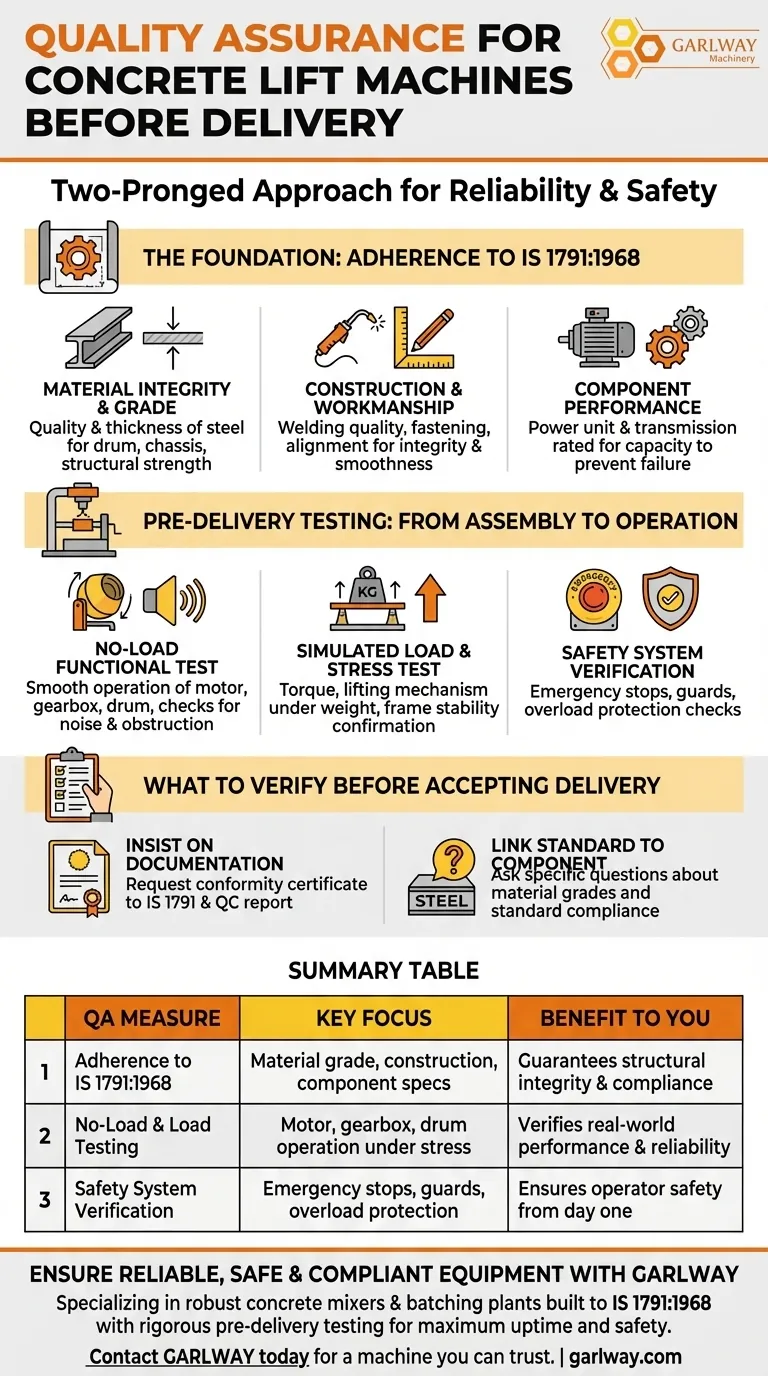
Visual Guide
Related Products
- Portable Cement Mixer with Lift Concrete Machine
- Portable Electric Small Cement Mixer Concrete Machine
- Hydraulic Concrete Mixer Machine Cement Mixing Equipment for Mixture Concrete
- Portable Concrete Mixer Machine Equipment for Mixing Concrete
- Auto Concrete Cement Mixer Machine New
People Also Ask
- What are the size and portability options for portable cement mixers? Find Your Perfect Match for Any Job
- Why is it necessary to use a portable concrete mixer? Gain Total Control & Efficiency
- How much concrete can you pour with a portable mixer? Find the Perfect Fit for Your Project
- What is a portable cement mixer? Achieve Consistent, On-Demand Concrete Mixing
- What are the power sources for portable cement mixers? Choose the Right Power for Your Job Site








