
In short, a Quick Capstan is a deck-mounted vertical winch used for mooring and maneuvering a vessel. It provides a powerful mechanical advantage, allowing a crew member to easily handle heavy dock lines that would be impossible to manage by hand, especially under tension.
A capstan is fundamentally a powered tool that multiplies force for handling heavy ropes. Its primary role is to make the demanding tasks of docking and maneuvering a boat safer, more controlled, and less physically strenuous for the crew.
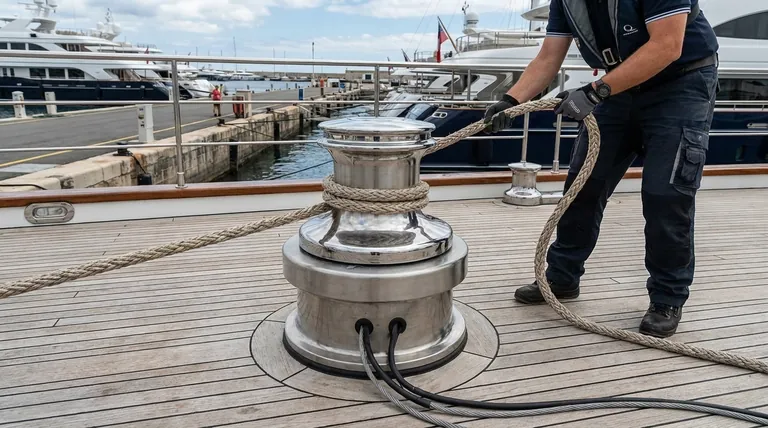
The Core Function: A Force Multiplier on Deck
A capstan's design is simple but highly effective. It consists of a rotating vertical drum, known as the warping head, powered by an electric or hydraulic motor. By wrapping a line around this drum, a single person can control immense loads with minimal effort.
Mooring and Docking
This is the most common application. When coming alongside a dock, lines are passed ashore and then brought back to the capstan. By engaging the motor, the capstan hauls the line, pulling the vessel snugly and securely against the pier.
Maneuvering and Warping
In tight quarters, a capstan can be used to "warp" the boat. This involves using a line to pivot the vessel or pull it along a dock without using the main engines, allowing for extremely precise and controlled movements in a confined space like a marina.
The Vertical Advantage
The vertical orientation of the drum is key. It allows a crew member to apply tension and pull lines from various angles on the deck, which is essential for the dynamic nature of mooring and maneuvering operations.
Distinguishing Capstans from Other Deck Machinery
It's easy to confuse a capstan with other deck equipment. Understanding the distinction clarifies its specific purpose.
Capstan vs. Anchor Windlass
An anchor windlass is designed specifically for deploying and retrieving an anchor. It often has a horizontal orientation and a special gypsy wheel to handle anchor chain. A capstan is a more general-purpose tool for handling fiber ropes (lines).
General Mooring vs. Tender Capstans
As the name implies, a general-purpose Quick Capstan is built for the high-stress, variable work of mooring. In contrast, a tender capstan is a specialized, often smaller unit designed for the single, repetitive task of pulling a tender or dinghy into its onboard garage.
Understanding the Trade-offs
While incredibly useful, capstans are not without their considerations. Being aware of the trade-offs is crucial for safe and effective operation.
Power and Installation
Capstans are powerful machines that require significant electrical power. They must be installed on a structurally reinforced part of the deck to handle the immense pulling forces they generate.
It's an Assist, Not an Automaton
A capstan does not operate on its own. A crew member must still "tail" the line—maintaining light tension on the free end—to ensure the wraps grip the drum. It assists the user; it doesn't replace them.
Significant Safety Considerations
The forces involved in mooring are enormous. Proper training is essential to avoid getting fingers, hands, or clothing caught in the line or the drum, which can cause severe injury.
Making the Right Choice for Your Goal
Selecting the right deck machinery depends entirely on the primary task you need to accomplish.
- If your primary focus is safe and controlled docking, especially with a shorthanded crew: A Quick Capstan is the ideal tool for managing heavy mooring lines.
- If your primary focus is reliable anchoring: A dedicated anchor windlass designed for your anchor and chain size is the correct equipment for the job.
- If your primary focus is retrieving a heavy tender into its garage: A specialized tender-retrieval capstan or winch system is better suited for this specific task.
Ultimately, a Quick Capstan serves as a powerful and reliable deckhand, simplifying the most demanding line-handling tasks on board.
Summary Table:
| Function | Key Feature | Benefit |
|---|---|---|
| Mooring & Docking | Hauls heavy lines from dock | Secures vessel with minimal crew effort |
| Maneuvering (Warping) | Pulls vessel in tight spaces | Enables precise movement without main engines |
| Force Multiplication | Vertical, powered drum | Allows a single person to handle immense loads |
| Key Distinction | Handles fiber ropes (lines) | Different from anchor windlasses (for chain) |
Simplify your vessel's most demanding operations with reliable deck machinery from GARLWAY.
As a specialist in heavy-duty equipment for marine and construction industries, we understand the critical need for power, safety, and durability. Our range of robust winches and capstans is engineered to provide the mechanical advantage your crew needs for safe mooring and precise maneuvering.
Whether you operate a commercial vessel or a large yacht, GARLWAY's solutions are designed to enhance operational efficiency and crew safety.
Contact our experts today to discuss the right deck equipment for your specific vessel and operational goals.
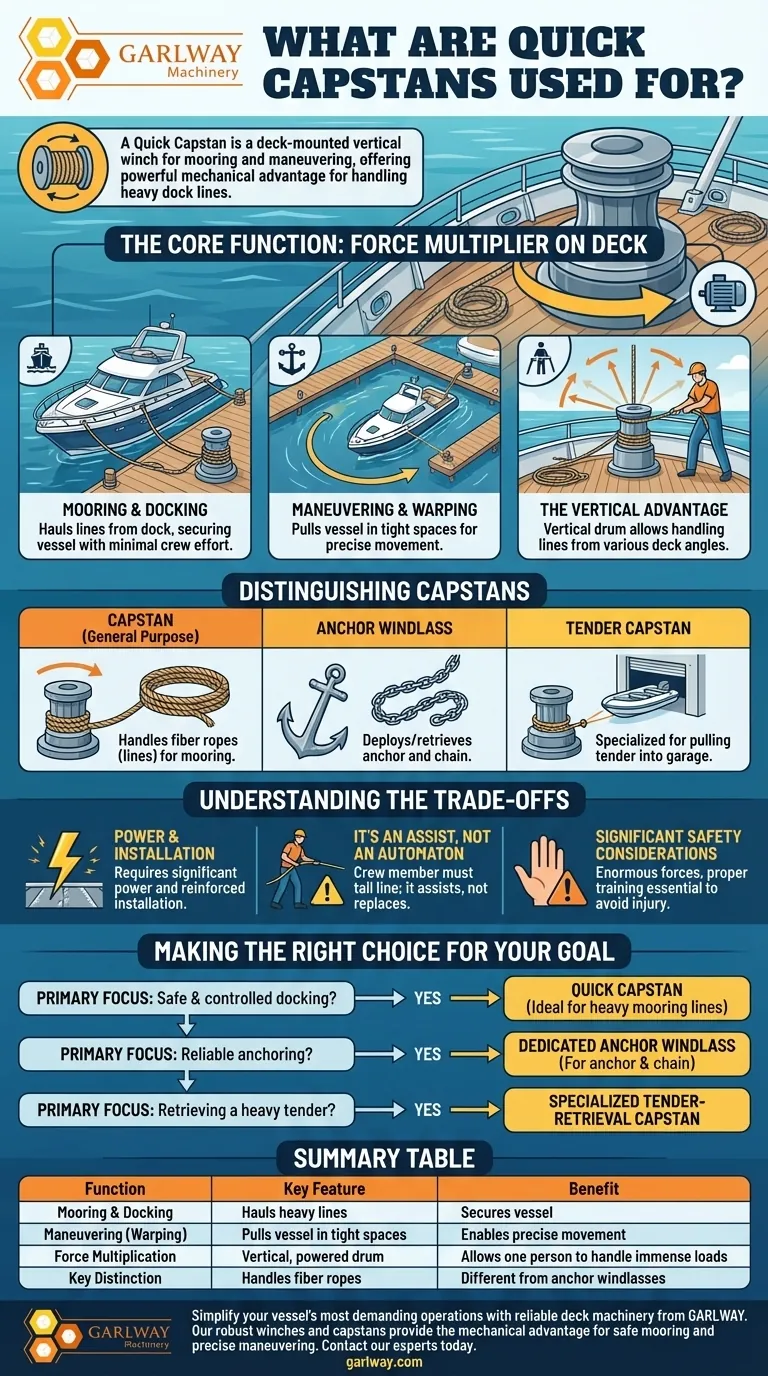
Visual Guide
Related Products
People Also Ask
- What features were incorporated into the upgraded portable winch system? Boost Your Recovery Power & Safety
- What are some uses mentioned for portable winches beyond vehicle recovery? Essential Versatility for Property & Work
- How could the twisting issue with a portable winch be mitigated? Achieve Safe, Centered Pulls with Proper Rigging
- What are the primary uses of a portable winch for a truck? Boost Your Truck's Capability and Self-Reliance
- What is the single rope traction force of the quick winch without a pulley block? 0.5 to 40 Tons Explained
