
The defining characteristic of a reversing drum mixer is its unique method of operation, which relies entirely on the direction of its rotation to control its function. Unlike other mixers that tilt to empty their contents, this machine mixes materials when rotating in one direction and actively discharges them by rotating in the opposite direction.
At its core, the reversing drum mixer trades the raw speed of a tilting mechanism for the precision of a mechanically controlled discharge. This design choice results in a highly consistent mix but makes it best suited for specific project scales where quality and control are paramount.
The Core Mechanism: Directional Control
The genius of the reversing drum mixer lies in its simplicity and the dual-function design of its internal blades. The entire process is governed by a single variable: the direction of rotation.
The Mixing Phase
When the drum rotates in its primary mixing direction, specially designed blades continuously lift and tumble the aggregates, cement, and water. This action folds the materials into each other, ensuring a thorough and highly uniform blend.
The Discharging Phase
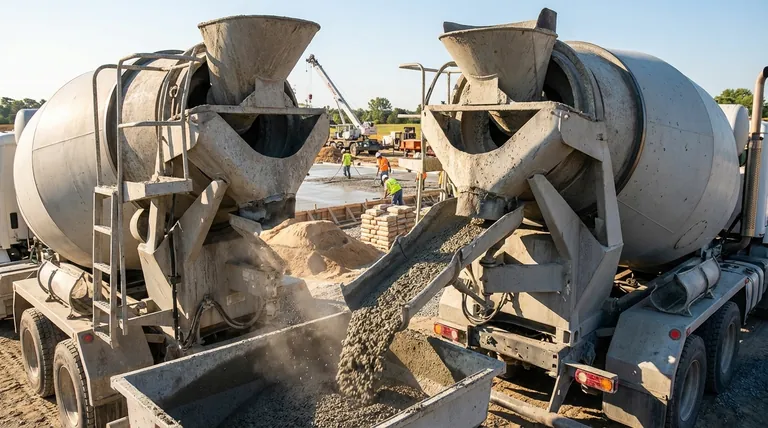
To empty the mixer, the operator simply reverses the direction of rotation. The same blades that efficiently mixed the concrete now act like an Archimedes' screw, pushing the finished mix forward and out of the discharge opening in a steady, controlled stream.
The Role of Dual Openings
This process is facilitated by a design featuring two separate openings. One opening is used for charging (loading the raw materials), while the other is dedicated to discharging the finished concrete, which helps streamline the workflow.
How This Operation Compares to Other Mixers
Understanding the reversing drum's unique operation is clearest when compared to the two other common types of drum mixers.
Contrast with Tilting Drum Mixers
Tilting mixers use a single, large opening for both loading and unloading. To discharge, the entire drum is tilted downwards, relying on gravity for a rapid and high-volume release of concrete. This method is fast but can be less precise than the controlled flow from a reversing mixer.
Contrast with Non-Tilting Drum Mixers
Non-tilting mixers are the simplest design. They mix effectively but lack any mechanical assistance for unloading. Discharging the concrete requires manual labor, typically by scooping it out, making them inefficient for anything beyond very small tasks.
Understanding the Trade-offs
The reversing drum's design creates a distinct set of advantages and limitations that are critical to understand before selecting one for a project.
Advantage: Superior Mix Quality
The continuous tumbling action and blade design are engineered to produce a highly homogeneous mix. This consistency is a significant benefit for projects where the final strength and finish of the concrete are critical.
Advantage: Controlled Discharge
Because the discharge is mechanical rather than gravity-fed, the operator has precise control over the flow rate. This is invaluable when filling smaller forms, wheelbarrows, or in situations that require a steady, manageable pour.
Limitation: Cost and Complexity
The reversing motor and control systems make these mixers more mechanically complex and generally more expensive than simpler tilting models. This initial investment can be a significant factor in the decision-making process.
Limitation: Optimal Project Scale
While highly effective, reversing drum mixers are typically best suited for small to medium-sized projects. For large-scale, high-volume concrete production, the faster discharge cycle of a large tilting mixer is often more efficient.
Making the Right Choice for Your Project
Choosing the correct mixer type depends entirely on the priorities of your specific application.
- If your primary focus is mix consistency and controlled discharge: The reversing drum mixer is an excellent choice, especially for projects where precision is more important than raw speed.
- If your primary focus is high-volume output and speed: A tilting drum mixer is likely more efficient due to its rapid, gravity-assisted discharge cycle.
- If your primary focus is minimal cost for small, occasional tasks: A basic non-tilting mixer may be sufficient, but you must account for the manual labor required to unload it.
Understanding this operational difference—control through rotation versus speed through tilting—is the key to selecting the right tool for your specific concrete needs.
Summary Table:
| Feature | Reversing Drum Mixer | Tilting Drum Mixer | Non-Tilting Mixer |
|---|---|---|---|
| Discharge Method | Mechanical, reverse rotation | Gravity, tilting drum | Manual scooping |
| Mix Quality | Highly homogeneous, consistent | Good, but less precise | Basic |
| Discharge Control | Precise, steady flow | Fast, high-volume | Labor-intensive |
| Best For | Small to medium projects, precision work | Large-scale, high-volume output | Very small, occasional tasks |
| Cost & Complexity | Higher | Moderate | Low |
Need a reliable concrete mixer for your construction project? GARLWAY specializes in construction machinery, offering high-performance reversing drum mixers, concrete batching plants, and winches for contractors and construction companies globally. Our mixers deliver the precise control and consistent quality you need for demanding applications. Contact our experts today to find the perfect solution for your specific needs and enhance your project's efficiency and results!
Visual Guide

Related Products
- Belle Mixer Drum Self Loading Mortar Mixers JS3000
- Concrete Cement Mixer Machine Drum Mixer for Construction
- Portable Cement Mixer with Lift Concrete Machine
People Also Ask
- What are the features of mobile transporting in a self loading mixer? Boost On-Site Efficiency
- Why is timely cleaning important for a self loading mixer? Prevent Costly Downtime and Mix Failure
- How is discharging accomplished in a self loading mixer? Master Precise Concrete Placement
- What is the purpose of keeping the drum rotating during transportation in a self loading concrete mixer? Ensure Quality & Consistency
- What components are involved in the loading process of a self loading concrete mixer? A Guide to the Key Systems


