
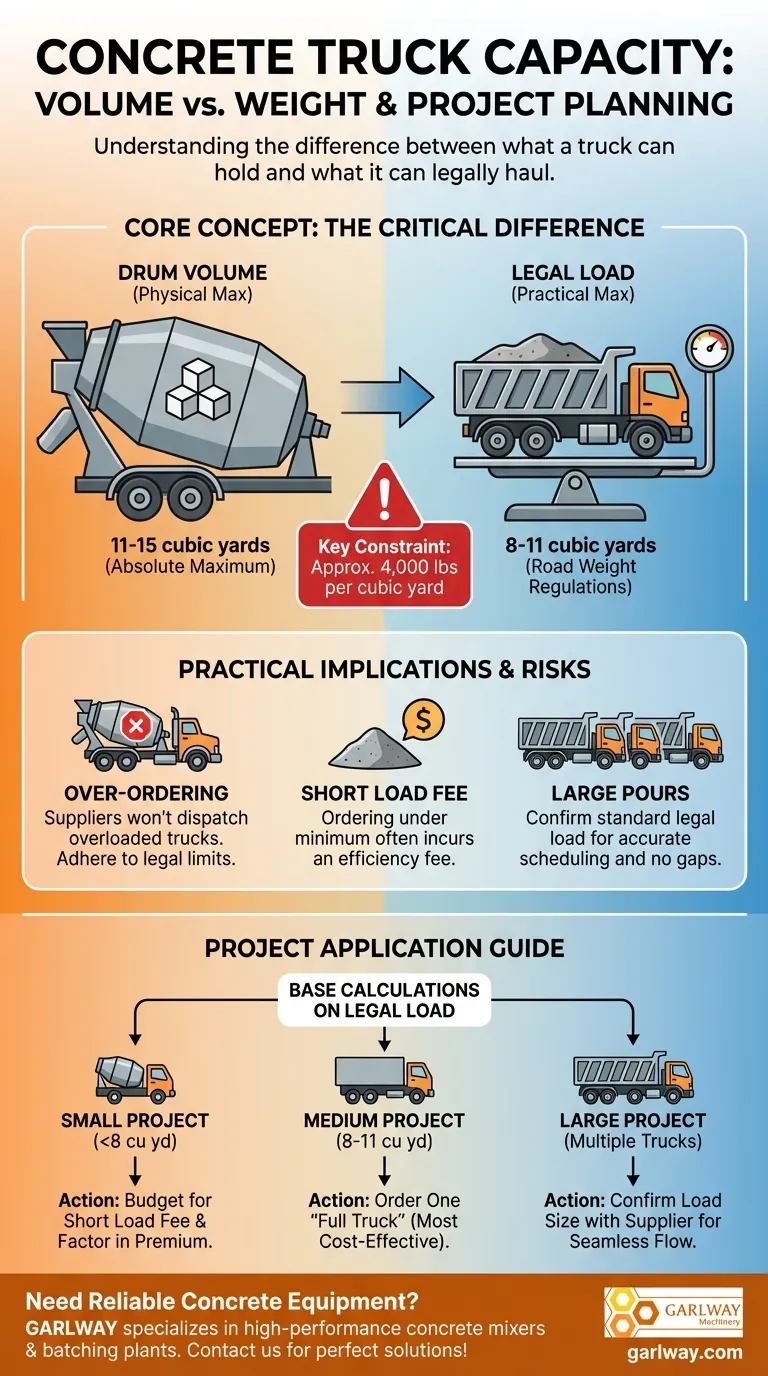
On average, a standard concrete mixer truck has a drum that can hold 11 to 15 cubic yards of concrete. However, the actual amount it can legally transport is almost always less, typically falling between 8 and 11 cubic yards. This critical difference is dictated not by the drum's volume, but by strict road weight regulations.
The most important factor determining a concrete truck's capacity is not its drum size, but the legal weight limit it can carry on public roads. For planning purposes, you should always assume a "full truck" contains between 8 and 11 cubic yards.
Volume vs. Weight: The Two Capacities of a Concrete Truck
The confusion around a concrete truck's capacity stems from the difference between how much the mixing drum can physically hold (volume) and how much the truck is legally allowed to weigh on the road (gross vehicle weight).
Drum Capacity (Volume)
A typical rear-discharge concrete mixer is built with a large steel drum. The internal volume of this drum is generally between 11 and 15 cubic yards. This is the absolute maximum amount of material the drum can contain.
Legal Load Limit (Weight)
The true constraint is weight. Concrete is incredibly heavy, weighing approximately 4,000 pounds per cubic yard.
Federal, state, and local Department of Transportation (DOT) regulations set strict limits on the maximum weight a vehicle can carry per axle to prevent damage to roads and bridges. A fully loaded concrete truck can easily exceed these limits.
Because of these weight restrictions, a truck with a 14-cubic-yard drum is often only legally permitted to carry 8, 10, or perhaps 11 cubic yards of concrete.
Understanding the Practical Implications
Failing to distinguish between drum volume and legal load can lead to costly planning mistakes and project delays. The legal load is the only number that matters when ordering.
The Problem with "Over-Ordering"
You cannot simply request a 14-cubic-yard delivery, even if the truck's drum is that large. The concrete supplier (the batch plant) is legally responsible for adhering to weight limits and will not dispatch an overloaded truck.
The "Short Load" Fee
Most concrete suppliers have a minimum order quantity, which is often the truck's maximum legal load (e.g., 8 cubic yards).
If you order less than this minimum, you will likely be charged a "short load" fee. This fee compensates the company for the inefficiency of sending a truck out with less than a full, profitable load.
Planning for Large Pours
For large projects requiring multiple trucks, always confirm the supplier's standard legal load size. This ensures you can accurately schedule deliveries and manage the pour efficiently without unexpected gaps or delays.
How to Apply This to Your Project
Base your calculations on the supplier's stated legal load, not the theoretical maximum volume of the drum.
- If your project is small (less than 8 cubic yards): Be prepared to pay a short load fee and factor this premium into your budget.
- If your project is medium (8 to 11 cubic yards): You can likely order one "full truck," which is the most cost-effective way to buy concrete.
- If your project is large (requiring multiple trucks): Communicate clearly with your supplier to confirm their maximum legal load per truck to ensure seamless scheduling.
Ultimately, understanding the distinction between a truck's volume and its legal weight capacity is the key to efficient and cost-effective concrete ordering.
Summary Table:
| Capacity Type | Typical Range | Key Constraint |
|---|---|---|
| Drum Volume (Physical Max) | 11 - 15 cubic yards | Physical size of the drum |
| Legal Load (Practical Max) | 8 - 11 cubic yards | Road weight regulations (approx. 4,000 lbs/yd³) |
Need the Right Concrete Mixer for Your Project?
Understanding truck capacity is just the first step. For a seamless pour, you need reliable equipment. GARLWAY specializes in high-performance construction machinery, including durable concrete mixers and batching plants designed for contractors and construction companies worldwide.
We help you maximize efficiency and profitability on every job. Contact GARLWAY today to find the perfect concrete solution for your needs!
Visual Guide
Related Products
- Ready Mixer Machine for Construction Ready Mix Machinery
- Mini Cement Mortar Mixer Truck for Construction
- JW1000 Mobile Cement Mixer Concrete Mixer Truck and Batching Plant
- Skid Steer Self Loading Concrete Mixers for Construction
- Harbor Freight JS1500 On Site Concrete Mixing Volumetric Cement Mixer
People Also Ask
- What are the purposes of low-speed agitation in truck mixers? Preserve Concrete Quality During Transit
- How is ready-mixed concrete transported from a commercial concrete batching plant? Ensuring Quality & Timely Delivery
- What are the main ingredients mixed in a concrete mixer truck? Master the Formula for Strong Concrete
- In what ways does a mobile concrete mixer improve quality control and consistency? Achieve Superior On-Site Concrete Quality
- What types of construction projects typically use concrete mixer trucks? From Highways to Home Foundations





