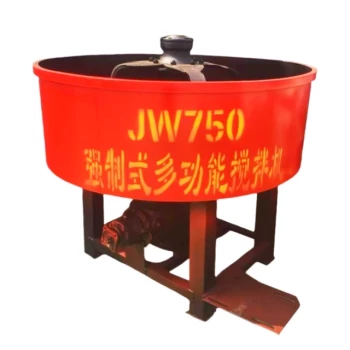
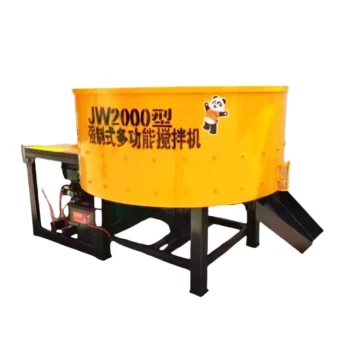
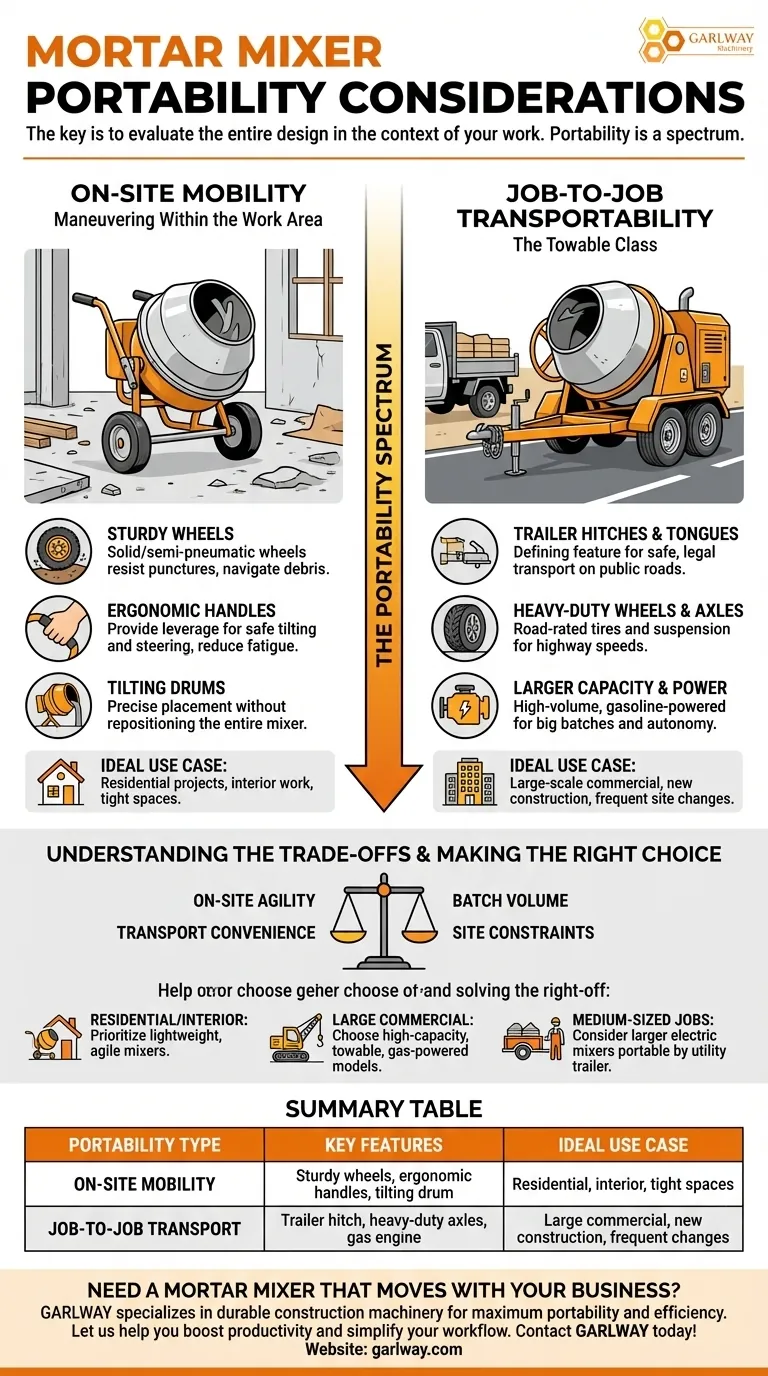
When considering mortar mixer portability, the key is to look beyond a single feature and evaluate the entire design in the context of your work. Portability exists on a spectrum, from models with wheels and handles designed for maneuverability within a single job site, to large, towable units built for transport between different locations.
The most critical insight is that "portability" isn't a single attribute. You must distinguish between on-site mobility (moving the mixer around a building) and job-to-job transportability (towing the mixer on public roads) to select the right machine.
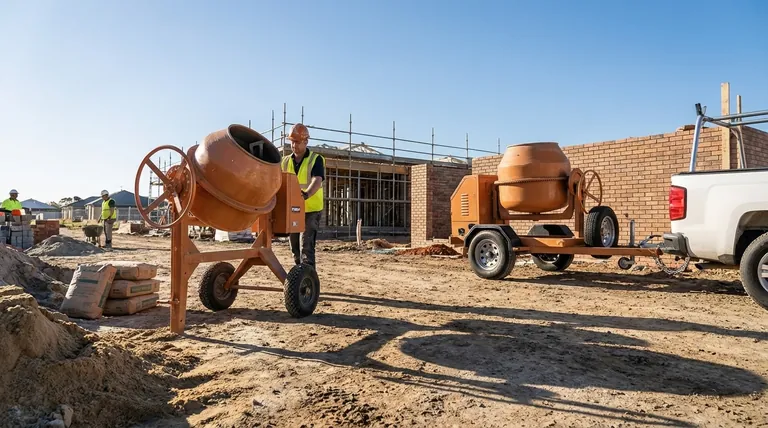
On-Site Mobility: Maneuvering Within the Work Area
For most residential or smaller commercial jobs, the primary concern is moving the mixer efficiently around the immediate work area.
Sturdy Wheels
The type and quality of the wheels are paramount. Solid rubber or semi-pneumatic wheels are common and resist punctures, making them ideal for navigating debris-laden sites.
Ergonomic Handles
Well-designed handles provide the leverage needed to safely tilt and steer a heavy machine. They reduce operator fatigue and improve control, especially when moving a loaded mixer over uneven ground.
Tilting Drums
While primarily for pouring, a tilting drum contributes to mobility. It allows the operator to precisely place a batch without having to reposition the entire mixer, saving time and effort.
Job-to-Job Portability: The Towable Class
For large-scale contractors or rental companies, moving equipment between job sites is a weekly, if not daily, reality. This requires a different class of mixer.
Trailer Hitches and Towing Tongues
This is the defining feature of a towable mixer. A standard trailer hitch allows the unit to be attached to a work truck for legal and safe transport on public roads.
Heavy-Duty Wheels and Axles
Unlike the smaller wheels on site-focused mixers, towable models feature road-rated tires, suspension, and heavy-duty axles capable of handling highway speeds.
Larger Capacity and Power Source
Towable mixers are built for high-volume jobs, which is why they feature much larger drum capacities. They are almost always powered by gasoline engines to provide the necessary torque for bigger batches and ensure operation without needing on-site electricity.
Understanding the Trade-offs
Choosing the right level of portability involves balancing competing factors. What you gain in one area, you often sacrifice in another.
On-Site Agility vs. Batch Volume
A smaller mixer with ergonomic handles is incredibly agile in tight spaces or on scaffolding. However, its small drum means you will be mixing more frequent batches, which can slow down a large crew.
Transport Convenience vs. Site Constraints
A towable mixer is unmatched for getting to a site, but it can be cumbersome once there. It requires a tow vehicle, more storage space, and can be difficult to position in tight or landscaped areas without causing damage.
Making the Right Choice for Your Project
Evaluate your typical workday and project scale to determine which features are most critical for your success.
- If your primary focus is residential projects or interior repair work: Prioritize a lightweight mixer with high-quality wheels and handles for maximum on-site agility.
- If your primary focus is large-scale commercial or new construction: A towable, gas-powered mixer is the professional standard for its high capacity and efficient job-to-job transport.
- If your primary focus is a mix of medium-sized jobs: Consider a larger-capacity electric mixer that is still light enough to be loaded onto a utility trailer by two people, offering a balance between output and mobility.
Ultimately, selecting the right mixer means aligning its transport design with the logistical demands of your work.
Summary Table:
| Portability Type | Key Features | Ideal Use Case |
|---|---|---|
| On-Site Mobility | Sturdy wheels, ergonomic handles, tilting drum | Residential projects, interior work, tight spaces |
| Job-to-Job Transport | Trailer hitch, heavy-duty axles, gas engine | Large-scale commercial, new construction, frequent site changes |
Need a mortar mixer that moves with your business?
GARLWAY specializes in durable construction machinery, offering a range of mortar mixers designed for maximum portability and efficiency. Whether you're a contractor needing agile on-site mobility or require high-capacity, towable models for large-scale projects, we have the right solution.
Let us help you boost productivity and simplify your workflow. Contact GARLWAY today to discuss your specific needs and find the perfect mixer for your job site demands!
Visual Guide
Related Products
- JDY350 Electric Hydraulic Mortar Mud Concrete Mixer
- JDC350 Small Cement Concrete Mortar Mixer
- Mini Cement Mortar Mixer Truck for Construction
- Belle Mixer Drum Self Loading Mortar Mixers JS3000
- JS1000 Volumetric Concrete Mortar Mixer for Sale Skid Steer Cement Mixer
People Also Ask
- When are electric mortar mixers typically used? Find the Perfect Tool for Small to Medium-Sized Jobs
- What are hydraulic concrete mixers used for? Powering Large-Scale Construction Projects
- How are mortar mixers utilized in concrete and grout projects? Maximize Your Mixing Efficiency
- What are the benefits of electric concrete mixers? Quiet, Clean, and Low-Maintenance Mixing
- What is a mortar mixer and what is its primary use? Master Masonry with the Right Equipment