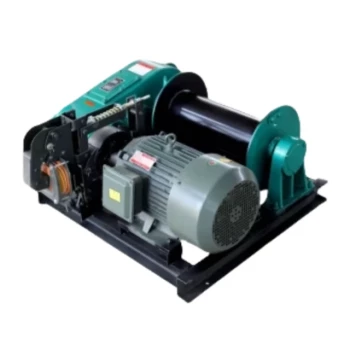
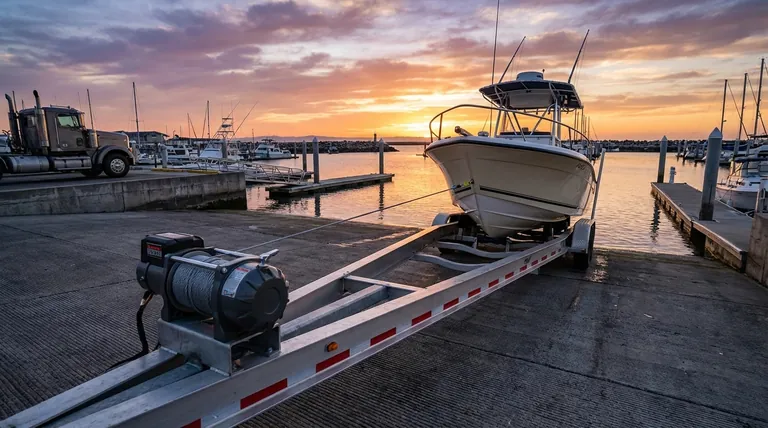
At the heart of every boat launch and recovery is the trailer winch. It is the essential mechanical device that provides the power needed to safely and efficiently pull a vessel from the water onto its trailer. More than a simple tool, it's a critical system that bridges the gap between land and water, turning a potentially difficult task into a controlled process.
A trailer winch is not merely a convenience; it's a fundamental piece of safety and operational equipment. The significance lies in its ability to provide mechanical advantage, ensuring that boats of any size can be handled safely, mitigating the risk of personal injury and equipment damage.
The Core Function: From Brute Force to Controlled Power
A boat and its engine are incredibly heavy, making it impossible to move them onto an inclined trailer by hand. The winch acts as a force multiplier, making this task manageable.
Mechanical Advantage in Action
A winch uses a system of gears to translate the relatively small force you apply (either by turning a crank or activating a motor) into a much larger pulling force. This allows a single person to move an object weighing thousands of pounds.
Manual vs. Electric: The Two Paths
The most fundamental distinction in trailer winches is their power source. Manual winches rely on human power to turn a crank, while electric winches use a 12-volt motor connected to the tow vehicle's battery.
A Closer Look at Winch Types
Understanding the specific mechanics of each type is crucial for appreciating their role and selecting the correct one for your needs.
Manual Winches: The Reliable Workhorse
Manual winches are valued for their simplicity, reliability, and lower cost. With fewer moving parts, there is less that can fail, and they require no external power source. Their effectiveness is determined by their gear ratio, which dictates how much pulling power is generated per crank turn.
Electric Winches: Power and Convenience
Electric winches offer unparalleled ease of use, retrieving a boat with the simple push of a button. They are significantly faster and eliminate the physical strain of manual cranking, which is especially important for larger boats or for operators with physical limitations.
Straps vs. Cables: The Critical Connection
The winch line itself is a key component. Steel cables are incredibly strong and abrasion-resistant but can develop sharp burrs and are extremely dangerous if they snap. Nylon straps are now more common, as they are less likely to cause injury if they break, won't rust, and are gentler on a boat's finish.
Understanding the Trade-offs and Safety Concerns
While essential, a trailer winch can also be a point of failure if not chosen, used, or maintained correctly. Objectivity requires acknowledging these risks.
The Danger of Undersizing Your Winch
A winch's capacity rating is its most important specification. Using a winch that is not rated for the total weight of your boat, motor, and gear puts immense strain on its components, creating a high risk of catastrophic failure during loading.
Maintenance is Non-Negotiable
Corrosion from saltwater, UV degradation of straps, and fraying of cables can all weaken the winch system over time. Regular inspection of the winch line, gears, and mounting bolts is a critical safety practice.
The Risk of a Line Breaking Under Load
A winch line under the load of a multi-thousand-pound boat stores a massive amount of potential energy. If it snaps, the recoiling line can cause severe injury or death. Always stand clear of the winch line's path during operation.
How to Select the Right Winch
Choosing the correct winch is a matter of matching the equipment to the specific load and environment.
Calculating Winch Capacity
The standard rule is to select a winch with a capacity of at least 1.5 times the total weight of your fully loaded boat (boat + motor + fuel + gear). For boaters who frequently use steep ramps, a capacity of 2 times the total weight is a safer choice.
Single-Speed vs. Two-Speed Manuals
For heavier boats, a two-speed manual winch is a significant upgrade. It offers a high-speed gear for quickly taking up slack and a low-speed, high-power gear for the difficult final pull onto the trailer bunks.
Considering Your Launch Environment
The steepness of the boat ramp directly impacts the force required to retrieve your vessel. Steeper ramps demand a winch with a higher capacity and a lower gear ratio to handle the increased load effectively.
Making the Right Choice for Your Boat
Your selection should be a deliberate decision based on your vessel, your physical abilities, and where you do your boating.
- If your primary focus is affordability and reliability for a smaller boat: A single-speed manual winch is your most straightforward and cost-effective solution.
- If your primary focus is ease of use and speed for a medium to large boat: An electric winch is a worthwhile investment that saves significant time and physical strain.
- If you frequently use steep ramps or have a heavier vessel: A two-speed manual winch provides the necessary mechanical advantage for a safe and controlled recovery.
By understanding these principles, you can ensure your trailer winch serves as a reliable and safe partner for every one of your boating adventures.
Summary Table:
| Winch Type | Best For | Key Features |
|---|---|---|
| Manual Winch | Smaller boats, budget-conscious users | Reliable, simple, no power source needed |
| Electric Winch | Medium to large boats, ease of use | Push-button operation, fast, reduces physical strain |
| Two-Speed Manual | Heavy boats, steep ramps | High-speed gear for slack, low-speed gear for power |
Need a reliable and powerful winch for your construction or marine project? GARLWAY specializes in manufacturing high-performance winches and other construction machinery, including concrete mixers and batching plants. Our equipment is designed for durability and safety, trusted by construction companies and contractors globally. Let us help you find the perfect solution for your heavy lifting and pulling needs. Contact GARLWAY today for a personalized consultation!
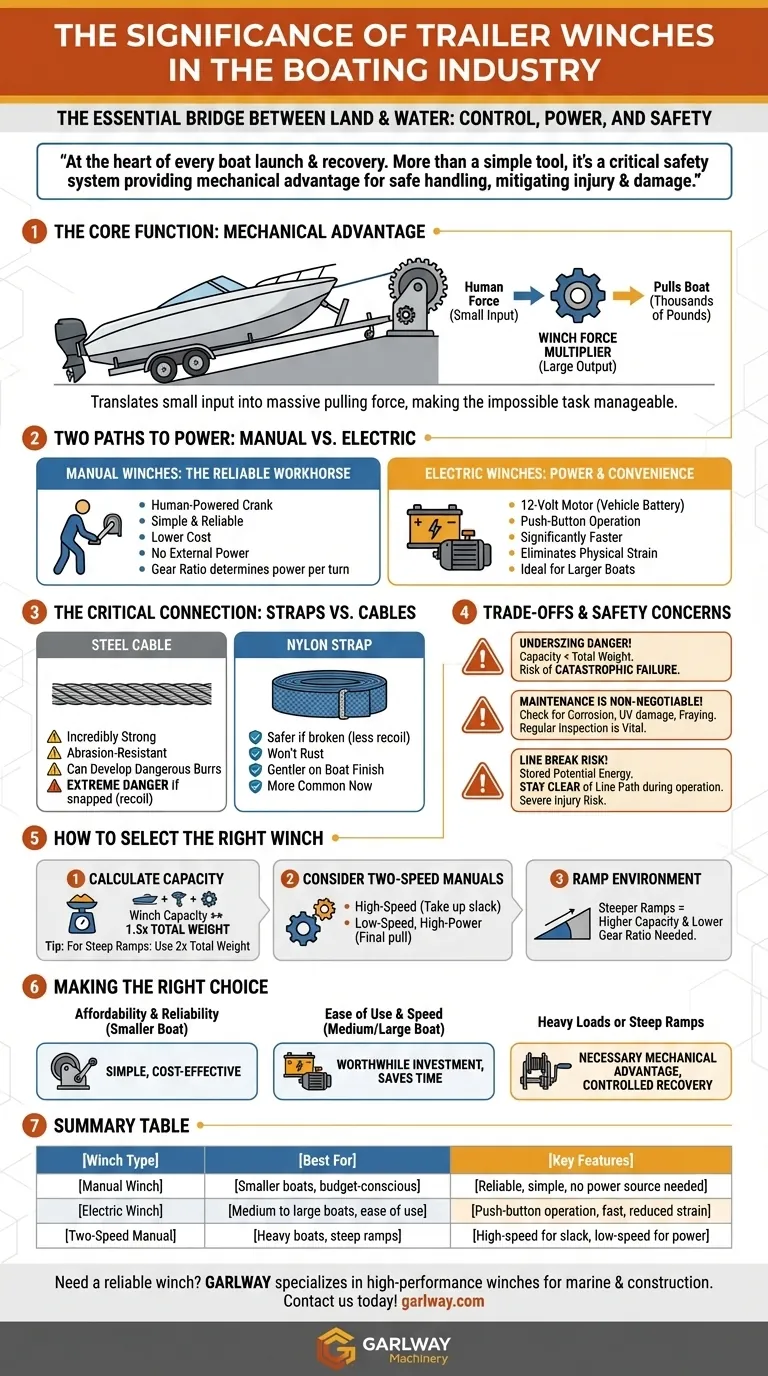
Visual Guide
Related Products
- Portable Small Trailer Winch
- 12000 lb Electric Boat Trailer Winch with Windlass Anchor Warn
- Warn Winch Windlass Boat Trailer Winch
- Best 18000 Pound Drum Anchor Trailer Winch
- Quick Windlass Portable Winch for Truck and Boat Best Boat Winch
People Also Ask
- What features were incorporated into the upgraded portable winch system? Boost Your Recovery Power & Safety
- What are some uses mentioned for portable winches beyond vehicle recovery? Essential Versatility for Property & Work
- How could the twisting issue with a portable winch be mitigated? Achieve Safe, Centered Pulls with Proper Rigging
- What should be considered when mounting a winch on a trailer? Ensure a Safe, Aligned Installation
- How can a winch be powered on a trailer? A guide to choosing the right setup for your needs.