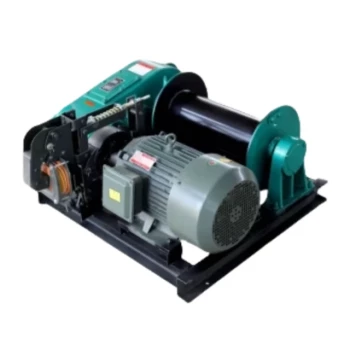
The primary advantages of electric hoists in warehouse operations are their ability to significantly increase speed, enhance precision, and improve worker safety. By automating vertical lifting, they reduce manual labor, which directly boosts throughput and allows personnel to be reallocated to more complex tasks.
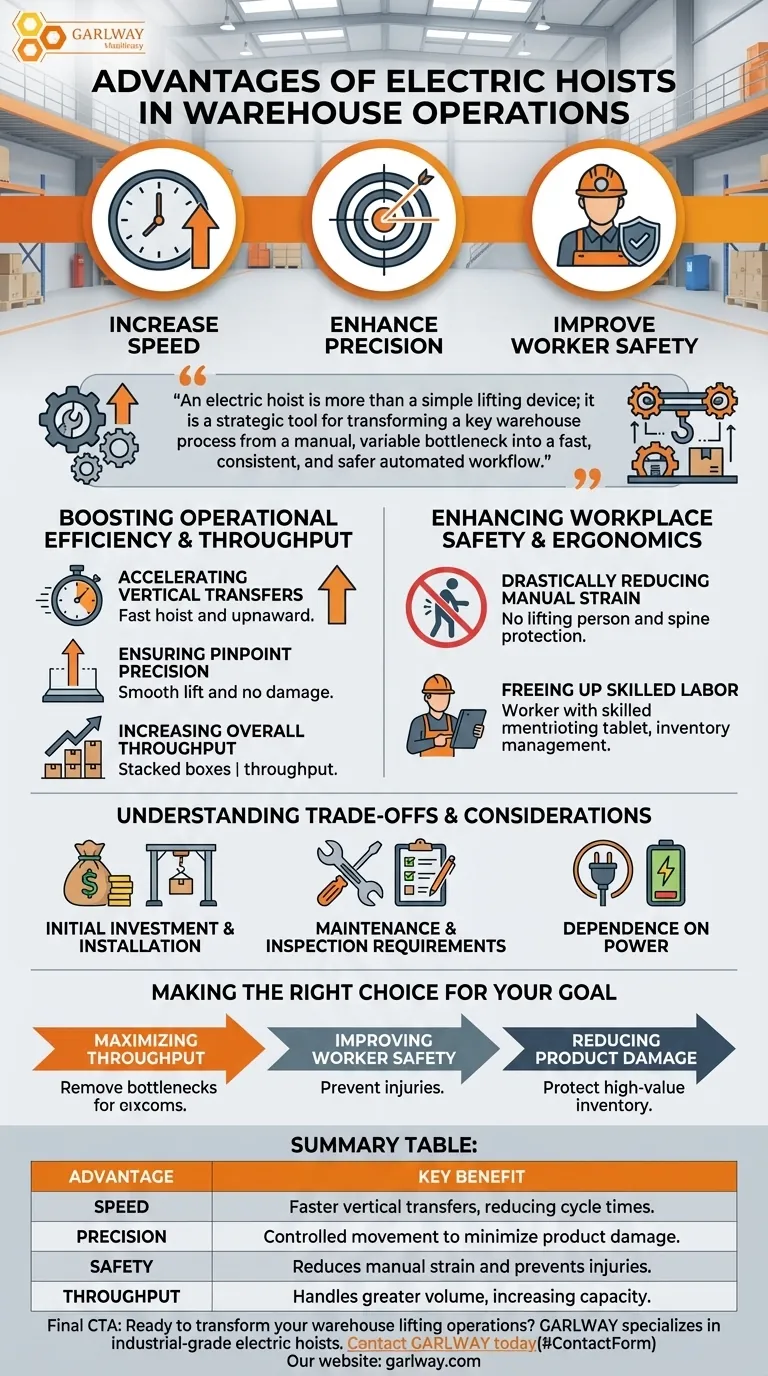
An electric hoist is more than a simple lifting device; it is a strategic tool for transforming a key warehouse process from a manual, variable bottleneck into a fast, consistent, and safer automated workflow.
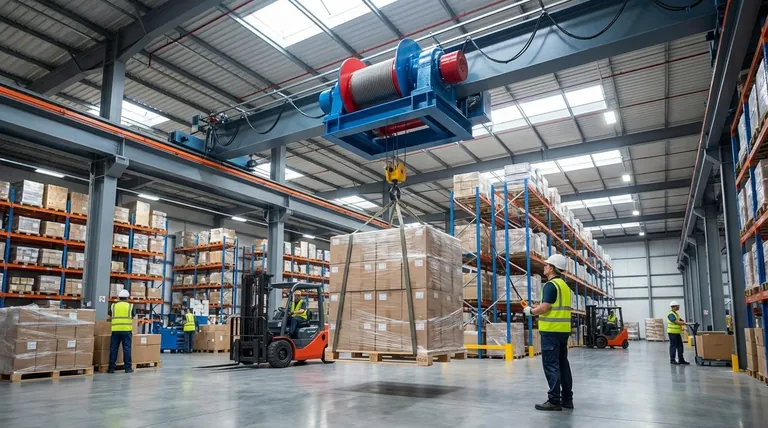
Boosting Operational Efficiency and Throughput
A core function of any warehouse is moving goods efficiently. Electric hoists directly address this by optimizing one of the most time-consuming and physically demanding parts of the process: vertical movement.
Accelerating Vertical Transfers
Electric hoists operate at a consistent and rapid pace, far exceeding the speed of manual lifting. This dramatically reduces the cycle time for moving items from storage racks to shipping docks or between different levels of a facility.
Ensuring Pinpoint Precision
These systems offer smooth, controlled movement. This precision is critical for placing heavy or delicate items without causing damage to the product, racking, or surrounding equipment, minimizing costly errors.
Increasing Overall Throughput
By speeding up the lifting process and reducing errors, electric hoists allow your facility to handle a greater volume of goods in the same amount of time. This increased throughput is a direct contributor to operational capacity and profitability.
Enhancing Workplace Safety and Ergonomics
Relying on manual labor for heavy lifting introduces significant risks. Electric hoists mitigate these risks by shifting the physical burden from the worker to the machine.
Drastically Reducing Manual Strain
The most immediate safety benefit is the reduction of manual handling. This helps prevent musculoskeletal injuries, which are among the most common and costly workplace injuries in warehouse environments.
Freeing Up Skilled Labor
When workers are no longer tied up with physically strenuous lifting, they can be deployed to higher-value tasks like inventory management, quality control, or order fulfillment. This optimizes the use of your workforce.
Understanding the Trade-offs and Considerations
While the benefits are substantial, adopting electric hoists requires a clear understanding of the associated responsibilities and limitations.
Initial Investment and Installation
Electric hoists represent a significant capital expenditure compared to purely manual solutions. The cost includes not only the hoist itself but also the supporting structure (like a gantry crane or monorail) and professional installation.
Maintenance and Inspection Requirements
To ensure safe and reliable operation, electric hoists require regular maintenance and periodic inspections as mandated by safety regulations. This represents an ongoing operational cost and requires diligent record-keeping.
Dependence on Power
As their name implies, these hoists depend on a stable electrical supply. A power outage can bring hoist-dependent operations to a complete halt unless a backup power source is available.
Making the Right Choice for Your Goal
To determine if an electric hoist is the right fit, evaluate it against your primary operational objectives.
- If your primary focus is maximizing throughput: An electric hoist's speed and consistency will directly remove lifting bottlenecks and increase the volume of goods you can process.
- If your primary focus is improving worker safety: The immediate reduction in manual lifting and the prevention of strain-related injuries provide a clear return on investment.
- If your primary focus is reducing product damage: The precise, controlled movement offered by an electric hoist minimizes the risk of impacts and drops, protecting high-value inventory.
By integrating an electric hoist, you fundamentally upgrade lifting from a labor-intensive chore into a streamlined and strategic part of your operations.
Summary Table:
| Advantage | Key Benefit |
|---|---|
| Speed | Faster vertical transfers, reducing cycle times. |
| Precision | Controlled movement to minimize product damage. |
| Safety | Reduces manual strain and prevents injuries. |
| Throughput | Handles greater volume, increasing capacity. |
Ready to transform your warehouse lifting operations?
GARLWAY specializes in robust construction machinery, including industrial-grade electric hoists designed for the demanding environment of warehouses and construction sites. Our solutions help construction companies and contractors globally enhance operational efficiency, ensure worker safety, and protect valuable materials.
Contact GARLWAY today to discuss how our hoists can be a strategic upgrade for your business!
Visual Guide
Related Products
- Electric Hoist Winch Boat Anchor Windlass for Marine Applications
- Electric and Hydraulic Winch for Heavy Duty Applications
- Hydraulic Winding Engine Harbor Freight Winch
- Heavy Duty Electric Boat Winch Windlass Anchor
- 12000 lb Electric Boat Trailer Winch with Windlass Anchor Warn
People Also Ask
- How does an electric anchor winch work? Power, Safety, and Reliable Operation Explained
- What are the advantages of installing an electric anchor winch on a boat? Boost Safety & Ease for Boaters
- What are the operational differences between electric hoists and winches? A Guide to Safe Lifting vs. Pulling
- What are the main benefits of a boat anchor winch? Boost Safety & Efficiency for Your Vessel
- How does a boat anchor winch work? A Guide to Reliable Anchor Handling