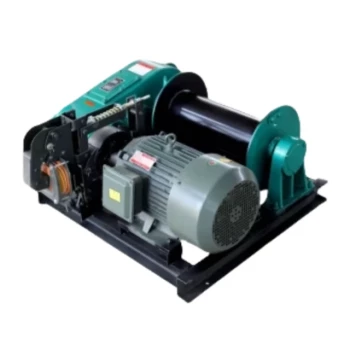
The primary function of an electric hoist is to vertically lift, lower, and transport heavy materials with precision and efficiency. Powered by an electric motor and managed through a control system, it automates the vertical movement of loads in industrial, construction, and manufacturing environments, serving as a critical tool where manual labor is impractical or unsafe.
An electric hoist is more than just a lifting device; it is an engineered solution designed to enhance operational productivity, improve workplace safety, and provide precise material handling in spaces where larger equipment like cranes or conveyors may not be suitable.
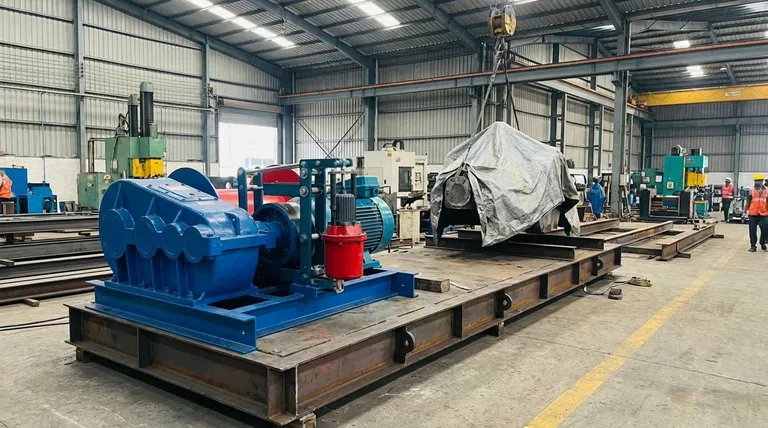
The Core Mechanism: How an Electric Hoist Operates
An electric hoist is a system of integrated components working together to achieve controlled vertical movement. Understanding its core parts clarifies its function and value.
The Electric Motor and Drivetrain
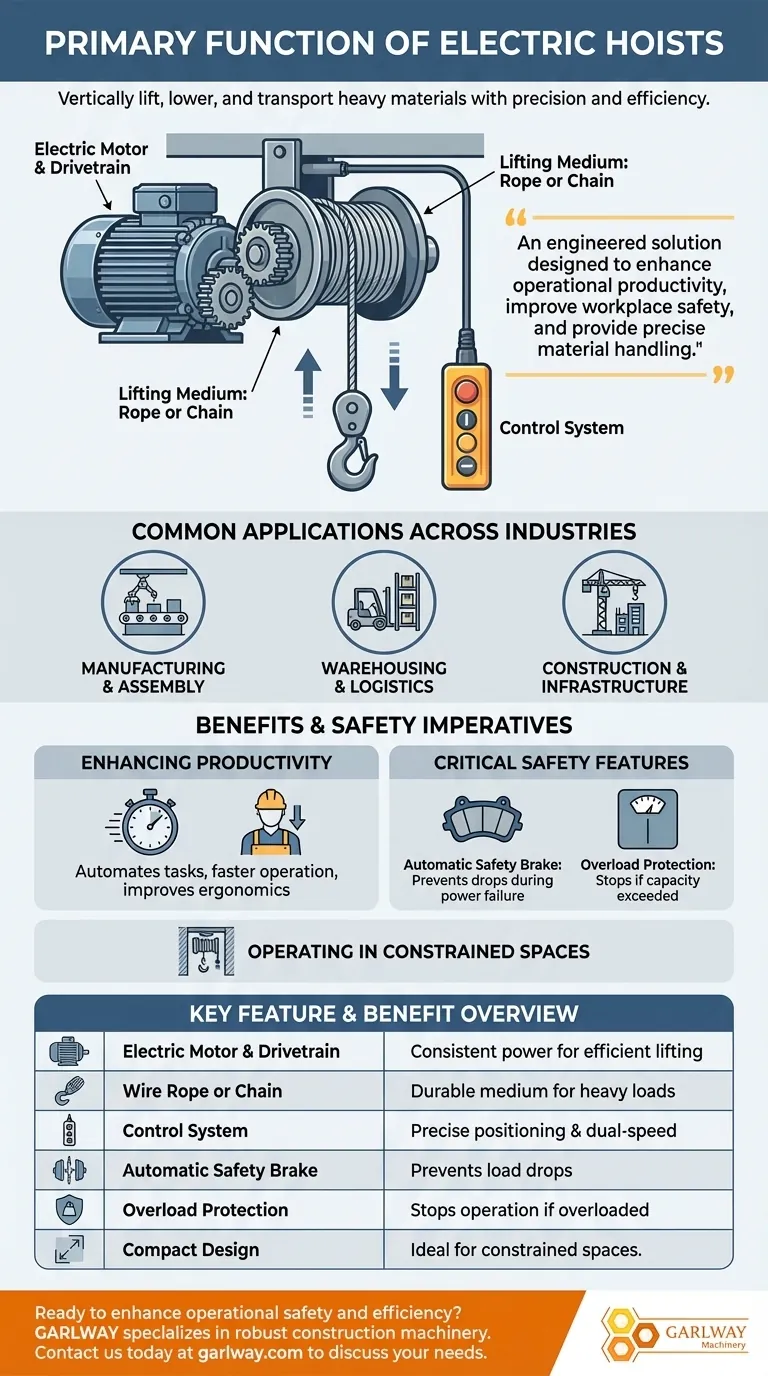
The heart of the hoist is its electric motor. This component provides the necessary power to turn a gearbox, which then rotates the rope drum or chain sprocket to initiate the lift.
The Lifting Medium: Rope or Chain
The motor's power is transferred to a lifting medium, typically a durable wire rope or a hardened steel chain. This medium is wound onto a drum or fed through a sprocket to raise or lower the attached load.
The Control System
Operators use a control system, often a push-button pendant, to manage the hoist's movement. These systems allow for precise positioning, and many models feature dual-speed configurations for both rapid lifting and slow, careful placement.
Common Applications Across Industries
The versatility and efficiency of electric hoists make them indispensable in a variety of sectors where heavy lifting is a routine requirement.
Manufacturing and Assembly
In factories and on assembly lines, electric hoists are used to position heavy components, move finished products, and load materials into machinery with speed and accuracy.
Warehousing and Logistics
Hoists streamline warehouse operations by lifting heavy stock onto shelves, loading goods onto trucks, and managing inventory in a way that minimizes manual strain and maximizes space.
Construction and Infrastructure
On construction sites, electric hoists are essential for lifting building materials, tools, and structural components to various levels of a project, from road construction to high-rise buildings.
Understanding the Benefits and Safety Imperatives
While the primary function is lifting, the true value of an electric hoist lies in its operational benefits and built-in safety features, which address critical workplace challenges.
Enhancing Productivity and Ergonomics
By automating lifting tasks, electric hoists operate much faster than manual methods. This significantly reduces physical strain on workers, improves ergonomics, and frees up labor for other duties.
Critical Safety Features
Modern hoists are equipped with essential safety mechanisms. An automatic safety brake engages instantly during a power failure, preventing a load from dropping. Overload protection sensors stop the hoist if the load exceeds its rated capacity.
Operating in Constrained Spaces
The compact design of an electric hoist is a major advantage. It allows for powerful lifting capabilities in tight areas where larger equipment like overhead cranes or extensive conveyor systems would be impractical.
Making the Right Choice for Your Goal
Selecting the right equipment depends entirely on your operational needs and priorities.
- If your primary focus is high-volume, repetitive lifting: An electric hoist provides the speed and automation necessary to maximize throughput and reduce worker fatigue in a manufacturing or warehousing setting.
- If your primary focus is safety and precision with valuable loads: A hoist with dual-speed controls, overload protection, and an automatic brake offers the control needed to handle sensitive materials securely.
- If your primary focus is versatile lifting in a compact area: An electric hoist is an ideal, space-saving solution for workshops, small construction sites, or any environment where larger material handling systems cannot fit.
By understanding its core function and operational advantages, you can leverage an electric hoist to create a safer and more efficient work environment.
Summary Table:
| Key Feature | Benefit |
|---|---|
| Electric Motor & Drivetrain | Provides consistent power for efficient lifting |
| Wire Rope or Chain | Durable medium for handling heavy loads |
| Control System (e.g., pendant) | Enables precise positioning and dual-speed operation |
| Automatic Safety Brake | Prevents load drops during power failure |
| Overload Protection | Stops operation if capacity is exceeded for safety |
| Compact Design | Ideal for use in constrained spaces |
Ready to enhance your operational safety and efficiency?
GARLWAY specializes in providing robust construction machinery, including reliable electric hoists, winches, concrete mixers, and batching plants. Our solutions are designed for construction companies and contractors globally who demand precision, durability, and safety.
Contact us today to discuss how our equipment can meet your specific lifting and material handling needs!
Visual Guide
Related Products
- Electric Hoist Winch Boat Anchor Windlass for Marine Applications
- Electric and Hydraulic Winch for Heavy Duty Applications
- Hydraulic Winding Engine Harbor Freight Winch
- Heavy Duty Electric Boat Winch Windlass Anchor
- 12000 lb Electric Boat Trailer Winch with Windlass Anchor Warn
People Also Ask
- How does an electric anchor winch work? Power, Safety, and Reliable Operation Explained
- What are the advantages of installing an electric anchor winch on a boat? Boost Safety & Ease for Boaters
- What are the operational differences between electric hoists and winches? A Guide to Safe Lifting vs. Pulling
- What are the main benefits of a boat anchor winch? Boost Safety & Efficiency for Your Vessel
- How does a boat anchor winch work? A Guide to Reliable Anchor Handling