
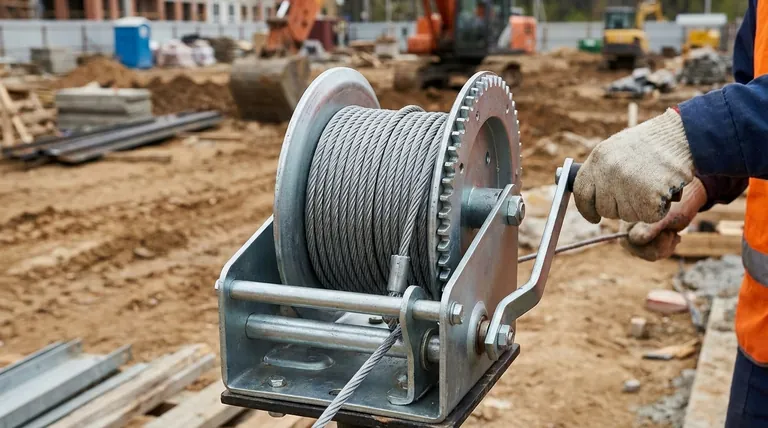
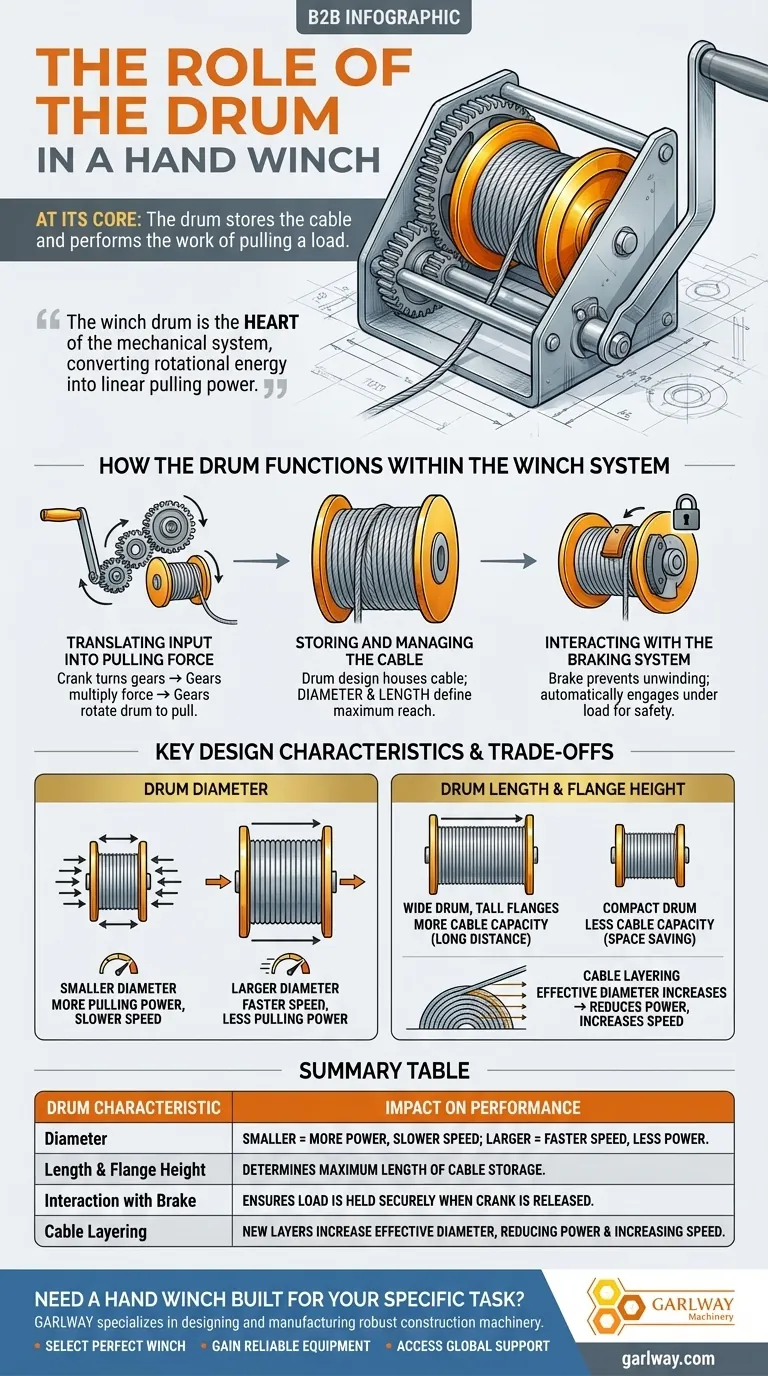
At its core, the drum of a hand winch is the central cylindrical component that stores the cable and performs the work of pulling a load. As the operator turns the crank, the winch's internal gearing causes the drum to rotate, winding the cable evenly and creating the pulling force required to move an object.
The winch drum is not merely a spool for the cable; it is the heart of the winch's mechanical system, responsible for converting rotational energy from the crank into linear pulling power.
How the Drum Functions Within the Winch System
A hand winch is a system of interconnected parts, and the drum is the final link in the chain that produces controlled force. Understanding its role requires seeing how it interacts with the other components.
Translating Input into Pulling Force
When you turn the hand crank, you are not turning the drum directly. Your effort is multiplied by a transmission system of gears.
These gears then rotate the drum, which spools the cable. This gearing is what allows a small amount of manual effort to pull a very heavy load.
Storing and Managing the Cable
The most visible function of the drum is to house the winch's cable or rope. Its physical design is critical to the winch's overall capability.
The drum's diameter and length directly determine how much cable can be stored, defining the maximum reach of the winch.
Interacting with the Braking System
The brake is a critical safety feature that prevents the drum from unwinding under load when you release the crank.
This mechanism, often a load-pressure brake, engages automatically with the drum or its connected gears. It ensures the load remains stationary and secure until you intentionally decide to lower it.
Key Design Characteristics of a Winch Drum
The specific dimensions of the drum have a direct impact on the winch's performance characteristics, including its power, speed, and capacity.
Drum Diameter and Pulling Power
The diameter of the drum influences the winch's mechanical advantage. A smaller diameter drum provides more pulling force for the same gear ratio but winds the cable more slowly.
Conversely, a larger diameter drum will retrieve the cable faster but may reduce the winch's maximum pulling capacity.
Drum Length and Flange Height
The length of the drum, along with the height of its side walls (flanges), dictates the total length and thickness of cable the winch can hold.
A winch designed for long-distance pulling will have a wider drum with taller flanges to prevent the cable from spilling over the sides as it's wound.
Understanding the Trade-offs
Choosing a winch involves balancing competing design factors, many of which center on the drum. Understanding these trade-offs is key to selecting the right tool for the job.
Capacity vs. Physical Size
A winch with a large drum can hold more cable, but it will also be larger, heavier, and more cumbersome. For applications where space and weight are concerns, a more compact winch with a smaller drum is often necessary.
Cable Layering and Efficiency
As cable winds onto the drum, it forms layers. Each new layer increases the effective diameter of the drum, which slightly reduces the winch's pulling power and increases its speed for subsequent layers. Proper spooling is crucial for maintaining performance and preventing cable damage.
How to Apply This to Your Task
Your specific goal will determine which drum characteristics are most important.
- If your primary focus is maximum pulling power: Look for a winch with a smaller effective drum diameter and a high-ratio gear system.
- If your primary focus is long-distance pulling: Prioritize a winch with a long drum and high flanges to accommodate a greater length of cable.
- If your primary focus is safety and control: Ensure the winch has a reliable, load-activated brake that works seamlessly with the drum to hold the load securely.
Ultimately, the drum is the component that puts the "pull" in your pulling machine, making its design central to the winch's function and capability.
Summary Table:
| Drum Characteristic | Impact on Performance |
|---|---|
| Diameter | Smaller diameter = More pulling power, slower speed. Larger diameter = Faster speed, less power. |
| Length & Flange Height | Determines the maximum length of cable the winch can store. |
| Interaction with Brake | Ensures the load is held securely when the crank is released. |
| Cable Layering | Each new layer increases effective diameter, slightly reducing power and increasing speed. |
Need a Hand Winch Built for Your Specific Task?
Understanding the drum's role is the first step to choosing the right winch. At GARLWAY, we specialize in designing and manufacturing robust construction machinery, including hand winches engineered for maximum performance and safety.
We help construction companies and contractors like you:
- Select the perfect winch based on your specific needs for pulling power, cable length, and portability.
- Gain reliable equipment built with durable drums and precise gearing for consistent, safe operation on the job site.
- Access global support and expertise from a trusted partner in construction machinery.
Let's discuss your project requirements. Contact GARLWAY today for a consultation and discover how our winches can provide the pulling power you need.
Visual Guide
Related Products
- Best 18000 Pound Drum Anchor Trailer Winch
- Quick Windlass Portable Winch for Truck and Boat Best Boat Winch
People Also Ask
- In what scenarios is a winch particularly useful for trailers? Load Heavy Items Safely & Efficiently
- How do you install a trailer winch? A Step-by-Step Guide for a Safe & Secure Setup
- What should be considered when mounting a winch on a trailer? Ensure a Safe, Aligned Installation
- What are the considerations for equipping a trailer with a winch for hauling a car? A Guide to Safe and Efficient Vehicle Loading
- What are the main types of trailer winches? Choose the Right Power Source for Your Load

