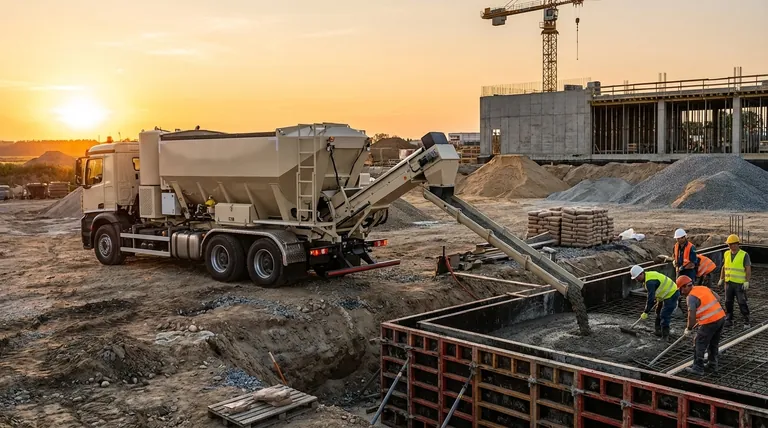
The historical significance of the volumetric mixer lies in its revolutionary shift of concrete production from a centralized plant to the actual job site. Invented in the early 1960s, this technology solved the critical logistical problems of waste and timing associated with traditional pre-mixed concrete, giving contractors direct control over their most crucial material.
The invention of the volumetric mixer was not just an improvement in equipment; it was a fundamental change in the construction workflow. By turning a truck into a mobile batch plant, it introduced unprecedented flexibility, efficiency, and precision to concrete delivery that remains a cornerstone of the industry today.
The Problem Before On-Site Mixing
Before the 1960s, all concrete was produced at a central batch plant and transported in barrel mixers. This created significant operational constraints.
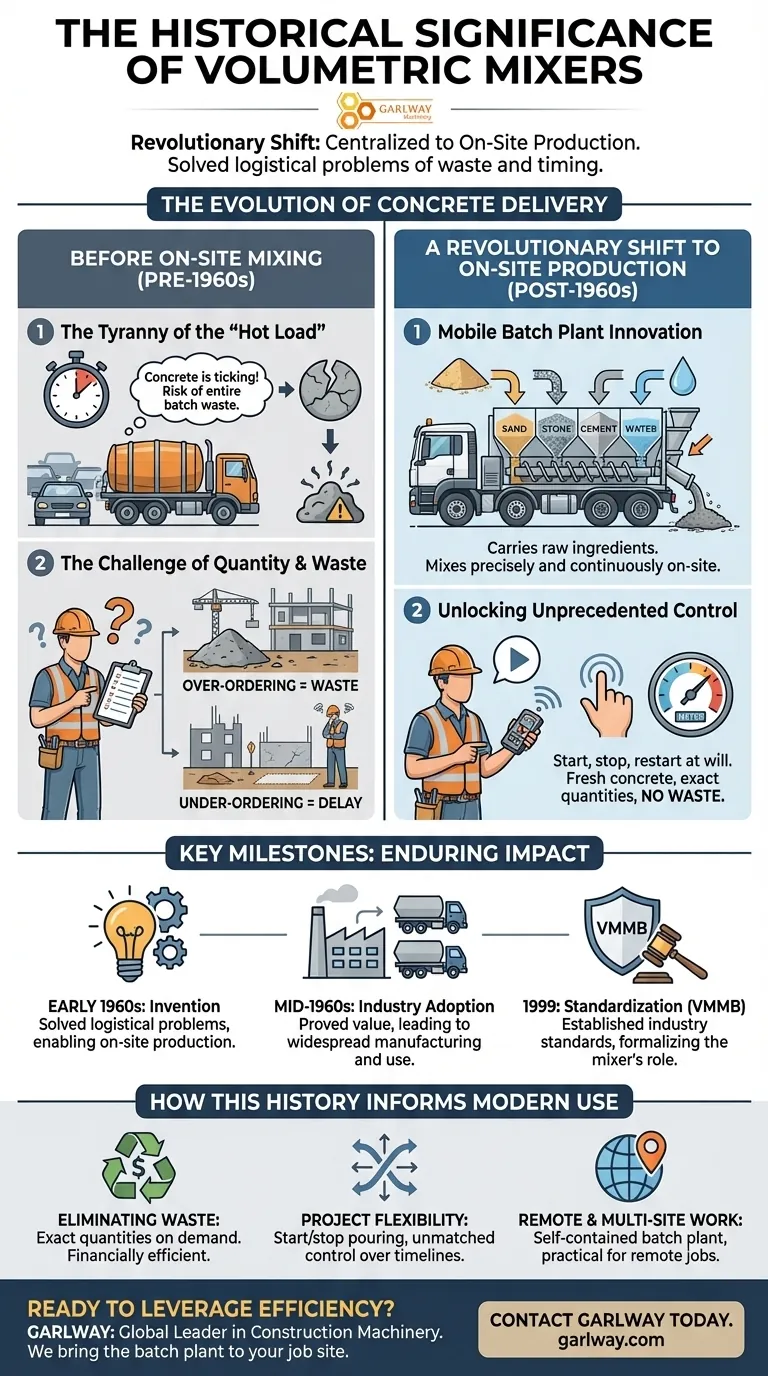
The Tyranny of the "Hot Load"
Traditional barrel trucks carry a "hot load"—concrete that is already mixed and has begun its hydration process. This means the clock is ticking from the moment it leaves the plant.
Any delay caused by traffic or on-site issues could compromise the entire batch, leading to wasted material and costly project setbacks.
The Challenge of Quantity and Waste
Contractors had to order a specific quantity of concrete in advance. Over-ordering resulted in wasted material and disposal costs, while under-ordering meant project delays and the expense of a second delivery.
A Revolutionary Shift to On-Site Production
The volumetric mixer directly addressed these challenges by redesigning the entire process. It doesn't carry mixed concrete; it carries the raw ingredients.
The Core Innovation: A Mobile Batch Plant
The key innovation was creating a self-contained, mobile system that stores sand, stone, cement, and water in separate compartments.
These components are mixed precisely and continuously on-site, producing fresh concrete on demand.
Unlocking Unprecedented Control
This shift gave contractors complete control over their supply. They could start, stop, and restart pouring at will, ensuring the concrete was always fresh.
Because the concrete is made to order, contractors could produce the exact amount needed for the job, effectively eliminating the waste associated with over-ordering from a traditional plant.
The Enduring Impact on the Industry
The volumetric mixer's practical advantages ensured its place as a permanent and vital piece of construction technology.
From Niche Invention to Industry Mainstay
While invented in the early 1960s, the concept quickly proved its value. By the mid-1960s, various companies began manufacturing their own versions, signaling broad industry adoption.
Formalizing the Standard
The technology's maturity was cemented in 1999 with the creation of the Volumetric Mixer Manufacturers Bureau (VMMB). This trade association established clear standards, formalizing the mixer's role as a reliable and standardized industry tool.
The Legacy of Versatility and Efficiency
The core benefits established over 60 years ago—versatility, efficiency, and cost-effectiveness—remain the primary reasons volumetric mixers are indispensable today, especially for projects requiring precise quantities or remote work.
How This History Informs Modern Use
Understanding the mixer's origin story clarifies its ideal applications in today's construction landscape.
- If your primary focus is eliminating waste: The volumetric mixer's ability to produce exact quantities on demand makes it the most financially efficient choice.
- If your primary focus is project flexibility: Its capacity to start and stop pouring at any time provides unmatched control over project timelines and complex pours.
- If your primary focus is remote or multi-site work: The mixer's function as a self-contained batch plant makes it the only practical solution for jobs far from a central plant.
This 60-year-old technology continues to solve the most fundamental challenges of concrete logistics with elegant simplicity.
Summary Table:
| Key Milestone | Year | Significance |
|---|---|---|
| Invention | Early 1960s | Solved logistical problems of traditional pre-mixed concrete, enabling on-site production. |
| Industry Adoption | Mid-1960s | Proved value, leading to widespread manufacturing and use. |
| Standardization | 1999 | Formation of the Volumetric Mixer Manufacturers Bureau (VMMB) established industry standards. |
Ready to leverage the efficiency and control of volumetric mixers on your project?
As a global leader in construction machinery, GARLWAY specializes in providing robust and reliable volumetric concrete mixers, winches, and batching plants designed for contractors and construction companies seeking to eliminate waste and enhance project flexibility. Our solutions bring the batch plant directly to your job site, ensuring you get the exact amount of fresh concrete you need, when you need it.
Contact GARLWAY today to discuss how our equipment can solve your concrete logistics challenges and drive your project's success.
Visual Guide
Related Products
- Belle Cement Mixer JS2000 Volumetric Concrete Mixer for Harbor Freight
- JS1000 Volumetric Concrete Mortar Mixer for Sale Skid Steer Cement Mixer
- Harbor Freight JS1500 On Site Concrete Mixing Volumetric Cement Mixer
- Portable Concrete Mixer Machine Equipment for Mixing Concrete
- HZS25 Best Cement Mixer for Quick Mix Concrete at Bunnings
People Also Ask
- What is a volumetric concrete mixer? A Mobile Concrete Batch Plant for On-Demand Mixing
- What is the predicted future for volumetric concrete mixers? Growth Driven by On-Demand Efficiency
- How does a volumetric concrete mixer contribute to sustainability? Reduce Waste, Water, and Emissions On-Site
- How does volumetric concrete compare to ready-mix concrete? Choose the Right Method for Your Project
- What types of concrete can be produced with volumetric mixers? Achieve On-Demand Mixing for Any Project