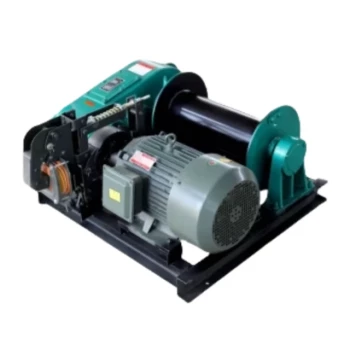
When it comes to relentless pulling power, a full-on hydraulic winch has a 100% duty cycle. This means it can operate continuously at its maximum rated load without any need for a cool-down period, as long as the vehicle's engine is running and supplying power to the hydraulic pump.
Unlike electric winches which are limited by heat buildup, hydraulic winches are engineered for non-stop work. Their ability to continuously dissipate heat through hydraulic fluid makes them the definitive choice for the most demanding industrial, commercial, and recovery operations.

What "Duty Cycle" Actually Means
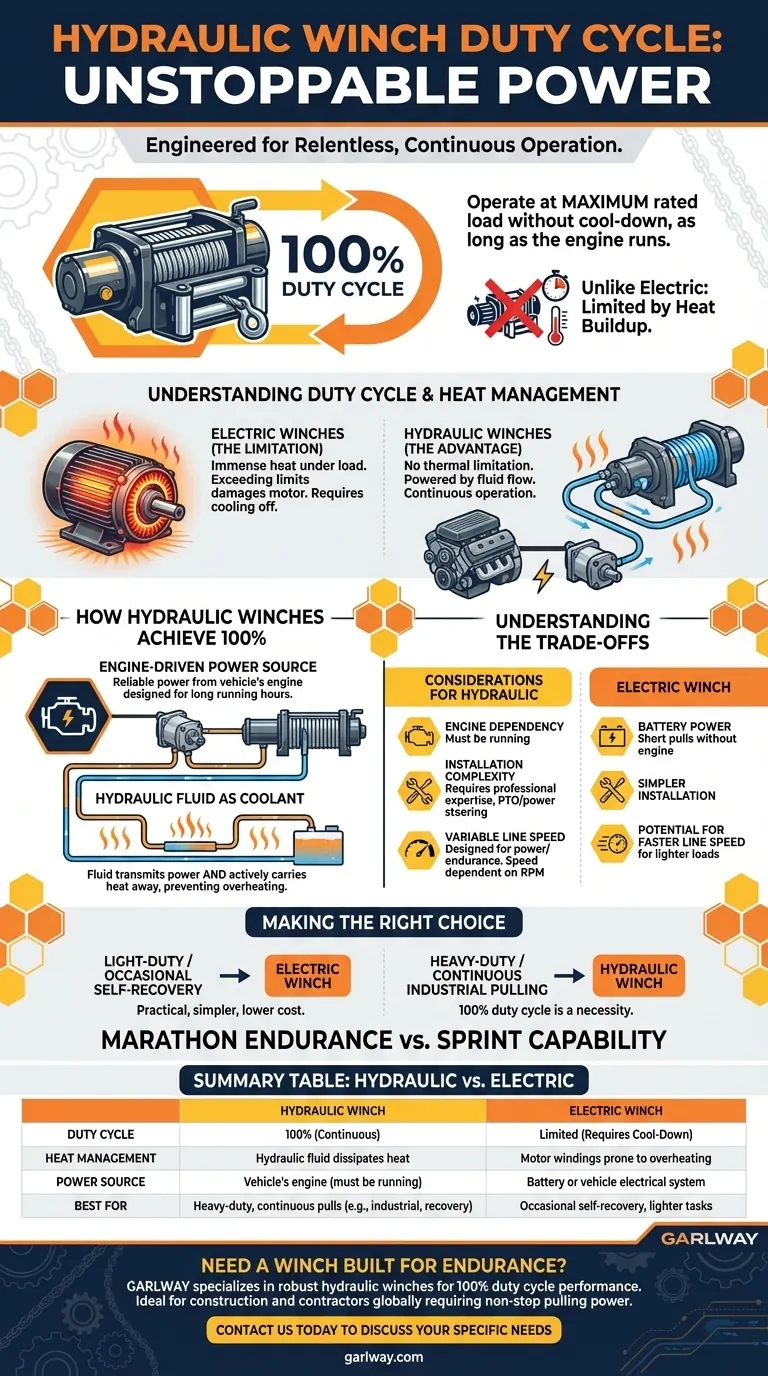
The concept of a duty cycle is a critical measure of a winch's endurance, primarily dictated by how it manages heat. The difference between electric and hydraulic systems is fundamental.
The Limitation of Electric Winches
Electric winch motors generate an immense amount of heat under load. Their duty cycle is a ratio of "on" time versus the required "off" or cool-down time. Exceeding this limit can lead to permanent damage to the motor windings.
The Hydraulic Advantage: Continuous Power
Hydraulic winches do not have this thermal limitation. They are powered by the flow of hydraulic fluid, driven by a pump that is itself powered by the vehicle's engine. This entire system is designed for continuous, sustained operation.
How Hydraulic Winches Achieve a 100% Duty Cycle
The ability to run indefinitely isn't magic; it's a result of a superior engineering approach to power transmission and heat management.
An Engine-Driven Power Source
The ultimate source of power for a hydraulic winch is the vehicle's engine. Since the engine is designed to run for hours on end, the winch has a constant and reliable power supply to draw from.
Hydraulic Fluid as a Coolant
This is the most critical factor. The circulating hydraulic fluid does more than just transmit power; it actively carries heat away from the winch's hydraulic motor. This heat is then dissipated across the entire hydraulic system, including its lines and fluid reservoir, preventing any localized thermal buildup.
Understanding the Trade-offs
While a 100% duty cycle is a massive advantage, hydraulic winches come with their own set of considerations that make them unsuitable for some users.
The Engine Dependency
The most significant trade-off is that the vehicle's engine must be running for the winch to operate. If your engine dies or cannot be started, the hydraulic winch is completely inoperable, whereas an electric winch could still perform a short pull from battery power alone.
Installation Complexity
Installing a hydraulic winch is typically more complex and costly than an electric model. It requires tapping into the vehicle's power steering system or installing a dedicated PTO (Power Take-Off) pump, which often requires professional expertise.
Variable Line Speed
Hydraulic winches are designed for power and endurance, not necessarily speed. Their line speed can be slower than some high-speed electric winches and is often dependent on the vehicle's engine RPM.
Making the Right Choice for Your Application
Your decision must be guided by a realistic assessment of your most common winching scenarios.
- If your primary focus is occasional self-recovery or lighter-duty tasks: The simplicity and lower cost of an electric winch are often more practical.
- If your primary focus is commercial recovery, industrial pulling, or scenarios requiring long, heavy, continuous pulls: The 100% duty cycle of a hydraulic winch is not a luxury—it is a necessity.
Ultimately, you are choosing between the sprint capability of an electric winch and the marathon endurance of a hydraulic system.
Summary Table:
| Feature | Hydraulic Winch | Electric Winch |
|---|---|---|
| Duty Cycle | 100% (Continuous) | Limited (Requires Cool-Down) |
| Heat Management | Hydraulic fluid dissipates heat | Motor windings prone to overheating |
| Power Source | Vehicle's engine (must be running) | Battery or vehicle electrical system |
| Best For | Heavy-duty, continuous pulls (e.g., industrial, recovery) | Occasional self-recovery, lighter tasks |
Need a winch built for endurance? GARLWAY specializes in construction machinery, offering robust hydraulic winches designed for 100% duty cycle performance. Ideal for construction companies and contractors globally who require reliable, non-stop pulling power for the most demanding operations. Contact us today to discuss your specific needs and discover the GARLWAY advantage!
Visual Guide
Related Products
- Electric and Hydraulic Winch for Heavy Duty Applications
- Hydraulic Winding Engine Harbor Freight Winch
- 12000 lb Electric Boat Trailer Winch with Windlass Anchor Warn
- Heavy Duty Electric Boat Winch Windlass Anchor
- Warn Winch Windlass Boat Trailer Winch
People Also Ask
- What are the differences between electric and hydraulic winches? Choose the Right Winch for Your Job
- What are some common uses for a heavy-duty winch? Power Your Construction & Industrial Projects
- What are electro-hydraulic winches and their applications? The Integrated Power Solution for Heavy-Duty Operations
- How do winches assist in bridge launching? Accelerate Bridge Placement with Controlled Pulling Power
- What are the benefits of using heavy-duty winches for large projects? Boost Efficiency & Safety