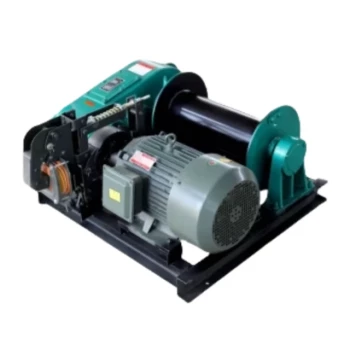
At its core, a standard profile winch is designed to be the versatile, all-purpose workhorse for securing cargo on flatbed trailers. It strikes a deliberate balance between providing enough height for easy operation and a secure grip on the strap, while remaining compatible with the widest range of trailers and load types.
The purpose of a standard profile winch is not to be average, but to be the optimal default choice. It prioritizes ease of use, robust load securement, and broad compatibility over the specialized, compact design of low-profile alternatives.
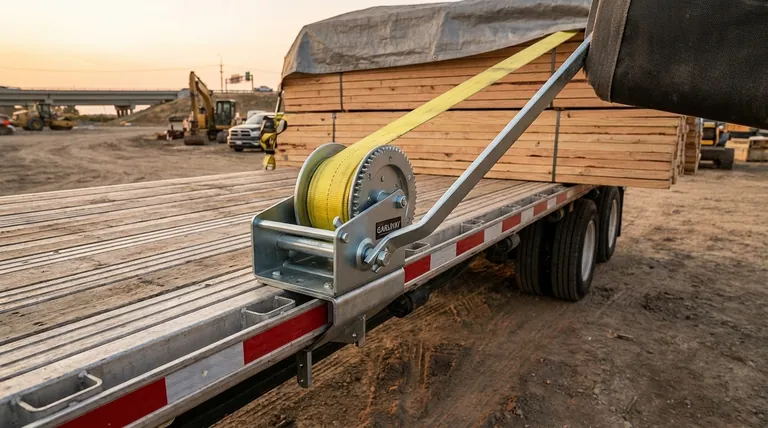
The Defining Characteristics of a Standard Winch
To understand why standard winches are the most common type you see on the road, it helps to break down their specific design advantages. Their purpose is found in the careful balance of these key features.
The Advantage of Moderate Height
The most visible feature is its height. This "standard" or "moderate" profile raises the winch drum and cap away from the trailer's side rail.
This elevation provides crucial clearance, making it significantly easier to insert a winch bar and gain the leverage needed to properly tension the strap.
Ensuring a Secure Grip
That moderate height also ensures the winch strap can wrap cleanly around the drum without rubbing against the trailer deck or frame.
A clean wrap is essential for preventing strap damage and ensuring that tension is applied evenly, which is critical for load safety.
Universal Compatibility
Standard profile winches are engineered to fit the most common mounting tracks, such as C-channel or side rails, found on the vast majority of flatbed trailers.
This universal design makes them a reliable and straightforward choice for both original equipment manufacturing and field replacement, requiring no special modifications.
How Standard Winches Compare to Alternatives
Choosing the right winch means understanding what it is not. The value of a standard profile winch becomes clearest when compared directly against its more specialized counterparts.
Standard vs. Low-Profile
Low-profile winches are designed for one primary purpose: to save space. They sit much closer to the trailer frame, making them ideal for situations where clearance is the top priority.
This could be necessary to accommodate exceptionally wide loads that overhang the trailer edge or to allow forklifts to get closer to the deck during side-loading.
The trade-off is that their compact size can make them more difficult to operate with a winch bar, as there is less room for leverage. A standard winch is easier to use in all situations where that extra clearance isn't a specific requirement.
Manual Securement vs. Powered Pulling
It's crucial to distinguish profile winches (both standard and low) from electric winches.
Profile winches are manual devices designed exclusively for load securement. Their function is to tension webbing straps to hold cargo down.
Electric winches, by contrast, are powered devices designed for pulling or lifting heavy loads, such as dragging a vehicle onto a trailer. They use wire rope or synthetic cable and are not intended for securing cargo straps.
Understanding the Trade-offs
While the standard profile winch is the best general-purpose tool, its design comes with one primary consideration that may make it unsuitable for certain specific applications.
Potential for Obstruction
The main drawback is its height. The very feature that makes it easy to use can also become an obstacle.
If you frequently haul wide loads that overhang the side of your trailer, a standard winch may interfere with the cargo. In these cases, a low-profile winch is the superior choice.
Not a Lifting Device
It must be reiterated that these are tensioning tools, not lifting or pulling devices.
Attempting to use a standard profile winch to pull a heavy object or lift it from the ground is extremely dangerous and can lead to catastrophic failure of the winch, the strap, or the trailer frame.
Making the Right Choice for Your Trailer
Selecting the correct winch is a simple matter of matching the equipment to your primary operational need.
- If your primary focus is versatility and daily usability: The standard profile winch is the definitive, industry-standard choice for general freight.
- If you have consistent clearance issues with wide loads: A low-profile winch is specifically designed to solve this problem and is the correct tool.
- If you need to pull rolling or heavy equipment onto the trailer: You require a powered electric or hydraulic winch, which is an entirely different system.
Ultimately, choosing a standard profile winch is the correct decision for the widest variety of load securement tasks.
Summary Table:
| Feature | Purpose & Benefit |
|---|---|
| Moderate Height | Provides clearance for easy winch bar operation and proper leverage. |
| Secure Grip | Ensures a clean strap wrap for even tension and prevents damage. |
| Universal Compatibility | Fits most common trailer tracks (C-channel/side rails) for easy installation. |
| Primary Use Case | The ideal, versatile choice for general freight and daily load securement. |
Need reliable, easy-to-use winches for your fleet?
GARLWAY specializes in high-quality construction machinery, including robust standard profile winches designed for the daily demands of construction companies and contractors. Our winches provide the secure, versatile cargo control you need to keep your operations safe and efficient.
Contact GARLWAY today to discuss your requirements and get a quote tailored to your fleet!
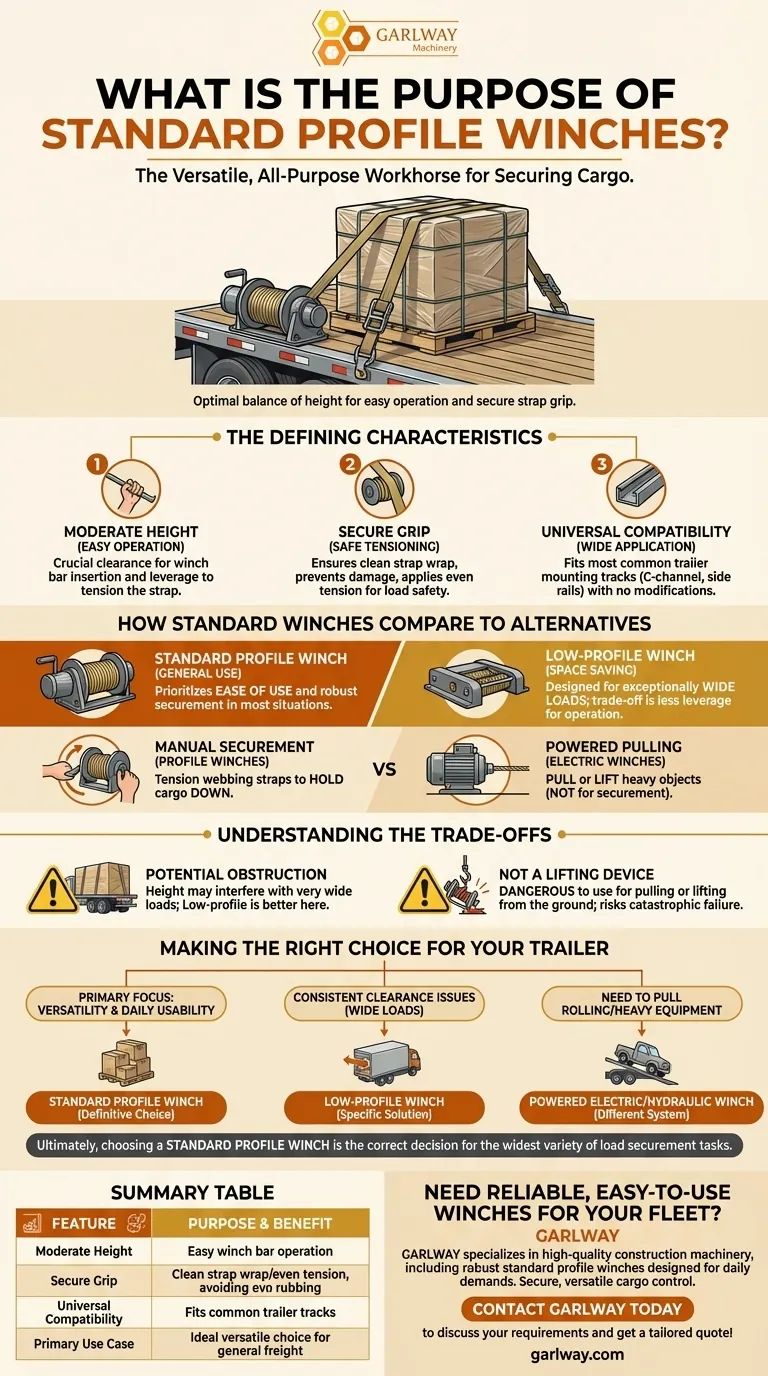
Visual Guide
Related Products
- Small Electric Winch 120V and 240V for Compact Applications
- Electric and Hydraulic Winch for Heavy Duty Applications
- Portable Small Trailer Winch
- Hydraulic Winding Engine Harbor Freight Winch
- Warn Winch Windlass Boat Trailer Winch
People Also Ask
- What makes electric winches suitable for off-road use? Key Features for Reliable Vehicle Recovery
- What are the common applications of electric winches? Power Your Lifting & Pulling Tasks
- What are the common uses of an electric winch? A Guide to Safe and Efficient Heavy Lifting
- What are the uses of electric winches in mining and tunneling? Enhance Safety and Efficiency Underground
- How do electric winches contribute to energy savings? Maximize Efficiency and Lower Costs