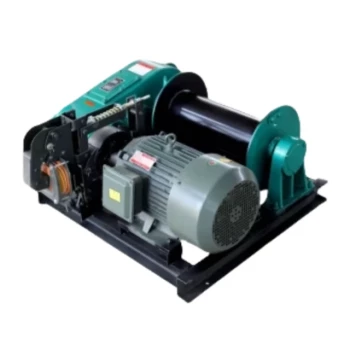
At its core, a hydraulic winch uses one of two distinct systems to release its cable drum for manual payout: a mechanical release or a pneumatic release. The mechanical system is a direct, manual lever on the winch housing, while the pneumatic system uses compressed air to disengage the drum remotely, typically from the vehicle's cab.
The choice between a mechanical or pneumatic release is a fundamental decision that balances the direct simplicity and reliability of a manual lever against the significant safety and convenience benefits of remote, air-powered operation.
The Core Function: Enabling "Freespool"
Before comparing the two systems, it's essential to understand their purpose. Both mechanical and pneumatic releases exist to engage and disengage the winch drum from the hydraulic motor and gearing.
What is Freespooling?
When the drum is disengaged, it can spin freely, a state known as "freespooling." This allows an operator to walk the cable out by hand to the anchor point quickly, without having to run the winch motor in reverse.
Why It's Critical
Freespooling is a crucial feature for efficiency and safety. Powering out a long length of cable is slow and puts unnecessary wear on the winch's hydraulic system. Manually pulling the cable is significantly faster and prepares the equipment for the actual work of pulling a load.
A Closer Look at the Two Release Systems
While both systems achieve the same goal—disengaging the drum's clutch—their method of operation and practical implications differ significantly.
The Mechanical Release System
A mechanical release is the most direct and simple design. It consists of a physical lever or handle mounted directly on the winch's gearbox.
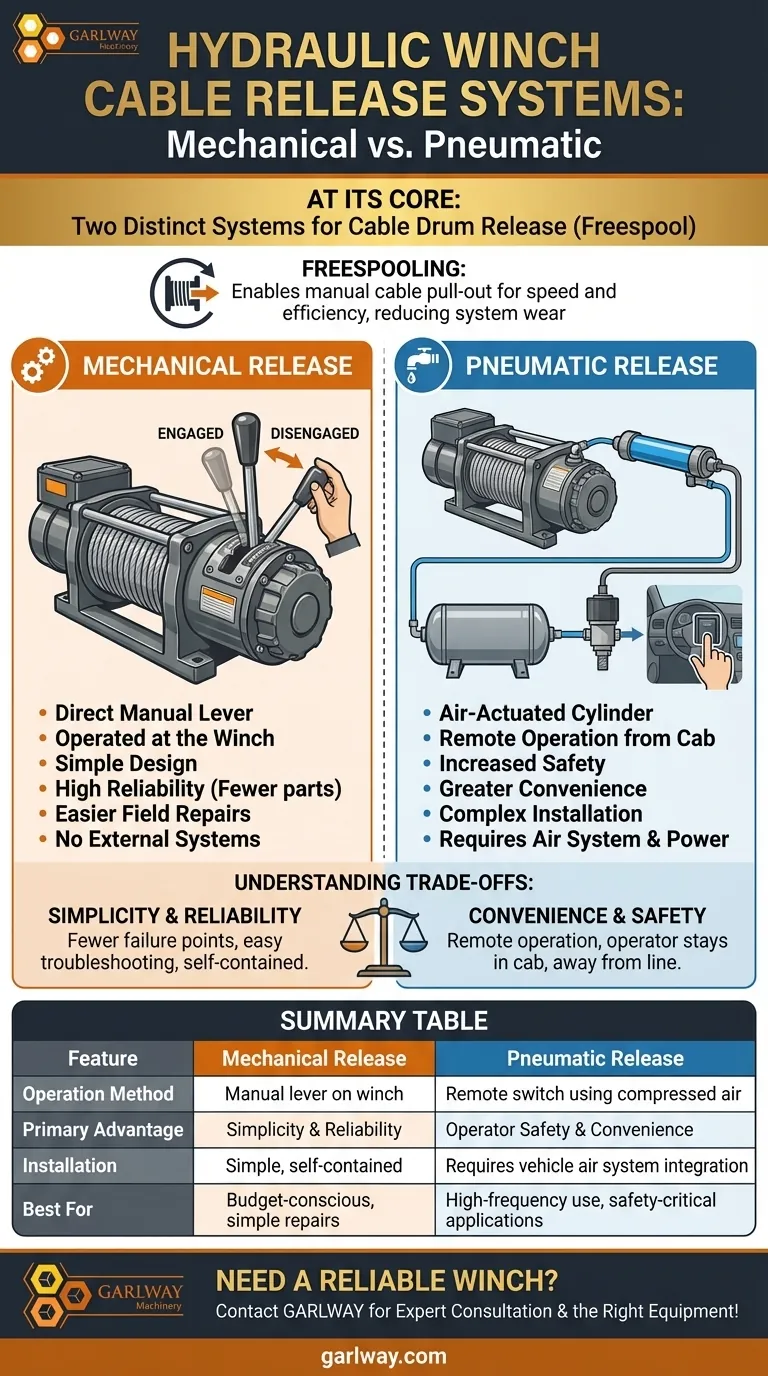
To operate it, a person must be at the winch. They physically move the lever from the "engaged" position to the "disengaged" position, which manually disconnects the clutch mechanism inside the winch.
The Pneumatic Release System
A pneumatic release uses the vehicle's compressed air system, the same one that often powers the air brakes. Instead of a manual lever, it uses an air-actuated cylinder.
When the operator flips a switch in the cab, an electric solenoid opens an air valve. This sends compressed air through a line to the cylinder on the winch, which then disengages the clutch. This allows for remote operation without ever leaving the driver's seat.
Understanding the Trade-offs: Mechanical vs. Pneumatic
Choosing the right system depends on understanding the inherent advantages and disadvantages of each design.
Simplicity and Reliability (Mechanical)
The primary advantage of a mechanical system is its simplicity. With fewer moving parts and no reliance on air lines, seals, or electrical switches, there are fewer potential points of failure.
This makes it exceptionally reliable and easier to troubleshoot and repair in the field, often with basic tools.
Convenience and Safety (Pneumatic)
The pneumatic system's main advantage is its convenience and the significant safety boost it provides. The operator can stay safely inside the vehicle's cab, away from the winch line which can be under unpredictable tension.
This remote operation is invaluable in poor weather conditions or on unstable ground, minimizing risk to personnel.
Installation and Maintenance
A mechanical winch is self-contained and requires no integration with other vehicle systems. In contrast, a pneumatic winch requires tapping into the vehicle's air system, running air lines, and installing electrical controls in the cab, making installation more complex.
Maintenance for a pneumatic system also involves checking for air leaks in lines and fittings, which is not a concern for a mechanical setup.
Making the Right Choice for Your Operation
The ideal system is directly tied to your operational priorities, budget, and the environment in which the winch will be used.
- If your primary focus is maximum reliability and simple field repairs: A mechanical release is the superior choice due to its lack of complex external systems.
- If your primary focus is operator safety and high-frequency use: A pneumatic release is essential for keeping personnel out of harm's way and improving operational efficiency.
- If you are retrofitting a vehicle without an onboard air system: A mechanical release is far simpler and more cost-effective to install.
Ultimately, your decision hinges on balancing the appeal of robust, self-contained simplicity with the clear safety and efficiency gains of remote-controlled operation.
Summary Table:
| Feature | Mechanical Release | Pneumatic Release |
|---|---|---|
| Operation Method | Manual lever on the winch | Remote switch using compressed air |
| Primary Advantage | Simplicity & Reliability | Operator Safety & Convenience |
| Installation | Simple, self-contained | Requires vehicle air system integration |
| Best For | Budget-conscious, simple repairs | High-frequency use, safety-critical applications |
Need a reliable winch for your next project?
Choosing the right cable release system is critical for the safety and efficiency of your construction or contracting work. At GARLWAY, we specialize in durable construction machinery, including hydraulic winches with both mechanical and pneumatic release options.
Our experts can help you select the perfect winch for your specific needs, ensuring your team operates safely and productively.
Contact GARLWAY today for a consultation and get the right equipment for the job!
Visual Guide
Related Products
- Hydraulic Winding Engine Harbor Freight Winch
- Electric and Hydraulic Winch for Heavy Duty Applications
- Small Electric Winch 120V and 240V for Compact Applications
- Electric 120V Boat Winch by Badlands
- 12000 lb Electric Boat Trailer Winch with Windlass Anchor Warn
People Also Ask
- What role does hydraulic fluid play in hydraulic winches? It's the Lifeblood of Your Heavy-Duty Pulling Power
- What vehicles commonly use hydraulic winches? For Industrial Trucks Needing Unmatched Power
- What are the features of hydraulic winches? Unmatched Power and Continuous Duty for Heavy Loads
- What preventive measures can be taken to avoid oil leakage in hydraulic winches? Ensure Long-Term Reliability
- What does 'power out' mean in a hydraulic winch? Achieve Absolute Control When Lowering Heavy Loads