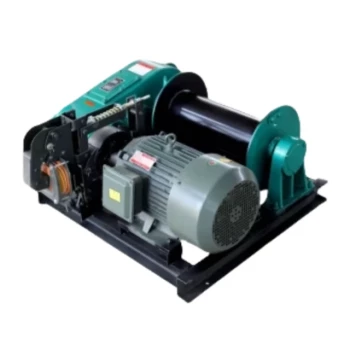
The key features of an electric hoist are a combination of mechanical components, control systems, and critical safety mechanisms. These elements work together to provide precise vertical lifting, with core features including an electric motor with an integrated brake, a gearbox for torque, and safety systems like overload protection and emergency stops.
An electric hoist is not merely a motor that lifts; it is an integrated system where every feature is engineered for precision, control, and, most importantly, operational safety. Understanding these features moves you from simply using the equipment to leveraging it effectively and safely.
Deconstructing the Core Components
The power and reliability of an electric hoist come from a few key mechanical parts working in unison.
The Powertrain: Motor and Gearbox
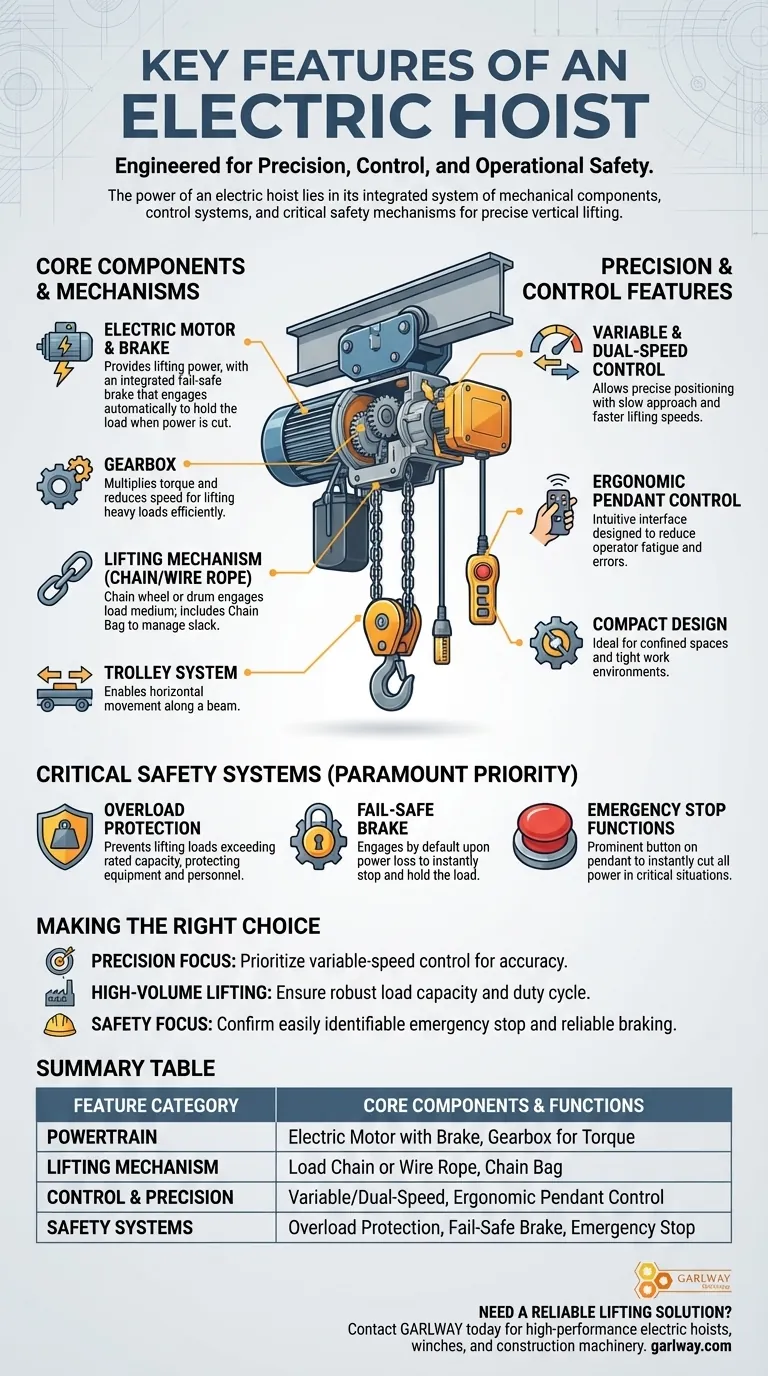
An electric motor provides the power for lifting. Crucially, this motor is paired with an electric brake that automatically engages when power is cut, securely holding the load in place.
The motor's power is channeled through a gearbox, which uses a series of gears to reduce speed and multiply torque. This allows a relatively small motor to lift heavy loads.
The Lifting Mechanism: Chain or Wire Rope
The gearbox turns a chain wheel (or drum for a wire rope hoist) that engages with the load chain to lift or lower the payload.
Most chain hoists also include a chain bag or container. This simple but essential feature keeps the slack end of the chain safely out of the way during operation.
The Trolley System: Enabling Horizontal Movement
While a hoist's primary function is vertical lifting, it can be mounted to a trolley. This allows the entire hoist assembly to move horizontally along a beam, providing movement across two axes.
Precision and Control Features
Modern hoists are designed for more than just raw lifting; they are built for accuracy and ease of use.
Variable and Dual-Speed Control
Many electric hoists offer dual-speed or variable-speed control. This feature is critical for applications requiring precision, allowing the operator to slowly approach a set point before using a faster speed for the main lift.
Ergonomic Controls
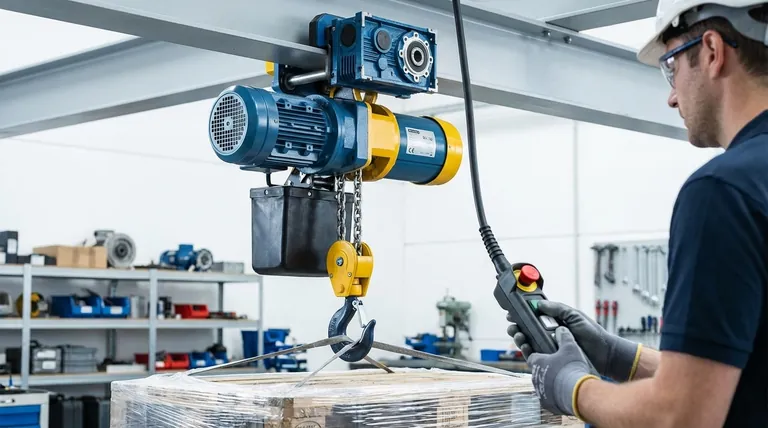
The operator interacts with the hoist via a pendant control. These are designed to be ergonomic and intuitive, reducing operator fatigue and the likelihood of errors.
Compact Design for Tight Spaces
Electric hoists are generally compact. Their design allows them to be used in workshops, assembly lines, and other confined spaces where larger cranes or forklifts cannot operate.
Understanding the Critical Safety Systems
Safety is the paramount design consideration for any lifting equipment. The hoist's features reflect this priority.
Overload Protection and Limit Switches
Nearly all electric hoists include overload protection. This system, often a limit switch or clutch, prevents the hoist from attempting to lift a load that exceeds its rated capacity, protecting the equipment, the structure, and personnel.
The Fail-Safe Brake
The hoist's electric brake is a fail-safe device. It is designed to engage by default and requires power to release, ensuring that if power is lost for any reason, the brake will immediately engage and stop the load from falling.
Emergency Stop Functions
Every hoist control pendant is equipped with a prominent emergency stop button. This allows the operator to instantly cut all power to the hoist in a critical situation, providing a final layer of manual safety control.
Making the Right Choice for Your Application
Selecting the right hoist means matching its features to the demands of your specific task.
- If your primary focus is precision and delicate positioning: Prioritize a hoist with true variable-speed control for the highest degree of accuracy.
- If your primary focus is high-volume industrial lifting: Ensure the hoist's load capacity, duty cycle, and overload protection are robust enough for your demands.
- If your primary focus is operational safety in a busy environment: Confirm the hoist has easily identifiable emergency stop functions and a reliable braking system.
By understanding these core features, you can select and operate an electric hoist that delivers not just power, but also precision and safety.
Summary Table:
| Key Feature Category | Core Components & Functions |
|---|---|
| Powertrain | Electric Motor with Brake, Gearbox for Torque |
| Lifting Mechanism | Load Chain or Wire Rope, Chain Bag |
| Control & Precision | Variable/Dual-Speed, Ergonomic Pendant Control |
| Safety Systems | Overload Protection, Fail-Safe Brake, Emergency Stop |
Need a reliable lifting solution for your project?
GARLWAY specializes in providing high-performance construction machinery, including robust electric hoists, winches, concrete mixers, and batching plants. Our equipment is engineered for precision, safety, and durability to meet the demanding needs of construction companies and contractors globally.
Contact GARLWAY today to discuss how our solutions can enhance your operational efficiency and safety.
Visual Guide
Related Products
- Electric Hoist Winch Boat Anchor Windlass for Marine Applications
- Electric and Hydraulic Winch for Heavy Duty Applications
- Hydraulic Winding Engine Harbor Freight Winch
- Heavy Duty Electric Boat Winch Windlass Anchor
- 12000 lb Electric Boat Trailer Winch with Windlass Anchor Warn
People Also Ask
- How does an electric anchor winch work? Power, Safety, and Reliable Operation Explained
- What are the advantages of installing an electric anchor winch on a boat? Boost Safety & Ease for Boaters
- What are the operational differences between electric hoists and winches? A Guide to Safe Lifting vs. Pulling
- What are the main benefits of a boat anchor winch? Boost Safety & Efficiency for Your Vessel
- How does a boat anchor winch work? A Guide to Reliable Anchor Handling