
At its core, an Automatic Free-Fall mechanism is an electronic system on a windlass that allows you to release the anchor and chain instantly with the push of a button. Instead of the motor slowly paying out the chain, this feature disengages the windlass clutch, letting gravity take over for a rapid, uncontrolled drop.
The critical advantage of Automatic Free-Fall is not just speed, but the ability to deploy the anchor with precision from the helm, eliminating the delay of moving to the bow or slowly powering down.
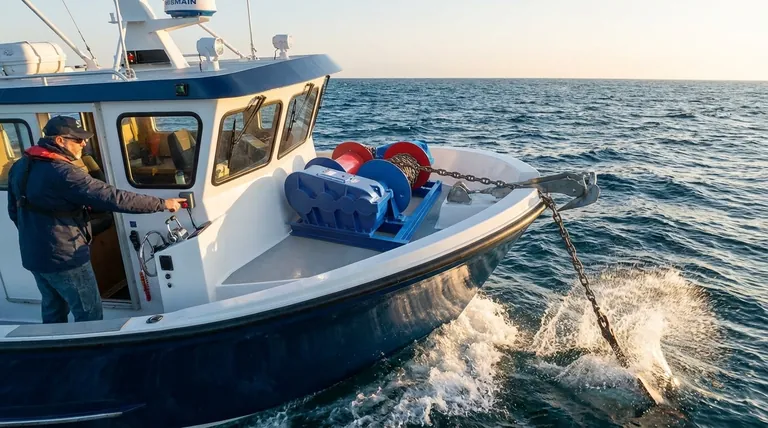
The Principle: Powered vs. Free-Fall Deployment
To understand the "automatic" feature, you first have to understand the two fundamental ways a windlass can deploy an anchor.
Standard Powered Deployment
Most modern windlasses use a powered motor to lower the anchor. The gypsy—a special notched wheel—grips the anchor chain and the motor turns it in reverse, paying out the chain at a slow and controlled speed.
This method is safe and steady, but it is not fast.
The Concept of Free-Fall
Free-Fall deployment works by completely disengaging the gypsy from the motor's gearbox. This is done by releasing a clutch mechanism.
With the clutch released, the gypsy can spin freely. The weight of the anchor and chain then pulls the chain out at maximum speed, limited only by gravity and friction.
Automatic vs. Manual: The Key Distinction
Both manual and automatic systems achieve the same goal—a fast, free-falling anchor. The difference lies entirely in how you activate it.
The Manual Approach
On a windlass with manual free-fall, a crew member must go to the bow of the boat. They typically insert a winch handle into the clutch nut and turn it to disengage the gypsy, initiating the free-fall.
The Automatic Advantage
An Automatic Free-Fall system replaces this physical action with an electrical command. A press of a button at the helm activates a solenoid or other electronic actuator on the windlass.
This actuator instantly releases the clutch, dropping the anchor the moment you command it. This remote capability is the defining feature.
Why Speed and Precision Matter
The primary applications for free-fall are situations where timing is critical. This is especially true for fishing over a specific wreck or anchoring in deep water where currents can quickly push the boat off its mark during a slow, powered deployment.
Understanding the Trade-offs
While convenient, an automatic system introduces factors that must be considered.
Added Complexity
The automatic mechanism adds components to the windlass system, including solenoids, wiring, and dedicated switches. This increases the overall complexity compared to a purely manual system.
Potential for Failure
More electrical components and moving parts introduce more potential points of failure. These systems require proper maintenance to ensure the solenoid and clutch mechanism remain reliable over time.
Cost and Installation
Windlasses equipped with Automatic Free-Fall are typically more expensive than their manual counterparts. The installation is also slightly more involved due to the additional wiring required back to the helm.
Making the Right Choice for Your Goal
Selecting the right system depends entirely on how you use your boat.
- If your primary focus is convenience and single-handed operation: Automatic Free-Fall is the superior choice, as it allows full anchor control from the helm.
- If your primary focus is precision anchoring for fishing: The ability to instantly drop anchor the moment your sounder marks the target makes an automatic system invaluable.
- If your primary focus is simplicity and maximum reliability: A windlass with a manual free-fall or standard power-out function has fewer components and potential failure points.
Choosing your windlass mechanism is about matching the equipment's capabilities to your specific anchoring needs.
Summary Table:
| Feature | Automatic Free-Fall | Manual Free-Fall | Standard Power-Out |
|---|---|---|---|
| Activation Method | Remote button at helm | Manual clutch release at bow | Motor-powered reverse |
| Deployment Speed | Instant, gravity-driven | Instant, gravity-driven | Slow and controlled |
| Primary Use Case | Precision fishing, single-handed operation | Fast deployment without remote need | General, safe anchoring |
| Complexity & Cost | Higher (adds solenoids, wiring) | Moderate | Lower |
Ready to upgrade your anchoring system? GARLWAY specializes in robust marine equipment, offering reliable windlasses and deck machinery for commercial vessels and serious boaters worldwide. Whether you need the precision of an Automatic Free-Fall system or a heavy-duty solution for your fleet, our engineering expertise ensures durability and performance. Contact our team today to discuss the perfect windlass for your vessel!
Visual Guide

Related Products
- Quick Windlass Portable Winch for Truck and Boat Best Boat Winch
- Electric Hoist Winch Boat Anchor Windlass for Marine Applications
- Heavy Duty Electric Boat Winch Windlass Anchor
- 12000 lb Electric Boat Trailer Winch with Windlass Anchor Warn
- Warn Winch Windlass Boat Trailer Winch
People Also Ask
- What features were incorporated into the upgraded portable winch system? Boost Your Recovery Power & Safety
- What are some uses mentioned for portable winches beyond vehicle recovery? Essential Versatility for Property & Work
- How could the twisting issue with a portable winch be mitigated? Achieve Safe, Centered Pulls with Proper Rigging
- What are the primary uses of a portable winch for a truck? Boost Your Truck's Capability and Self-Reliance
- What is the single rope traction force of the quick winch without a pulley block? 0.5 to 40 Tons Explained


