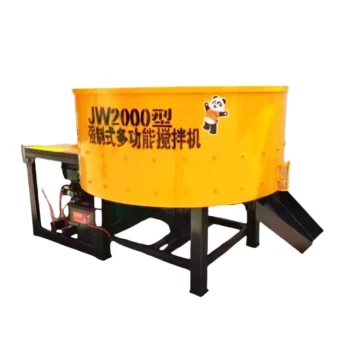
At its core, a pan mixer is an industrial mixing machine characterized by a stationary cylindrical pan and a set of rotating, star-shaped blades. These components work together to combine materials like sand, cement, aggregate, and water into a uniform mixture, most commonly for producing high-quality concrete. Its design allows for large capacities, with industrial models capable of holding up to 1000 gallons.
The crucial distinction of a pan mixer is its forced mixing action. Unlike drum mixers that simply tumble materials, a pan mixer's rotating blades create intense shearing and folding forces, resulting in a faster, more consistent, and homogeneous final product.
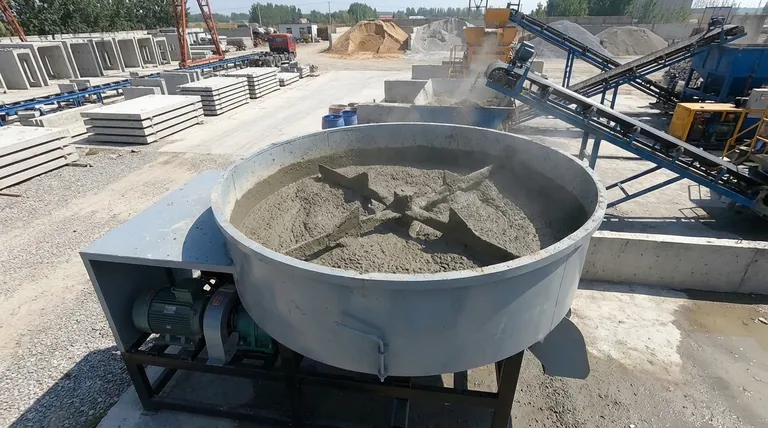
How a Pan Mixer Achieves a Superior Mix
The effectiveness of a pan mixer comes from the specific design and interaction of its primary components. This system is engineered for consistency and efficiency.
The Stationary Pan
The cylindrical pan remains stationary during operation. This stability ensures that the mixing energy is applied directly and efficiently to the materials by the moving blades, rather than being wasted on moving the entire vessel.
The Rotating Star-Shaped Blades
The mixing head, often configured in a star or planetary pattern, rotates within the pan. These blades are precisely angled to force materials from the pan's outer walls toward the center and vertically, creating a powerful circulatory motion.
The Forced Mixing Action
This blade movement generates a high-shear, forced mixing action. It actively folds, kneads, and shears the particles, ensuring every grain of sand and aggregate is coated with cement paste. This process is significantly more thorough and rapid than the passive gravity-based tumbling seen in common drum mixers.
Key Applications and Use Cases
The consistent, high-quality output of pan mixers makes them the preferred choice for applications where mix integrity is paramount.
High-Performance and Specialty Concrete
Pan mixers are ideal for producing high-strength, fiber-reinforced, or self-compacting concrete. The intense mixing action ensures uniform dispersion of additives, admixtures, and fibers, which is critical for achieving specified performance characteristics.
Precast and Prestressed Concrete
The precast industry relies on extremely consistent batches to produce identical structural elements. Pan mixers deliver this reliability, ensuring uniform strength, color, and finish across an entire production run.
Mortar, Grout, and Refractory Materials
Producing mortars and grouts requires a perfectly homogeneous, lump-free consistency. The shearing action of a pan mixer excels at breaking down clumps and ensuring all components are fully wetted and integrated.
Understanding the Trade-offs
While highly effective, the pan mixer is not the universal solution for every project. Understanding its advantages and limitations is key to making an informed decision.
Advantage: Superior Mix Quality
The primary benefit is the exceptional homogeneity of the mix. This leads to stronger, more durable, and more reliable end products.
Advantage: Speed and Efficiency
The forced mixing action is significantly faster than tumbling. This allows for higher production throughput, reducing cycle times for each batch.
Disadvantage: Higher Cost and Complexity
Pan mixers are more complex machines with more moving parts than simple drum mixers. This results in a higher initial purchase price and potentially more intensive maintenance requirements.
Disadvantage: Increased Wear
The high-shear action that makes pan mixers so effective also leads to greater wear and tear on the mixing blades and pan liners, especially when processing highly abrasive aggregates. These components are considered consumables and must be replaced periodically.
When to Choose a Pan Mixer
Your choice of mixer should align directly with the quality requirements and logistical constraints of your project.
- If your primary focus is maximum quality and batch consistency: A pan mixer is the definitive choice for high-performance, precast, or specialty concrete applications.
- If your primary focus is high-volume, standard-grade concrete for general site work: A simpler, more portable drum or transit mixer is often more cost-effective.
- If your primary focus is handling stiff, low-slump mixes: The powerful forced action of a pan mixer provides a distinct advantage over other mixer types.
Ultimately, investing in a pan mixer is a decision to prioritize the quality and consistency of the final material above all else.
Summary Table:
| Feature | Pan Mixer | Drum Mixer |
|---|---|---|
| Mixing Action | Forced (Shearing/Folding) | Tumbling (Gravity-Based) |
| Mix Quality | Superior Homogeneity | Standard Grade |
| Best For | Precast, High-Performance Concrete | General Site Work |
| Key Advantage | Speed & Consistency | Portability & Lower Cost |
Ready to enhance your concrete production with superior mix quality?
GARLWAY specializes in providing robust and efficient construction machinery for contractors and construction companies worldwide. Our range of concrete mixers, including high-performance pan mixers, are engineered for durability and precision to ensure your projects meet the highest standards of strength and consistency.
Contact GARLWAY today to discuss your specific needs and discover the right mixer for your operation.
Visual Guide

Related Products
- Belle Mixer Drum Self Loading Mortar Mixers JS3000
- Construction Products Concrete Plant Machine Mixing Concrete Mixer
- Commercial Construction Mixer Machine for Soil Cement Mixing Concrete
- Portable Electric Small Cement Mixer Concrete Machine
- JDC350 Small Cement Concrete Mortar Mixer
People Also Ask
- What are the features of mobile transporting in a self loading mixer? Boost On-Site Efficiency
- Why is timely cleaning important for a self loading mixer? Prevent Costly Downtime and Mix Failure
- How is discharging accomplished in a self loading mixer? Master Precise Concrete Placement
- What is the purpose of keeping the drum rotating during transportation in a self loading concrete mixer? Ensure Quality & Consistency
- What components are involved in the loading process of a self loading concrete mixer? A Guide to the Key Systems