
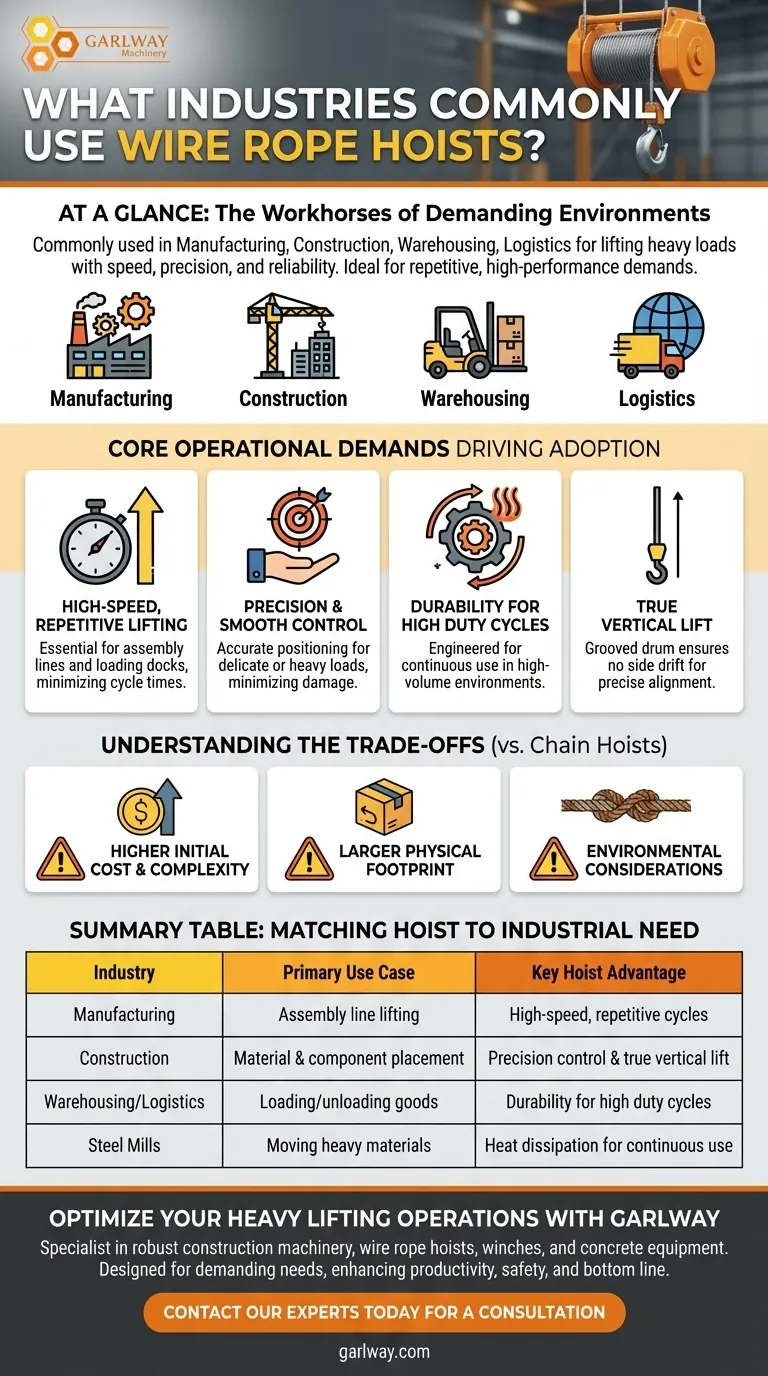
At a glance, wire rope hoists are the workhorses of demanding industrial environments. They are most commonly used in sectors like manufacturing, construction, warehousing, and logistics where the primary need is to lift and move heavy loads with speed, precision, and relentless reliability.
The critical insight is that these industries don't just need to lift heavy things; they need to do it repeatedly, quickly, and with precise control. A wire rope hoist's design is uniquely suited to meet these high-performance operational demands, setting it apart from other lifting solutions.
The Core Operational Demands Driving Adoption
While many tools can lift a load, wire rope hoists are chosen for a specific set of operational advantages. Understanding these advantages reveals why they are indispensable in certain industrial applications.
High-Speed, Repetitive Lifting
In manufacturing and logistics, cycle time is critical. A wire rope hoist uses an electric motor and a rotating drum to wind the rope, allowing for significantly faster lifting speeds than many alternatives.
This speed is essential for keeping assembly lines moving or quickly loading and unloading trucks at a busy warehouse dock.
Precision and Smooth Control
The mechanism of a wire rope hoist provides exceptionally smooth and controlled movement. This allows operators to position heavy or delicate loads with a high degree of accuracy.
Think of lowering an engine block onto a car chassis in a factory or carefully placing a prefabricated concrete panel on a construction site. This level of control minimizes product damage and enhances safety.
Durability for High Duty Cycles
Wire rope hoists are engineered for continuous, demanding use. The design of the wire rope and drum system is excellent at dissipating the heat generated during frequent lifting and lowering.
This makes them ideal for environments like steel mills or high-volume warehouses where the hoist may be in operation for most of a shift.
True Vertical Lift
A key engineering advantage of many wire rope hoists is their ability to provide a "true vertical lift." The grooved drum ensures the hook travels straight up and down without any side-to-side drift.
This is critical for positioning loads in tight spaces or when aligning components with machinery, a common requirement in advanced manufacturing.
Understanding the Trade-offs
No single solution is perfect for every task. To make an informed decision, it's crucial to understand the limitations of wire rope hoists compared to other systems, such as chain hoists.
Higher Initial Cost and Complexity
A wire rope hoist system is typically more expensive to purchase and install than a comparable chain hoist. Its mechanical complexity also requires more specialized maintenance.
Larger Physical Footprint
The drum and motor assembly of a wire rope hoist generally requires more horizontal space, or "headroom," than the more compact profile of a chain hoist. This can be a limiting factor in facilities with low ceilings.
Environmental Considerations
While robust, the wire rope itself can be more vulnerable to damage from crushing or kinking than a hardened steel chain. It may also be less suitable for extremely harsh chemical environments without specialized coatings or stainless steel options.
Matching the Hoist to the Industrial Need
The right choice always depends on the specific operational goal. Your decision should be based on the primary demand of your application.
- If your primary focus is high-volume production or logistics: A wire rope hoist is the superior choice due to its speed and durability in repetitive lifting cycles.
- If your primary focus is the precise positioning of sensitive components: The smooth, controlled, and true vertical lift of a wire rope hoist makes it the most reliable tool.
- If your primary focus is intermittent lifting in a constrained space: A simpler, more compact, and less expensive chain hoist might be a more cost-effective solution.
Ultimately, selecting the right hoist is about aligning the equipment's core strengths with the performance demands of your industry.
Summary Table:
| Industry | Primary Use Case | Key Hoist Advantage |
|---|---|---|
| Manufacturing | Assembly line lifting | High-speed, repetitive cycles |
| Construction | Material and component placement | Precision control & true vertical lift |
| Warehousing/Logistics | Loading/unloading goods | Durability for high duty cycles |
| Steel Mills | Moving heavy materials | Heat dissipation for continuous use |
Optimize your heavy lifting operations with GARLWAY.
As a specialist in robust construction machinery, GARLWAY provides durable and efficient wire rope hoists, winches, and concrete equipment designed for the demanding needs of construction companies and contractors worldwide. Our solutions are engineered to enhance your productivity, safety, and bottom line.
Let's discuss how our lifting equipment can power your projects. Contact our experts today for a personalized consultation!
Visual Guide
Related Products
People Also Ask
- How does an electric anchor winch work? Power, Safety, and Reliable Operation Explained
- What are the advantages of installing an electric anchor winch on a boat? Boost Safety & Ease for Boaters
- What are the operational differences between electric hoists and winches? A Guide to Safe Lifting vs. Pulling
- What are the main benefits of a boat anchor winch? Boost Safety & Efficiency for Your Vessel
- How does a boat anchor winch work? A Guide to Reliable Anchor Handling
