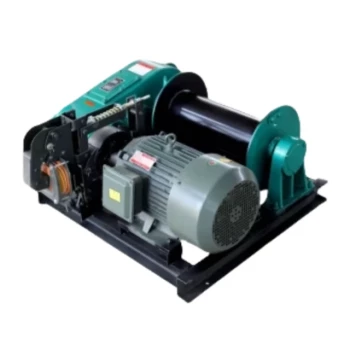
A truly reliable and convenient winch for your truck is defined by its core pulling power, its failsafe braking system, and its flexible, safe control interface. The key features to look for are a load capacity significantly higher than your vehicle's weight, a durable motor, a 100% load-holding brake, and the inclusion of wireless remote controls for safe operation.
The most dependable winch isn't just the one with the highest pound rating. It's a balanced system where the motor, gearing, and braking are engineered to work together flawlessly, ensuring you have controlled, repeatable power when you are in a difficult situation.
The Foundation of Reliability: Core Performance Metrics
A winch's primary job is to pull immense weight without failing. Its reliability is rooted in three fundamental components: capacity, motor, and the brake that holds it all in place.
Calculating the Right Load Capacity
The single most important specification is load capacity. A common and safe industry guideline is to choose a winch with a capacity of at least 1.5 times your vehicle's Gross Vehicle Weight (GVW).
This overhead is not for pulling your truck's dry weight on flat ground. It accounts for the additional forces of being stuck in mud, sand, or on a steep incline, which can easily double or triple the required pulling force.
The Motor and Drivetrain: The Powerhouse
The motor and its associated gearing generate the pulling power. A powerful, durable motor ensures the winch can handle sustained pulls without overheating or failing under stress.
This system is the heart of the winch. Look for established brands known for durable internals, as this is where cheaper models often cut corners.
The Critical Role of the Braking System
An automatic, 100% load-holding brake is a non-negotiable safety feature. This mechanism engages the instant you stop pulling, preventing the rope from slipping or "rolling back" under load.
Without a reliable brake, a vehicle could slide backward the moment the motor stops, creating an incredibly dangerous situation. This is one of the most critical components for safe recovery.
Essential Features for Convenience and Safety
Beyond raw power, certain features make a winch easier and, more importantly, safer to use in the field.
Control at a Distance: Wireless Remotes
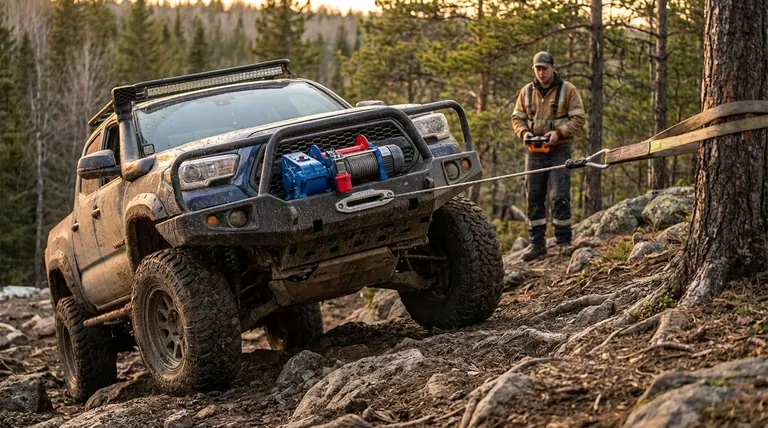
Wireless remotes are a major advancement in both convenience and safety. They allow the operator to stand clear of the winch line, offering a much better vantage point to monitor the entire recovery.
Being able to move around freely helps you avoid the direct path of the cable, which is the most dangerous area should the line ever snap. Many modern winches include both a wired and a wireless remote for redundancy.
Line Choice: Synthetic Rope vs. Steel Cable
The choice of line material has a significant impact.
Synthetic rope is lighter, easier to handle, and significantly safer if it breaks, as it stores less kinetic energy and is less likely to whip violently.
Steel cable is highly durable and resistant to abrasion but is also much heavier and can develop sharp burrs over time. If it snaps, it can be extremely dangerous.
Weatherproofing and Durability
Your winch lives on the front of your truck, exposed to rain, mud, and dust. A high Ingress Protection (IP) rating, such as IP67 or IP68, is a clear indicator of reliability.
This rating ensures the winch's sensitive motor and electrical components are sealed against water and debris, preventing premature failure.
Understanding the Trade-offs
Choosing a winch involves balancing performance characteristics. Understanding these trade-offs helps you select the right tool for your specific needs.
Power Draw vs. Battery Health
A winch under load is the single biggest electrical draw on your vehicle. It can easily pull over 400 amps, putting immense strain on your battery and alternator.
Always run your engine during winching operations. For frequent use, consider upgrading to a high-output alternator and a quality battery to support the demand.
Speed vs. Pulling Power
Winch speed is determined by the gear ratio. A winch with a higher numerical gear ratio will pull more slowly but will have more power and draw less current under heavy load.
Conversely, a winch with a lower gear ratio will retrieve the line faster with no load but will struggle more and draw more power during a difficult recovery. For most truck recoveries, pulling power is more important than speed.
Making the Right Choice for Your Truck
Your ideal winch depends on how you plan to use your vehicle.
- If your primary focus is occasional self-recovery and peace of mind: Prioritize a winch from a reputable brand with a capacity of at least 1.5x your GVW, a proven automatic brake, and a wireless remote.
- If your primary focus is serious off-roading and frequent use: Invest in a model with a high IP rating for weatherproofing, a quality synthetic rope for safety, and a powerful series-wound motor.
- If your primary focus is utility work like loading a trailer: A winch with a smooth, controllable motor and a reliable brake is more important than maximum pulling capacity.
Ultimately, choosing the right winch is an investment in a system that guarantees you have the power and control you need, exactly when you need it most.
Summary Table:
| Key Feature | Why It Matters | What to Look For |
|---|---|---|
| Load Capacity | Determines pulling power for safe recovery. | At least 1.5x your truck's GVW. |
| Automatic Brake | Holds load securely, preventing dangerous rollback. | 100% load-holding, failsafe system. |
| Control System | Allows safe operation away from the cable path. | Wireless remote (with wired backup). |
| Weatherproofing | Protects internal components from elements. | High IP rating like IP67 or IP68. |
| Line Type | Impacts safety, weight, and handling. | Synthetic rope (safer) or steel cable (durable). |
Ready to equip your truck with a winch you can trust?
At GARLWAY, we specialize in engineering durable construction and recovery equipment. Our winches are built with the powerful motors, reliable automatic brakes, and robust weatherproofing detailed in this article, ensuring you have controlled, repeatable power for any situation.
Whether you're a contractor on a job site or an off-road enthusiast, we provide the reliable performance you need. Contact our experts today to find the perfect winch for your specific truck and requirements.
Get Your Personalized Recommendation →
Visual Guide

Related Products
- Quick Windlass Portable Winch for Truck and Boat Best Boat Winch
- Portable Small Trailer Winch
- Best 18000 Pound Drum Anchor Trailer Winch
- Electric and Hydraulic Winch for Heavy Duty Applications
- Warn Winch Windlass Boat Trailer Winch
People Also Ask
- What features were incorporated into the upgraded portable winch system? Boost Your Recovery Power & Safety
- What are some uses mentioned for portable winches beyond vehicle recovery? Essential Versatility for Property & Work
- How could the twisting issue with a portable winch be mitigated? Achieve Safe, Centered Pulls with Proper Rigging
- What are the primary uses of a portable winch for a truck? Boost Your Truck's Capability and Self-Reliance
- What is the single rope traction force of the quick winch without a pulley block? 0.5 to 40 Tons Explained